


Renzi invites Europe to take a "selfie" and stop being boring. Italy's Matteo Renzi creates a stir with a speech in the European Parliament.

"If Europe was to take a selfie today, it would be a tired, resigned image," said Italian prime minister Matteo Renzi in a debate with MEPs on his country's priorities for the Council presidency for the next six months. He said European leaders should act with conviction and determination to keep Europe in the lead on global issues. The debate on 2 July touched upon a broad range of issues, from the Italian contribution to Europe through the ages to the place of Europe in a fast-changing world. He said Europe needs to be part of ongoing exciting global processes and not lock itself within its borders.

Mr Renzi acknowledged that the crisis had left all of us with a "deep wound", saying Europe faced a challenge to rediscover its soul, history and values. Referring to the Stability and Growth pact, he said: "We now have stability. We are asking for growth to be a fundamental element of European policy."

You can watch the full speech of Matteo Renzi at the European Parliament on 2 July here

Commonspace.eu political editor said "Italy's presidency of the EU is the first opportunity for the young and recently appointed Prime Minister to make his mark on the world stage. Renzi's speech to the European Parliament was well received well beyond the Parliament Chambers. It struck a cord, especially with Europe's youth. It was the speech of a confident and articulate politician, in tune with the modern world, and with a vision of the challenges and solutions ahead. Italians have also only recently discovered Renzi, and liked him. His move from Mayor of Florence to the Premiership in Rome came at a particularly low moment in Italian politics. Renzi has however given Italians a new hope. His party had the most convincing victory of all the established political parties in Europe in the recent elections for the European Parliament. Italy still has many serious economic and political challenges in front of it, but Renzi's performance at the European Parliament yesterday has sent a clear message that a new Italy is rising, one that is confident to be in the leadership of Europe for the next six months."

source: commonspace.eu with italia2014.eu

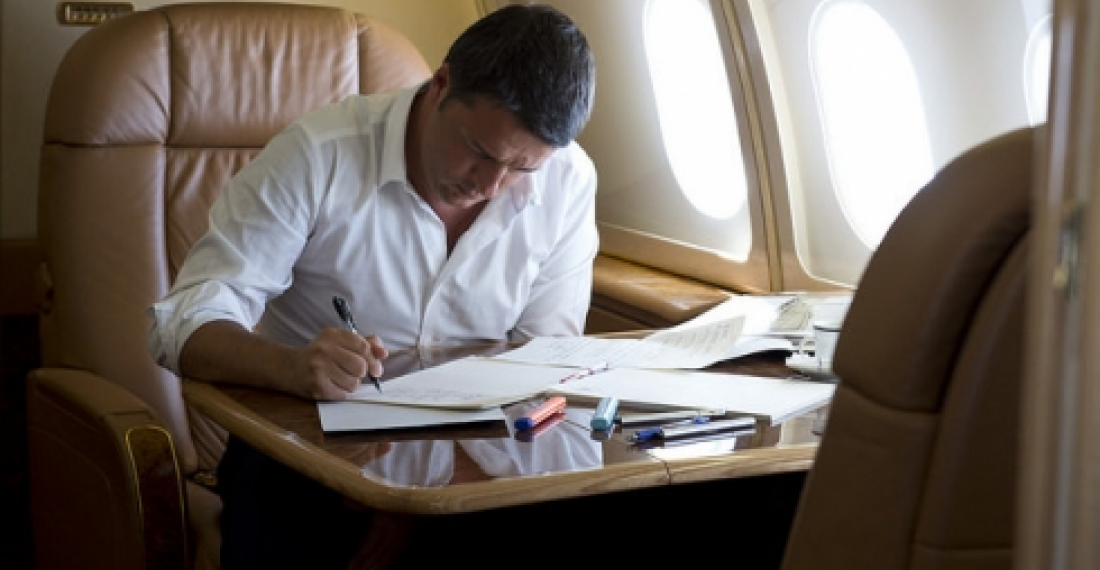
photo: Italian Prime Minister Matteo Renzi on the plane preparing his speech to the European Parliament on 2 July 2014 (picture courtesy of the web site of the Italian Presidency of the EU www.italia2014.eu).
 

Related articles

Editor's choice
News
Nikol Pashinyan re-appointed as Armenian prime minister after decisive June election victory

Nikol Pashinyan re-appointed as Armenian prime minister after decisive June election victory

Armenia president, Vahagn Khachaturyan has re-appointed Nikol Pashinyan as Armenian prime minister, after the decisive victory of his Civil Contract party in parliamentary elections in June. During a ceremony at the Presidential Palace in Yerevan, President Khachaturyan signed a decree on the appointment of Nikol Pashinyan as Prime Minister of the Republic. President Vahagn Khachaturyan said in short remarks: It is a great honor for me to sign a decree on appointing you to the post of Prime Minister of the Republic of Armenia, for which I received a proposal from the political majority in the National Assembly, under Article 149 of the Constitution of the Republic of Armenia. I sincerely congratulate you, I wish you great patience, endurance, and determination to lead us in these difficult times, to lead the country to the future, a prosperous future. Nikol Pashinyan thanked the president and added,  I must say honestly that in 2018, when I assumed the post of Prime Minister of the Republic of Armenia as a result of the People's, non-violent, velvet revolution, it would have been difficult to predict that we would go down such a path and I think it would have been difficult to predict that we would be able to overcome this path. But we are where we are, and I think that the key role and significance in all this is unequivocally and undoubtedly the people of the Republic of Armenia, who, after all, have demonstrated special expressions of state consciousness and state-centeredness throughout this period. And of course, this is a great obligation and commitment. Of course, the Government will be formed in the near future and all members of the Government, including me, will already enshrine our obligations to our people in the text of the oath.  In the meantime Ruben Rubinyan has been elected Speaker of the National Assembly of Armenia, following a secret vote of MPs. He is a 36-year-old MP from the ruling Civil Contract party, who was one of the deputy speakers in the previous parliament and, until recently, was the special representative in the negotiations on the normalization of relations with Turkey.

Popular

Editor's choice
Interview
Thursday Interview: Murad Muradov

Thursday Interview: Murad Muradov

Today, commonspace.eu starts a new regular weekly series. THURSDAY INTERVIEW, conducted by Lauri Nikulainen, will host  persons who are thinkers, opinion shapers, and implementors in their countries and spheres. We start the series with an interview with Murad Muradov, a leading person in Azerbaijan's think tank community. He is also the first co-chair of the Action Committee for a new Armenian-Azerbaijani Dialogue. Last September he made history by being the first Azerbaijani civil society activist to visit Armenia after the 44 day war, and the start of the peace process. Speaking about this visit Murad Muradov said: "My experience was largely positive. My negative expectations luckily didn’t play out. The discussions were respectful, the panel format bringing together experts from Armenia, Azerbaijan, and Turkey was particularly valuable during the NATO Rose-Roth Seminar in Yerevan, and media coverage, while varied in tone, remained largely constructive. Some media outlets though attempted to represent me as more of a government mouthpiece than an independent expert, which was totally misleading.  Overall, I see these initiatives as important steps in rebuilding trust and normalising professional engagement. The fact that soon a larger Azerbaijani civil society visits to Armenia followed, reinforces the sense that this process is moving in the right direction." (click the image to read the interview in full)

