


The leaders of Armenia, Azerbaijan and Georgia made upbeat televised addresses to their respective nations as 2013 was coming to an end, positively evaluating the past year and confidently prediciting a successful 2014..
In his televised message President Ilham Aliev of Azerbaijan said "2013 has been a very successful year for our country. All Azerbaijani citizens are happy with development of our country on all fronts. Our international positions have been strengthened."
The President hailed Azerbaijan's success in implementing its foreign policy and in strengthening the Armed Forces.
Referring to Nagorno-Karabakh, President Aliev said,
"The Armenia-Azerbaijan Nagorno-Karabakh conflict must be solved on the basis of the territorial integrity of our country. Other options are ruled out. Azerbaijan will never allow the establishment of the second fictitious Armenian state on its territory. I am sure that territorial integrity of our country will be restored and the citizens of Azerbaijan will be living in the occupied lands. Azerbaijanis will also return to their historical lands in the future. I have no doubt about that. We must be more powerful and have a stronger army and ensure the economic development in order to achieve this goal."
On economic matters, President Aliev said that
"Our economy has grown 3,4-fold in the last decade and it is the biggest indicator in the world. Some 1.2 million jobs have been created. The country has achieved great successes in poverty reduction. The poverty level is about 5 percent in the country. Fight against unemployment yielded good results. Level of unemployment in Azerbaijan is below 5 percent."
The Azerbaijani leader referred to major energy projects that had been initiated in the last year, namely, TAP, TANAP and Shahdeniz 2, calling the latter "a historical project of the 21st century."
Aliev made a brief reference to the Presidential elections held in October and thanked the Azerbaijani people for their support. He added that "political reforms will be continued in our country. Positive steps to build a democratic society are being undertaken with the rule of law and all freedoms ensured. Azerbaijan is growing into one of the leaders in implementation of political reforms."
Traditionally the new year address of the Armenian President Serzh Sargsyan is shorter, and it was also the case this year.
President Sargsyan told his compatriots:
"The passing year has been full of many initiatives and events, but I believe the most significant among them was the deeply conscious work aimed at Armenia's economic growth and enhanced level of security. We have furthered Armenia's economic, political and military cooperation with the Russian Federation, and next year, I am certain, we will become a full member of the Customs Union. Armenia is creating a new reality which will make her more protected and more competitive.
We have continued and will steadily continue our course towards reformation. Our cooperation with Europe and the United States in this area will not weaken but will become even deeper. Our goal is inalterable: we want Armenia to be a modern state with strong societal relations and mature legal structure.
Let's face it: the passing year has also had some ordeals. Despite all difficulties we have been able to make a promise of the regular increase of wages and pensions a reality. We have found basic solutions which will work beyond the next year."
Sargsyan made no direct reference to Nagorno-Karabakh in his address.
There were also positive and upbeat new year messages from the President and Prime Minister of Georgia.
Both President Giorgi Marghvelashvili and Prime Minister Irakli Garibashvili referred to the new era that had started in Georgia in 2013, and emphasised the importance of the Association Agreement with the European union which was initialled in November, and is due to be signed and come into effect in 2014. Prime Minister Garibasghvili in his speech referred to the restoration of justice in the country and said that the process started in 2013 will continue. On his part President Marghvelashvili called for national unity and sent greetings to "Abkhaz and Ossetian compatriots".
source: commonspace.eu with official websites and agencies.
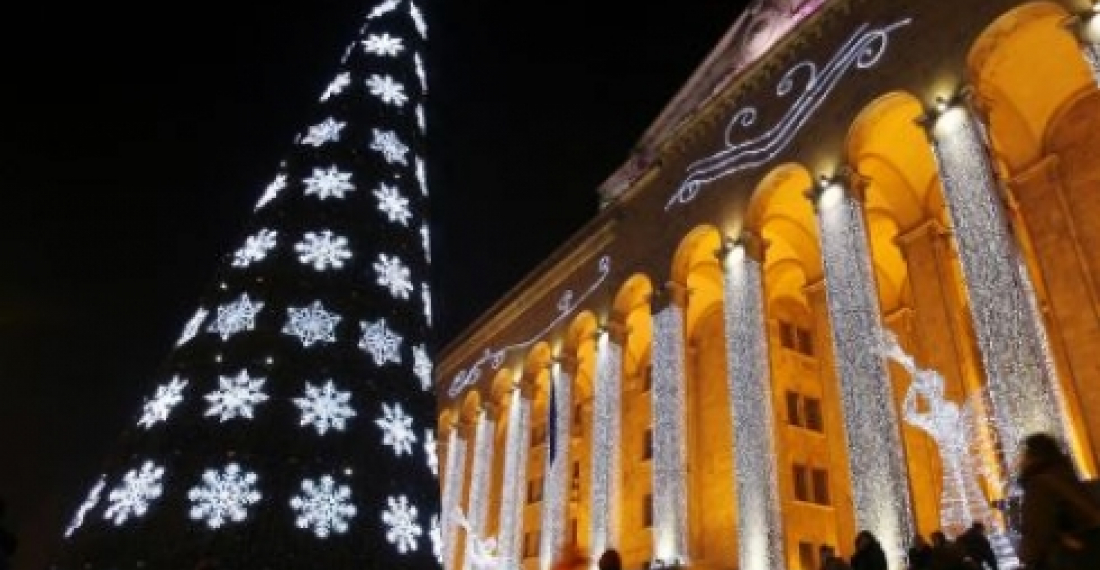
photo: New Year decorations in front of the building of the Georgian Parliament in Tbilisi.



