


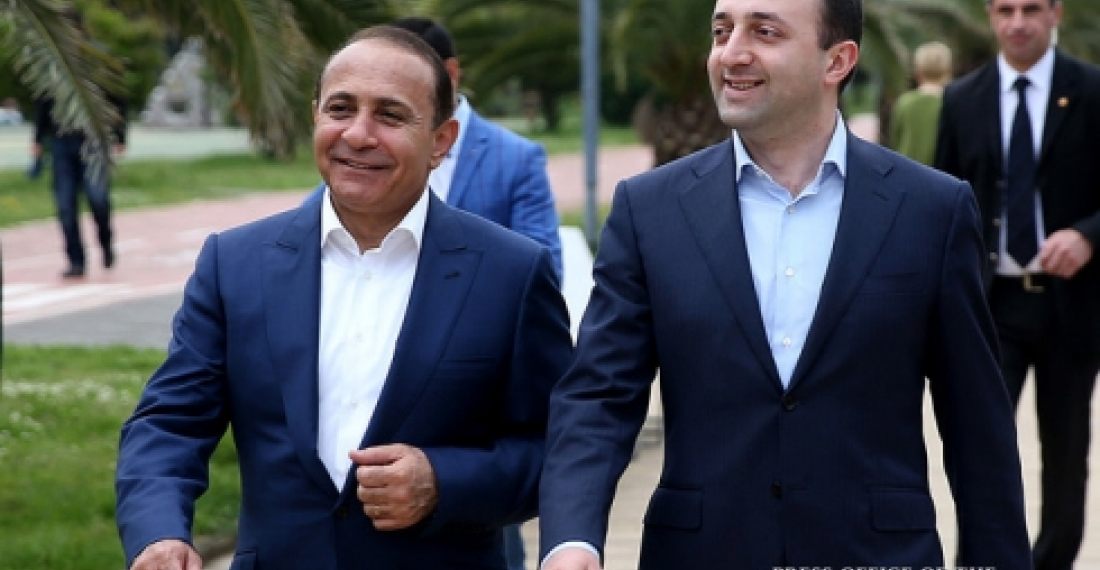
Prime Ministers of Georgia and Armenia met in Batumi.

The Prime Ministers of Georgia and Armenia met in Batumi on Sunday (17 May) to discuss a range of issues related to their bilateral relations. Irakli Garibashvili and Hovik Abrahamyan focused primarily on economic relations between the two countries, according to the press services of the two prime ministers.

Georgia and Armenia have opted for different trajectories in their international economic relations, with Georgia signing an Association Agreement with the European Union, whilst Armenia has since January become a full member of the Russia led Eurasian Economic Union. Both governments have pledged to do their utmost to ensure that these different international obligations will not harm their bilateral relations.

Earlier this month Georgia expressed its displeasure at a meeting between the Chairman of the Armenian Parliament and the Chairman of the Parliament in the self declared Republic of South Ossetia. The Armenian side said that the meeting was of a private nature, but Georgia felt that it indicated Armenian encouragement to South Ossetia's secession from Georgia.

source: commonspace.eu

photo: Armenian Prime Minister Hovik Abrahamyan and Georgian Prime Minister Irakli Garibashvili after their meeting Batumi on Sunday, 17 May 2015 (Picture courtesy of the Press Service of the Government of Armenia).
 

Related articles

Editor's choice
News
European Green parties invite UK to rejoin the EU, 10 years after Brexit.

European Green parties invite UK to rejoin the EU, 10 years after Brexit.

The European Green Party, bringing together all Green parties across the EU, is the first European political family to make an explicit political invitation for the UK to rejoin, 10 years after Brexit.  The Green party leaders, united on Friday at the Green Leadership Council in Brussels, and stated in a common Declaration that the way forward for the EU is to enlarge to the East and the West, and to roll out a radical move towards renewable energy to ensure European autonomy.  Vula Tsetsi, Co-Chair of the European Green Party, said:  'On the eve of Europe Day, we European Greens are clear: the European Union must enlarge and its doors should be re-opened for the United Kingdom. If, in the future, the people of the UK choose this path, we are ready to welcome them back. Ten years after Brexit, it is increasingly clear that Brexit weakened both the UK and the EU. Any political process must begin with a political signal, and today, the European Greens are the first European political family to say clearly that our door is open to a future return of the UK in the EU. We now call on the other European political families to follow.’ The European Green Party fully supports enlargement across Europe, from the Western Balkans and Ukraine to any European country that chooses a shared democratic future within the European Union, as a more united Europe is a stronger Europe. Ciarán Cuffe, Co-Chair of the European Green Party, added:  'Europe’s dependence on oil and gas is keeping it weak, exposed and vulnerable. If we are serious about peace, security, and independence, we must break free from fossil fuels and go all in on renewable energy. Wind and solar are not just climate solutions, they are the foundation of a stronger, independent and ultimately free Europe. Investing in renewables will protect us from the price spikes linked to fossil fuel.' (click the image to read the full report).

Popular

Editor's choice
Interview
Thursday Interview: Murad Muradov

Thursday Interview: Murad Muradov

Today, commonspace.eu starts a new regular weekly series. THURSDAY INTERVIEW, conducted by Lauri Nikulainen, will host  persons who are thinkers, opinion shapers, and implementors in their countries and spheres. We start the series with an interview with Murad Muradov, a leading person in Azerbaijan's think tank community. He is also the first co-chair of the Action Committee for a new Armenian-Azerbaijani Dialogue. Last September he made history by being the first Azerbaijani civil society activist to visit Armenia after the 44 day war, and the start of the peace process. Speaking about this visit Murad Muradov said: "My experience was largely positive. My negative expectations luckily didn’t play out. The discussions were respectful, the panel format bringing together experts from Armenia, Azerbaijan, and Turkey was particularly valuable during the NATO Rose-Roth Seminar in Yerevan, and media coverage, while varied in tone, remained largely constructive. Some media outlets though attempted to represent me as more of a government mouthpiece than an independent expert, which was totally misleading.  Overall, I see these initiatives as important steps in rebuilding trust and normalising professional engagement. The fact that soon a larger Azerbaijani civil society visits to Armenia followed, reinforces the sense that this process is moving in the right direction." (click the image to read the interview in full)

