


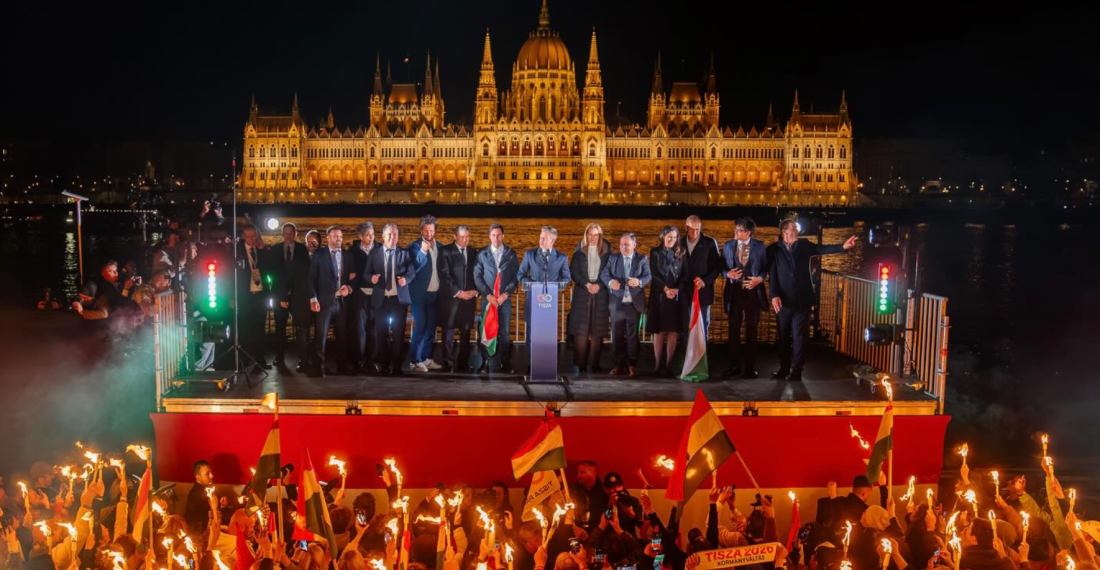
In this op-ed for Commonspace.eu, Anna Szedlacsek, Junior Research Assistant at LINKS Europe Foundation, argues:
"Even with a commanding electoral victory, Péter Magyar would need to 'de-capture' a state where the chief prosecutor, media regulators, and constitutional authorities hold long mandates designed specifically to survive a change in government. This means that while voters can replace a cabinet, they cannot instantly replace the institutional architecture Orbán built over fourteen years"
Here is her op-ed in full:
The rise of Péter Magyar has transformed Hungarian politics from a stagnant contest into a genuine struggle over the country’s geopolitical future. Once associated with the orbit of Viktor Orbán’s ruling system, Magyar now presents himself as the figure who can bring Hungary back into the European mainstream. His message is direct: Hungary must strengthen its position within the European Union and secure its place in the West, “where it has always belonged.” Yet, no matter how compelling this western pivot sounds, Magyar would inherit a state whose institutions and energy system remain deeply entangled with Russia.
For years, Orbán silently intensified relationships with Moscow. Hungary has benefited from cheap gas and oil contracts, with Russian crude making up 93% of Hungary’s oil imports in 2025, representing a 32% increase from 2021. Another key project is the Paks II nuclear power plant, agreed upon in 2014 by Viktor Orbán and Vladimir Putin, with the Russian Rosatom acting as the main contractor. Lastly, the leaked conversation between Putin and Orbán, as well as Péter Szijjártó’s, Hungary’s Minister of Foreign Affairs, calls to Sergey Lavrov, his Russian counterpart during breaks in EU Council meetings, have resulted in Fidesz being viewed by many Hungarians (and others) as catering to Russian interests.
On the other hand, Magyar has declared seeking to bind Hungary to the West, ending Orbán’s seesaw foreign policy. As a clear signal of this strategy, Magyar claims that his first visits as prime minister will be to Warsaw, Vienna, and Brussels, in that order. Magyar has also pledged to deepen ties with neighboring countries, building on close economic relations and historical connections dating back to the Austro-Hungarian Empire. At the same time, negotiations with Brussels are already underway: last Wednesday (29 April), Magyar has met with Ursula von der Leyen, President of the European Commission, to discuss steps to unlock €10.4bn of the EU's Covid-19 recovery fund —around 10 percent of national output— before it expires at the end of August. Magyar is also looking to unlock an additional €6.3 billion in cohesion funds that were frozen because of rule-of-law concerns under the Orbán government. Beyond that, Hungary could gain access to €16.1 billion in low-interest EU defence loans, while Magyar is also expected to seek an end to the €1 million per day penalty Budapest has been paying for violating EU migration regulations.
For any incoming Hungarian government, access to those funds would be economically transformative. Magyar understands this. He has pledged to pursue more constructive relations with Brussels and to stop using Hungary’s veto powers as bargaining chips for unrelated concessions. Regarding concerns over democratic backsliding and corruption, his party, TISZA (Respect and Freedom Party) in its platform pledges to “uncover the hidden truth and present it to the public: the true state of the economy, healthcare, and education; secret government decisions; domestic and international treaties; loans; and concealed agreements, ”and, following a national security review, to “publish the summaries of government meetings held between 2010 and 2026,” as well as the “complete documentation related to the asset management of the Hungarian National Bank under the presidency of György Matolcsy.”
In addition, the program outlines the creation of new watchdog agencies of the Anti-Corruption Office and the National Asset Recovery and Protection Office to recover stolen public wealth and uncover corruption cases, economic, and political abuses from the past 20 years. Finally, it underscores a commitment to restoring democratic governance by ensuring Hungary joins the European Public Prosecutor’s Office and by reestablishing checks and balances within the political system.
Regarding Russian energy, Magyar emphasized that diversification – rather than disengagement – is the core objective. As he put it:
"…we will do everything possible to diversify the energy mix… because that gives us security – and energy security is one of the most important issues in Hungary –, and secondly, this is how you can purchase oil and gas at the lowest prices."
At the same time, he underscored the limits of geopolitical change:
"We cannot change geography. Russia will be here, and Hungary will be here. We will try to diversify, but that doesn’t mean that we want to detach ourselves…"
Magyar also faces domestic constraints beyond geopolitics. Even with a commanding electoral victory, he would need to “de-capture” a state where the chief prosecutor, media regulators, and constitutional authorities hold long mandates designed specifically to survive a change in government. This means that while voters can replace a cabinet, they cannot instantly replace the institutional architecture Orbán built over fourteen years. But the institutional structures are not the only legacy of the Fidesz era: the Hungarian economy has virtually stagnated since 2023, with average annual growth of 0.1%, leaving the TISZA government with a state budget deficit near 5% of GDP. Western partners expecting immediate transformation may therefore need to wait for Magyar to learn to navigate not only a politically entrenched state apparatus, but also a fiscally constrained economy in which ambitious reforms, social spending, and strategic reorientation will all compete for limited resources. Any democratic renewal in Hungary is likely to be shaped as much by budget arithmetic as by political will.
Furthermore, while Tisza’s two-thirds majority gives it significant leverage, it also entails political risks. It has made some question whether Magyar would just sit on the power structures constructed by Orbán or would eventually end up becoming Hungary's next dictator. However, the situation at hand is more complex. The victory of Magyar, while certainly benefiting from a people-centered, energetic campaign, is primarily explained by a very strong anti-Orbán/anti-corruption sentiment. Accordingly, his voter base encompasses voters from the entire political spectrum: it is specifically because this coalition is united less by ideology than by opposition to the current regime that it would be structurally difficult for Magyar to recreate the centralized, leader-worshipping culture of the System of National Cooperation, constructed under Orbán’s rule or to govern in the Orbán mold. Nevertheless, when trying to meet the EU’s rule of law criteria, Magyar must be careful not to be seen as employing extraordinary measures beyond the rules of democratic control and accountability when trying to deconstruct a system of extraordinary corruption.
Source: Anna Szedlacsek is a Junior Research Assistant at LINKS Europe Foundation. Anna Szedlacsek is also pursuing a bachelor's degree in International Studies and an Honours degree in Governance and Global Affairs at Leiden University.



