Filter archive

Publication date
Editor's choice
GULF CRISIS
Monday Commentary: The war nobody wanted, but that may end up harming everybody

Monday Commentary: The war nobody wanted, but that may end up harming everybody

The war of the United States and Israel against Iran has entered its third week. Not a very long time some would say, but enough already to have changed the Middle East, not in any good way. As the BBC veteran Security Correspondent, Frank Gardner, put it, the war has put a shadow over the whole region. Nobody, except for Benyamin Netanyahu, wanted this war, not even Donald Trump. The war, unless it is stopped quickly may end up harming everybody. The way out is clear: De-escalate, negotiate, and re-build, even if as of today, the prospect for that appear distant. The only way out of the present crises is first through de-escalation. A cease fire may not be possible for weeks, but using diplomatic back channels the US and Iran may agree to de-escalate,  or to put it more crudely, stop shooting. It will be up to Trump to ensure that Netanyahu stops shooting too. Once de-escalation happens, the difficult process of negotiations can start again, focusing on the nuclear file and picking up from where discussions were left on 27 February. This is an agreement within reach – a non nuclear Iran in  return for the lifting of sanctions. Other possibilities are possible, and once a cease fire is agreed the EU and China can also be involved in the discussions. Finally, a process of rebuilding must start. The GCC have the money to do reconstruction of infrastructure quickly. Reputational damage to their Shangri-la image will take longer. Rebuilding Iran will be more challenging, given the scale of the destruction, and will require more money than Tehran has. Even as the bombs continue to fall, this issue needs to be considered. In the end no one really wanted this war, and no-one is going to benefit from it. It must be brought to an end as soon as possible, but the thinking of what happens after must start now.
Editor's choice
News
Updated: Kazakhstan approves important constitutional changes

Updated: Kazakhstan approves important constitutional changes

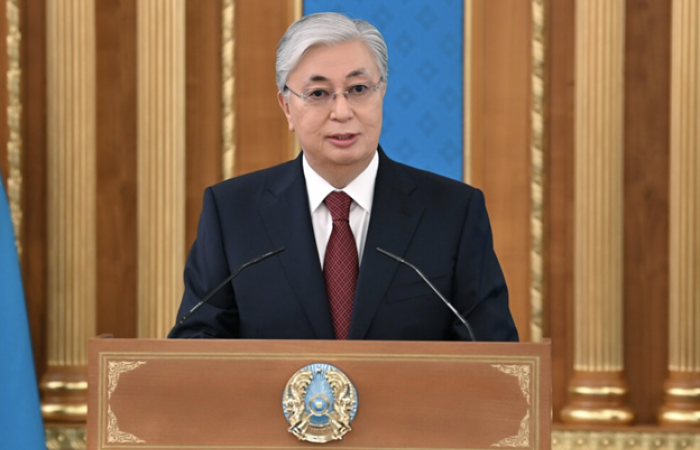
Kazakh voters in a referendum on Sunday approved a new constitution, exit polls showed. Two exit polls said around 87% of voters had backed the new constitution. Turnout stood at 73%, the electoral commission earlier said. The new constitution streamlines the country's parliament, and recreates the office of vice president, which was abolished in 1996. According to the Central Referendum Commission of Kazakhstan, 12,046,617 citizens were eligible to participate in the referendum. 359 international observers and 206 foreign journalists were accredited to monitor the referendum in order to ensure the transparency of the voting process. International organizations monitoring the referendum include the Organization for Security and Cooperation in Europe, the CIS, the Shanghai Cooperation Organization, the Organization of Turkic States, and the Organization of Islamic Cooperation. The Central Referendum Commission must announce the final results of the vote within seven days after the referendum. A total of 10,401 polling stations operated inside and outside the country to organize voting. 71 of them were opened at diplomatic missions in 54 countries. The new Constitution will enter into force on July 1, 2026. After that, elections for a new parliament are planned in the country, and these elections are expected to be organized by the end of August. The position of vice president will be implemented after the formation of the new parliament. The referendum was the fifth in the history of independent Kazakhstan and leads to the adoption of a new fundamental law that will determine the direction of the country's political and legal development in the coming years. The Referendum was held at the initiative of the President of Kazakhstan Kassym-Jomart Tokayev and envisages the implementation of large-scale constitutional reforms in the country. According to the submitted draft, approximately 84 percent of the text of the Constitution has been updated and new articles and sections have been developed. The question on the ballot paper asks, "Do you accept the new Constitution of the Republic of Kazakhstan?" Voters express their position by answering "for" or "against" this question. Currently, the Constitution adopted on August 30, 1995, is in force in Kazakhstan. Since its adoption, the document has been repeatedly amended and supplemented. The latest amendments entered into force in September 2022. However, the scale of the proposed reforms necessitated the preparation of a new Constitutional document. Thus, the amendments cover approximately 84 percent of the text of the existing basic law. The draft of the new Constitution was presented to the public in early February 2026. After the document was published, the country's citizens were given more than a month to familiarize themselves with it and discuss the proposed changes. (Click the picture to read more)
Editor's choice
Interview
Thursday Interview: Dr. Jamie Shea

Thursday Interview: Dr. Jamie Shea

Tensions are rising in Iran and across the Middle East, uncertainty hangs over Donald Trump’s commitment to the Euro-Atlantic security umbrella, and war continues along Europe’s eastern border. Against this backdrop, commonspace.eu spoke this week with Dr. Jamie Shea, the former Deputy Assistant Secretary General for Emerging Security Challenges at NATO (North Atlantic Treaty Organization), about what lies ahead. He held several senior positions during a 38-year career at NATO, and represented the Alliance on the international stage as its spokesperson during the 1999 Kosovo War, when he briefed the international press throughout NATO’s air campaign against Yugoslavia. Since retiring from NATO in 2018, he has continued his work as a professor, lecturer, speaker and adviser on European and transatlantic security affairs. Dr. Shea discusses the strategic consequences of Russia’s war against Ukraine for NATO’s future, the need for the Alliance to adapt to a rapidly changing battlefield shaped by drones and technological innovation, and the importance of cooperation between NATO and the European Union in strengthening Europe’s defence capabilities.  He argues that instability in the Middle East could reshape the strategic balance for Europe: “The one who smiles is Vladimir Putin, because an oil price of over $100 a barrel for a long period of time is going to refill the Russian war chest, as Putin funds a lot of his Ukraine war effort from his energy resources. You can see that the Americans have already lifted sanctions on Russia to allow Russia to export oil to India to keep international markets flowing. This is what we call ‘robbing Peter to pay Paul’. Yes, it helps the situation in the Gulf temporarily. It removes pressure on the oil market. But the impacts of the war will also mean more inflation, higher energy prices, and higher gas prices in Europe. You are then going to get a lot of European countries saying, ‘well, sorry, but I can’t spend 5 percent of GDP on my defence any longer.’” To read the full interview, click on the image above.