


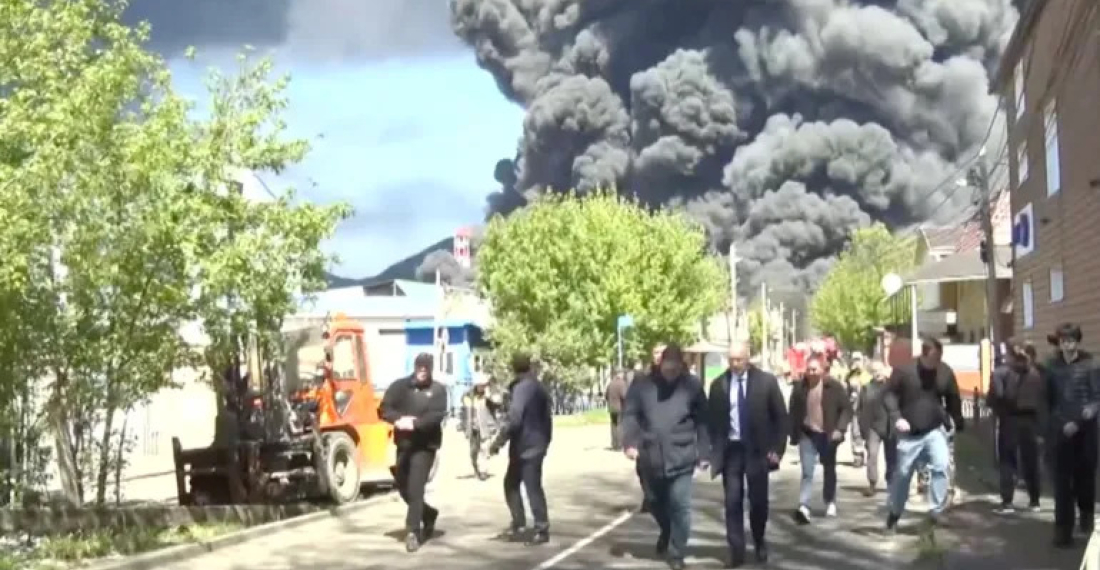
Since 16 April, Tuapse, Russia, which houses one of the country’s largest oil refineries, has been hit with three successive Ukrainian drone strikes. While attempting to undermine Russia’s oil industry, Ukrainian strikes have caused oil spills and black rain, compromising the town's health and surrounding environments.
The initial strike on 16 April resulted in a fire that lasted for two days. Four days later, 20 April, the refinery was struck again, leaving a dense cloud of smoke across the sky, and a fire lasting five days. According to Rospotrebnadzor's assessment on 21 April, smoke from the fire emitted toxic chemicals, finding benzene, xylene, and soot at levels three times those deemed safe for exposure. Shortly after the strike, black rain, a weather phenomenon where soot and ash blacken raindrops falling from the sky, descended upon Tuapse.
Following the 20 April attack, at least eight oil storage tanks had been destroyed and leaking petroleum into nearby Tuapse river, which carried it into the Black Sea and deposited along the coastal shores.
Russian authorities have tasked more than a dozen boats to remove the oil slick along Black Sea shores and placed booms on beaches to mitigate the spill. Emergency personnel and volunteers have taken excavators, barrels, and plastic bags to the stony beaches to clean up the spill.
Despite cleaning efforts, Ruslan Khvostov, chairman of Russia’s Green Alternative party, told Al Jazeera that consequences for the local ecosystem “could be serious and last for years”.
“Oil products settle in the bottom sediments of the Black Sea, disrupting the food chain, and everyone will suffer,” Khvostov said.
The third strike landed on Tuesday (28 April), initiating a massive fire and the subsequent release of combustion emissions. The town was evacuated due to concerns regarding deteriorating environmental conditions.
Over 160 firefighters were deployed to respond to the fire, and Krasnodar regional governor Veniamin Kondratyev praised them for their service in a Telegram message on Tuesday, commenting: "Our top priority is preserving the lives and health of city residents and visitors.”
Source: commonspace.eu with Al Jazeera and BBC



