


This analysis, prepared by the commonspace.eu editorial team, was first published on Central Asia Concise, on 30 April 2026.
Kazakhstan’s well known ‘multi-vector’ foreign policy approach centered on economic ties, connectivity, and confidence building, continues to be the defining characteristic of the government’s diplomatic efforts. However, with the continuing U.S.- Israel- Iran conflict the country has had to navigate the fallout and cut some losses, raising questions about if Kazakhstan’s famed multi-vector foreign policy approach has finally been overstretched.
The geopolitical situation surrounding Iran seems to be constraining the extent to which this multi-vector approach can continue to be extended towards everybody, specifically Iran. Immediately after the escalation accompanying ‘Operation Epic Fury’, Kazakh President Kassym-Jomart Tokayev extended heartfelt messages of solidarity to the leaders of the United Arab Emirates, Saudi Arabia, Qatar, Bahrain, Kuwait, and Jordan, and condemned the strikes on their territories. In contrast, Kazakhstan’s messages to Iran were relayed in a more impersonal manner with condolences issued through channels of the Ministry of Foreign Affairs. As the conflict continued, Kazakhstan remained the only Central Asian state to avoid sending aid to Iran. Kazakhstan does not share a border with Iran and therefore may not have the same extent of historically deep ties with the country that other Central Asian states have, such as Uzbekistan, which has been much more forthcoming in its support, both in terms of physical aid and public statements. However, Kazakhstan’s current relatively cool response should be contrasted to a much more forthcoming relationship with Iran prior to the war. Diplomatic relations officially began in 1992, and bilateral trade had been rising ever since. Just in December last year at the Kazakhstan-Iran Business Forum, attended by both President Tokayev and President Masoud Pezeshkian of Iran, the Kazakh leader lauded the increasing mutual trade volume and set an ambitious goal of reaching $2 billion in bilateral trade volume in the future. Tokayev highlighted Iran’s essential role in expanding regional connectivity, and as an export hub for Kazakh goods. Fast forward to last week, Kazakhstan has now suspended several projects with Iran as the Minister of National Economy, Serik Zhumangarin, claimed that shipments through the Persian Gulf were never a dominant issue for Kazakhstan to begin with. As of now, this planned cooperation has been put on hold, with the Kazakh government citing the difficulties of the military situation in Iran but not explicitly mentioning what projects have been paused. It seems likely that most, if not all of these initiatives are now on hold and in danger of being cancelled completely. The significance of this development is best illustrated by listing the initiatives in question. Several of the ongoing projects were: The Kazakhstan-Turkmenistan-Iran railway; the Kazakhstan Trading House in Tehran; the construction of an Iranian dairy plant in Kazakhstan; projects focused on strengthening links between Kazakhstan’s ports of Aktau and Kuryk with the Iranian ports of Amirabad and Anzali; and plans for mutual cooperation on preserving the Caspian Sea. The current pause and potential cancelation of these initiatives down the line may just be the price of Kazakhstan’s multi-vector diplomacy, as Kazakhstan seems to be leaning further and further towards the U.S. rather than siding with its regional partner.
Embracing the U.S. and Israel
Standing in contrast to Kazakhstan’s slowing engagement with Iran, is its rapidly developing relationship with the U.S. and Israel. Although Kazakhstan already recognized Israel in 1992, it announced its intention to enter the Abraham Accords in November 2025, inviting the Israeli foreign minister in January, and hosting Israeli President Isaac Herzog only several days ago. The Abraham Accords offer Kazakhstan a practical new path to engaging with international partners, utilizing its convening power to access Israeli companies, as well as American and Gulf investors and policymakers. It is therefore unsurprising that this push for the Abraham Accords matches Kazakhstan’s diplomatic engagement with the U.S. from 2025 onwards. You may recall that Kazakhstan’s engagement in Trump’s ‘Board of Peace’ and the ‘Critical Minerals Ministerial’ was covered in a previous Central Asia Concise. This has now been reinforced by newly invigorated Kazakh diplomatic efforts towards Washington recently, after the commencement of ‘Operation Epic Fury’, effectively demonstrating the government’s preference towards partnership with Washington, regardless of the ongoing conflict. A prominent Kazakh delegation to the U.S. in mid-April, led by Erzhan Kazykhan, the Kazakh Special Representative for Negotiations with the U.S., attended several meetings in Washington, and discussed energy, critical minerals and transport infrastructure topics with U.S. investors. Citing Kazakhstan’s efforts in engaging with the U.S. backed diplomacy initiatives mentioned earlier, Kazykhan presented Kazakhstan as a key partner for American interests in the region and highlighted Tokayev’s November 2025 meeting with Trump as the catalyst for this new economic cooperation.
Kazakhstan continues to demonstrate this commitment through its efforts in bringing the ‘Trump Route for International Peace and Prosperity’ (TRIPP) to life. The Kazakh Government has consistently engaged with both Armenia and Azerbaijan, most recently having the Kazakh Foreign Minister visit Yerevan, and engaging with Baku through the Organisation of Turkic States (OTS). Tokayev also made it a point to bring both countries together at the Astana April 2026 Regional Ecological Summit. The TRIPP depends on the Armenia-Azerbaijan peace process, as well U.S. sponsorship, which in turn depends on further institutionalisation of peace between the two countries, and Kazakhstan is clearly making efforts to expedite progress. The TRIPP gives Kazakhstan an alternative branch as part of the Trans-Caspian International Transport Route (TITR), more widely known as the Middle Corridor. This not only allows for greater logistical transport flexibility from Kazakhstan but offers another redundancy for exporting its goods, particularly towards the European market, especially now at a time where transport through Hormuz and Iran remains compromised. When it comes to the U.S. vs. Iran trade-off for Kazakhstan, the country clearly sees the potential for U.S. cooperation as much more beneficial than maintaining close ties to its regional partner in Iran. Multi-vector foreign policy can only stretch so far, and in this regard the Kazakh government’s calculus has put America first.
Not to be forgotten: Russia and China
Although the war in Iran is capturing much of the attention in the region, an analysis of Kazakhstan’s multi-vector foreign policy would not be complete without considering Russia and China. Kazakhstan’s economic engagement with China remains steady, as most of its critical raw minerals are processed there. Construction on an almost $600 million trade and logistics hub on the Kazakh side of the Khorgos border started yesterday further solidifying this relationship. Importantly, Kazakhstan manages to continue its economic cooperation with China and maintain Chinese investment despite participating in U.S. initiatives such as the ‘Critical Minerals Ministerial’ which is a clear attempt at loosening China’s dominant grasp critical mineral supply. However, engaging with China comes with commitments that may extend past the purely economic realm. Recently, a Kazakh court convicted 19 Kazakh activists for criminal incitement following a protest in November during which activists affiliated with the Atajurt movement, burned Chinese flags and portraits of Xi Jinping while demanding the release of Kazakhs imprisoned in China. The Atajurt movement revolves around activist activity in support of Kazakhs as well as other minorities imprisoned in re-education camps in Xinjiang, China. This is not the first time that Kazakhstan has clamped down on activists of this nature, but the sentences and context of this instance set a new precedent. Convictions ranged from probation up to 5 years of imprisonment. The charges were upgraded from lesser administrative charges to the more serious charge of criminal incitement. The new charges were filed after the Chinese consulate in Almaty lodged an official complaint describing the protest as an “open provocation” and an insult to the “Communist Party of China and China’s leader”. The actions do not only expose the Kazakh government to criticism for persecuting their own citizens on behalf of China, but they also stand in stark contrast to the values of liberal democracies, such as the U.S., with who Kazakhstan is continuing to deepen ties.
Finally, the current geopolitical situation has also exposed risks in Kazakhstan’s relationship with Russia. Kazakhstan has announced that Russia will be stopping the flow of Kazakh oil through the Druzhba pipeline Europe from 1 May onwards, due to Russia dealing with some technical issues. It is possible that this is just another instance of economic coercion directed at European countries supporting Ukraine, or potentially the result of Ukraine’s repeated attacks on Russian energy infrastructure, particularly its oil refineries and pumping facilities. Some estimates have placed Russia’s total oil export capacity at only 60% of what it was before Ukraine’s attacks, making it likely that the closure of the Kazakh-Russian pipeline towards Samara is due to technical issues from damaged infrastructure, rather than a Russian political ploy through economic coercion. Although this cut off has not yet been officially confirmed by Russia it is a significant development as all oil leaving Kazakhstan through the Druzhba pipeline will be cut off for at least a month, according to Kazakhstan’s energy minister. The loss of the Druzhba pipeline does not present dramatic consequences for Kazakhstan, as it exports the vast majority of its oil through the Caspian Pipeline Consortium (CPC), a route running from Tengiz and Atyrau north of the Caspian and then passing into Russia where it crosses over towards the Black sea ending at Novorossiysk. However, CPC relevant infrastructure has also come under repeated Ukrainian attacks, with Novorossiysk and Tuapse in particular being heavily targeted. Kazakhstan remains largely dependent on Russia for its energy exports, and the risk of these export routes closing may also be the most salient driving factor underpinning Kazakhstan’s push for U.S. cooperation and foreign investment. This may allow the nation to gain more autonomy over its energy exports through inhouse refinement and processing, while also opening new export paths and create the necessary redundancies for future crises.
It is pre-emptive to describe Kazakhstan’s multi-vector diplomacy as overstretched or having become unviable. The government has proven its ability to navigate the recent setbacks while continuing to push for new economic opportunities and balancing its contrasting relationships. It seems that so far Kazakhstan has only decided to distance itself from Iran, possibly realising that a close relationship with both the U.S. and Iran is untenable while the countries are in a direct confrontation. However, this is bound to happen at some point in any multi-vector approach as comprehensive and widespread as Kazakhstan’s. So far, the Kazakh government has not faced backlash from one of its partners due to its relationship with another, and the country has proven its resilience in the face of a new conflict in the region, on top of the disruption of global energy supply. Ultimately, the following months will be an important test to see if this multi-vector foreign policy can continue to stretch and accommodate the escalating geopolitical situation.
source: This analysis, prepared by the commonspace.eu editorial team, was first published on Central Asia Concise, on 30 April 2026.
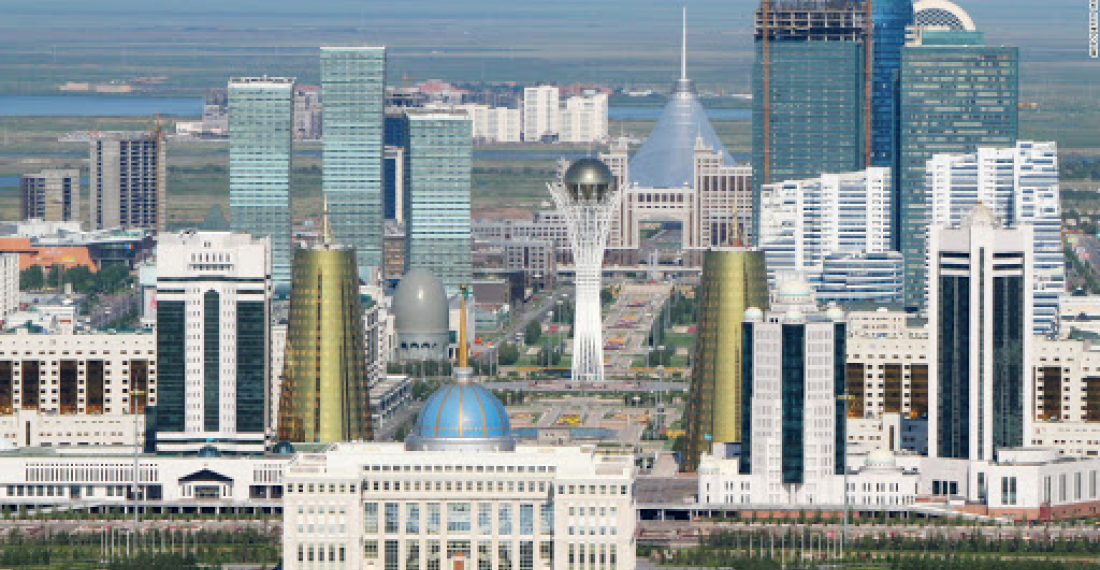
photo: Astana general view (archive picture).



