Filter archive

Publication date
Editor's choice
Opinion
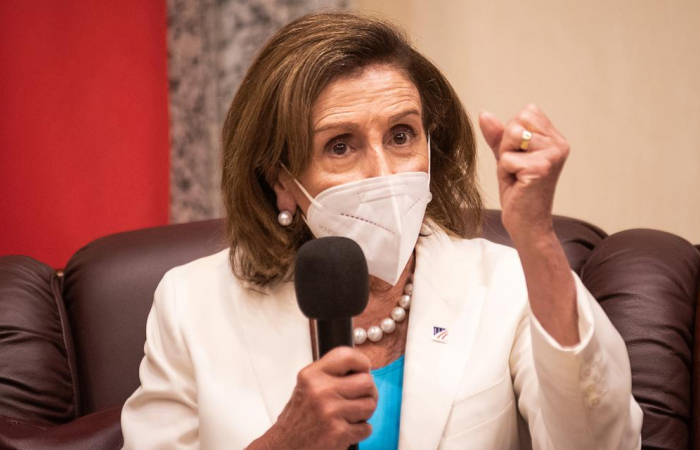
Opinion: The future of the China-US-Russia triangle after Pelosi's visit to Taiwan

Opinion: The future of the China-US-Russia triangle after Pelosi's visit to Taiwan

Since February 24, 2022, the international community's focus was concentrated entirely on the war in Ukraine and the growing Russia – West confrontation. It seemed that nothing could change the situation until the end of hostilities in Ukraine. However, on August 2 and 3, almost everyone’s attention shifted from Ukraine to Taiwan. As the Speaker of the US House of Representatives, Nancy Pelosi, stated her intention to visit Taiwan, up to half a million people were watching the trajectory of her plane on air flight tracking sites. The negative reaction of China, including the warning of President Xi during his conversation with President Biden that those who played with fire would be perished by it, created hype around this visit. Many were discussing the possibility of Chinese military jets closing the airspace over Taiwan and preventing Pelosi’s plane from landing in Taiwan, while some enthusiasts were even contemplating the possibility of a US-China direct military clash. As Pelosi landed in Taiwan and met with the Taiwanese President, the global social media was full of amateur assessments about the strategic victory of the US and the confirmation of the US global hegemony. However, as the dust settles down, and information noise and manipulation eventually decreases, a more serious assessment is needed to understand the real consequences of this visit.
Editor's choice
News
On Greenland, Europe will  not be intimidated

On Greenland, Europe will not be intimidated

European countries are resolute in their support for Greenland and Denmark, in the face of continued threats by the Trump administration to take control of Greenland, which is a self-administered territory within the Kingdom of Denmark. The latest move by the Trump Whitehouse was to impose a 10% tariff on eight European countries that have declared their support for Greenland and Denmark. Trump wrote on Friday on social media, "Starting on February 1, 2026, all of the above-mentioned countries (Denmark, Norway, Sweden, France, Germany, the United Kingdom, the Netherlands, and Finland) will impose a 10% tariff on all goods shipped to the United States. On June 1, 2026, these tariffs will increase to 25%," In a message on X, the president of the European Commission, Ursula von der Leyen  said: "Territorial integrity and sovereignty are fundamental principles of international law. They are essential for Europe and the international community as a whole." She added that Europe consistently emphasized in many ways, including through NATO, that they have shared transatlantic interests in peace and security in the Arctic. She also emphasized that the pre-coordinated Danish exercise, held with allies, meets the need to strengthen Arctic security and does not pose a threat to anyone. "The EU stands in full solidarity with the people of Denmark and Greenland. Dialogue remains essential and we are committed to taking forward the process launched last week between the Kingdom of Denmark and the United States," the European Commission President wrote. She also said that the tariffs Trump wants to impose would undermine transatlantic relations and risk a dangerous downward spiral. EU ambassadors will meet in emergency session on Sunday in Brussels to discuss the matter. This is likely to be followed by a meeting of Foreign Ministers later this week.
Editor's choice
Interview
Thursday Interview: Murad Muradov

Thursday Interview: Murad Muradov

Today, commonspace.eu starts a new regular weekly series. THURSDAY INTERVIEW, conducted by Lauri Nikulainen, will host  persons who are thinkers, opinion shapers, and implementors in their countries and spheres. We start the series with an interview with Murad Muradov, a leading person in Azerbaijan's think tank community. He is also the first co-chair of the Action Committee for a new Armenian-Azerbaijani Dialogue. Last September he made history by being the first Azerbaijani civil society activist to visit Armenia after the 44 day war, and the start of the peace process. Speaking about this visit Murad Muradov said: "My experience was largely positive. My negative expectations luckily didn’t play out. The discussions were respectful, the panel format bringing together experts from Armenia, Azerbaijan, and Turkey was particularly valuable during the NATO Rose-Roth Seminar in Yerevan, and media coverage, while varied in tone, remained largely constructive. Some media outlets though attempted to represent me as more of a government mouthpiece than an independent expert, which was totally misleading.  Overall, I see these initiatives as important steps in rebuilding trust and normalising professional engagement. The fact that soon a larger Azerbaijani civil society visits to Armenia followed, reinforces the sense that this process is moving in the right direction." (click the image to read the interview in full)
Editor's choice
Event
commonspace.eu is getting better

commonspace.eu is getting better

Commonspace.eu will this year celebrate its 15th anniversary. In this period we provided space for different opinions, including to persons from the countries and areas we are focused on, which have included Georgians, Armenians, Azerbaijanis, Yemenis, Ukrainians and many others. We have also, as much as is possible for a news outlet that does not have a network of paid journalists, provided accurate information, especially at times of crises. We have done so whilst remaining inspired by our vision for a just and peaceful world, of a Europe that works in peace and collaboration with its neighbourhood, and to give a voice to youth, women, minorities and other groups that struggle to be heard. This week we are launching new features, and strengthening established ones, to make commonspace.eu more effective, and more useful for our eclectic readership. On Thursday, we launch our new series, THURSDAY INTERVIEW. The interviews will be conducted by Lauri Nikulainen, and the first interview is with Murad Muradov, Vice President of the Topchubashov Centre in Baku. On Friday we will have a selection from our regular newsletters: Caucasus Concise, Arabia Concise and Central Asia Concise. We hope to add a fourth newsletter shortly. On Monday, the Monday Commentary by our Managing Editor, Dr Dennis Sammut, is back. The commentaries reflect the author’s years of experience, but equally his passion for change and a better world. On Tuesday and Wednesday, we feature articles by our regular guest contributors, including Onik Krikorian, Benyamin Poghosyan and Vasif Huseynov. We will of course also feature daily news stories from Europe, and the regions around it, the neighbourhood with which we need to build a common future. We hope that you will find commonspace.eu interesting and useful.
Editor's choice
Opinion
Opinion: With a foot in every camp, Armenia seeks to create a niche for itself through a diversified foreign policy

Opinion: With a foot in every camp, Armenia seeks to create a niche for itself through a diversified foreign policy

The days when Armenia was considered an outpost of Russia are long gone. Prime Minister Nikol Pashinyan has sought new relations with both the European Union and the United States. Relations with Brussels have peaked to new heights, with even talk of EU membership. And no lobbying by the powerful Armenian diaspora in the US could achieve that historical moment on 8 August in the White House, when Pashinyan and Azerbaijani president Aliyev, not only set the stage for peace between their two countries, but also opened the way for a new relationship with the United States. But Pashinyan has been able to do all this whilst at the same time keeping the relations with Russia warm. Armenia remains an active member of the Russia-led Eurasian Economic Union (EAEU). In December, Pashinyan participated in Eurasian Economic Union (EAEU) meetings in Moscow and St. Petersburg. Johnny Melikyan, Senior Research Fellow at the Orbeli Centre in Yerevan summed up the visit this way: The recent December 2025 visits of Armenian Prime Minister Nikol Pashinyan to Russia highlighted a practical and interest-based stage in Armenian–Russian relations. Rather than symbolism, the agenda was dominated by concrete issues of economic cooperation, connectivity, trade, and participation in Eurasian integration formats. You can read Johnny Melikyan's comment in full by clicking on the image