


Foreign ministers from Arab and Islamic countries on Wednesday called on Iran to immediately halt its attacks on regional states, warning that the future of relations with Tehran depends on its respect for sovereignty and non-interference in internal affairs.
Foreign ministers from Arab and Islamic countries on Wednesday called on Iran to immediately halt its attacks on regional states, warning that the future of relations with Tehran depends on its respect for sovereignty and non-interference in internal affairs.
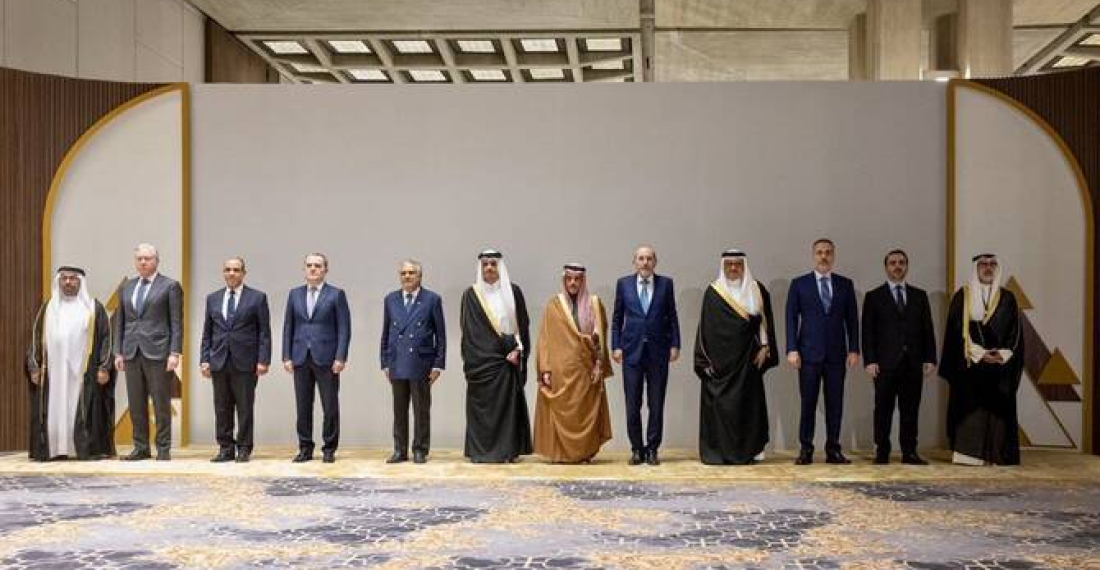
The meeting brought together foreign ministers from Azerbaijan, Bahrain, Egypt, Jordan, Kuwait, Lebanon, Pakistan, Qatar, Saudi Arabia, Syria, Türkiye, and the United Arab Emirates.
In a joint statement issued after a consultative ministerial meeting in Riyadh, the ministers stressed that continued Iranian actions — both direct and through allied groups — threaten regional security and undermine prospects for diplomacy.
“The future of relations with Iran depends on respecting the sovereignty of states and non-interference in their internal affairs,” the statement said, in a clear reference to Tehran’s support for proxy groups across the region.
The ministers strongly condemned what they described as deliberate Iranian attacks using ballistic missiles and drones targeting civilian infrastructure, including oil facilities, desalination plants, airports, residential buildings, and diplomatic premises across Gulf Cooperation Council countries and beyond.
They said such actions “cannot be justified under any pretext,” and affirmed the right of affected states to defend themselves in accordance with Article 51 of the United Nations Charter.
Calling for immediate de-escalation, the ministers urged Iran to adhere to international law, international humanitarian law, and the principles of good neighborliness as a first step toward restoring stability and advancing diplomatic solutions.
The statement also emphasized the need for Iran to comply with UN Security Council Resolution 2817, which calls for an immediate cessation of attacks and prohibits support, financing, or arming of affiliated militias in Arab countries.
This includes groups such as the Houthi movement in Yemen and Hezbollah in Lebanon, which several regional governments accuse Iran of backing.
The ministers also warned against any threats to international shipping, urging Iran to refrain from actions that could disrupt navigation in the Strait of Hormuz or the Bab el-Mandeb — two of the world’s most critical maritime chokepoints.
On Lebanon, the ministers reaffirmed support for the country’s sovereignty, stability, and territorial integrity, backing efforts by the government to ensure that all weapons remain under state control. They also condemned Israel’s military actions in the country and its broader regional posture.
The group pledged to maintain close coordination and consultation to monitor developments and formulate unified positions, including taking “necessary legitimate measures” to safeguard their security and sovereignty and to bring an end to what they described as Iranian aggression.
source: commonspace.eu with Arab News (Riyadh) and agencies
photo: Foreign Ministers of GCC and neighbouring countries after their meeting in Riyadh on 18 March 2026



