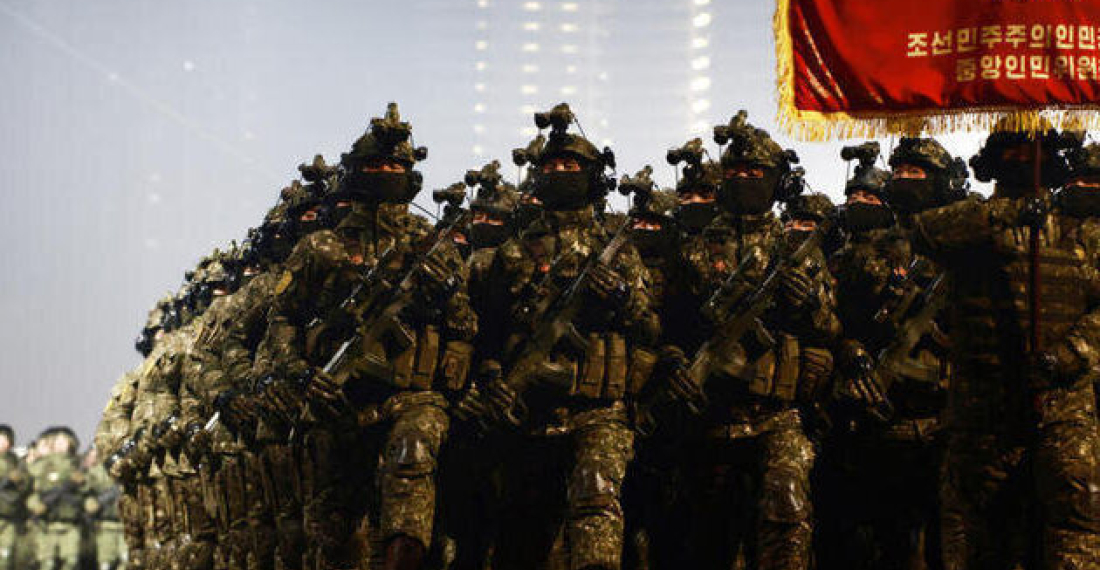
Last Saturday (August 8), Ukrainian President Volodymyr Zelensky said that between 30,000 and 50,000 North Korean troops could be deployed to Russian territory, significantly increasing Pyongyang’s military involvement in Moscow’s war against Ukraine. Zelensky made the claim in a post on X, saying that “a decision has been made” to deploy the personnel, but he did not explain how Kyiv obtained the information.
The estimate is higher than the figure Zelensky cited in July, when he said Russia was seeking an additional 30,000 North Korean troops. Since 2024, North Korea has already sent an estimated 11,000 to 14,000 soldiers to Russia. According to the reports, North Korean forces have supported Russian operations, including efforts to repel a Ukrainian incursion into Russia’s Kursk region.
Zelensky also warned that North Korea is gaining battlefield experience through its cooperation with Russia. He said Pyongyang was obtaining military technology and knowledge from Moscow while Russian forces were using North Korean weapons against Ukraine. Notably, Ukrainian intelligence estimates that North Korea supplied as much as half of Russia’s requirements for 122mm and 152mm artillery shells by the end of 2025. Pyongyang has also supplied ballistic missiles, long-range artillery, multiple-launch rocket systems and millions of artillery and mortar rounds. According to assessments cited in the reports, North Korea’s military cooperation with Russia has generated up to $22 billion in foreign revenue for Kim Jong Un’s government since 2022.
North Korean missile capabilities are also being integrated into Russian operations. Ukrainian military intelligence representative Andrii Cherniak said Russia was preparing to station a North Korean missile unit in the western Voronezh region. The approximately 90-person unit could be equipped with up to 120 ballistic missiles. Pyongyang has also recently supplied Russia with additional KN-23 and KN-24 short-range ballistic missiles. After an almost year-long pause, Russia has resumed using such weapons against Ukraine, including in a July 30 strike that hit a residential building in the Kryvyi Rih region.
The expanding military relationship follows a comprehensive strategic partnership treaty signed by Russian President Vladimir Putin and North Korean leader Kim Jong Un during Putin’s visit to Pyongyang in June 2024. The agreement includes mutual assistance provisions in the event of external aggression.
Amid Ukraine’s shortage of advanced air-defense interceptors, Zelensky called for closer defense cooperation with South Korea. He said Kyiv was seeking South Korean assistance with air-defense systems and was prepared to pursue drone-related agreements, with Ukrainian diplomats already in contact with Seoul.
Source: commonspace.eu with Kyiv Post (Kyiv), North Korea Times (Sydney) and The Jerusalem Post (Jerusalem).