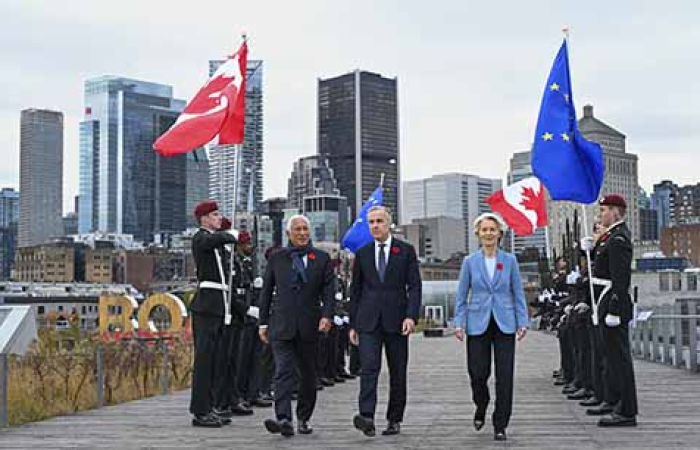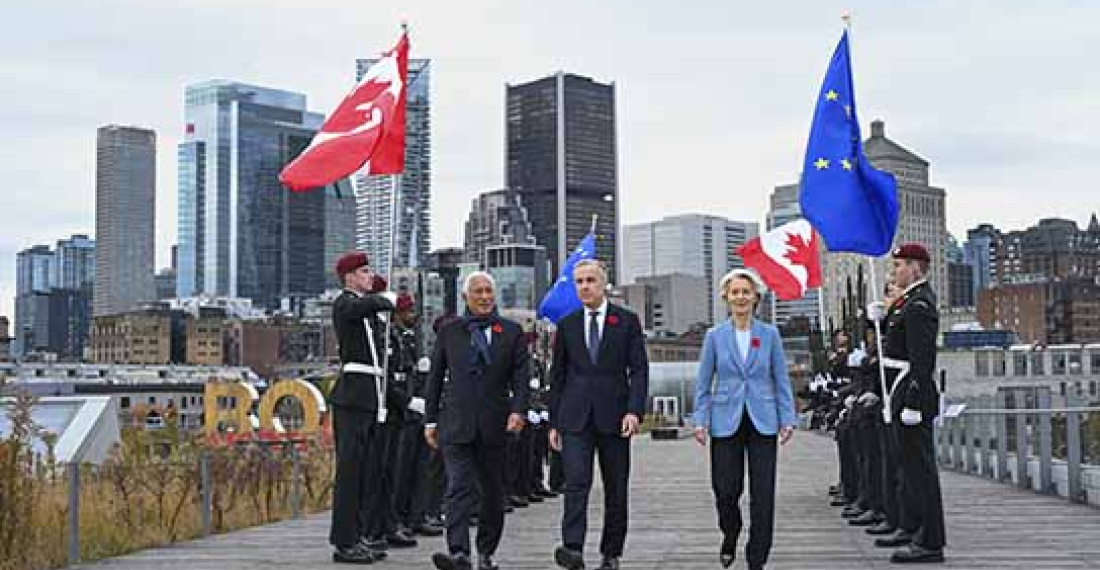
António Costa, President of the European Council, and Ursula von der Leyen, President of the European Commission, represented the EU at the 21st EU-Canada summit, which took place in Montreal on 29 and 30 October 2026. Prime Minister Mark Carney represented Canada.
The summit marked a major milestone in EU-Canada relations, paving the way for an even broader and deeper political partnership. Leaders took stock of progress made since the previous EU-Canada summit and issued a joint statement launching an Alliance for the Future. Building on their longstanding strategic partnership, the alliance aims to deepen cooperation and create a common prosperity and economic security space.
This is a moment to act with clarity and ambition. By aligning more closely – economically, technologically and strategically – Canada and the EU are building an Alliance for the Future based on trust and shared values that meets the scale of today's challenges and opportunities and will reinforce the freedom, prosperity and safety our citizens expect and deserve. We are stronger together.
EU-Canada statement
The alliance will strengthen cooperation across six areas:
- trade and regulatory cooperation
- digital, research and communications technologies
- critical resources and energy
- financial services and markets
- security and preparedness
- people-to-people ties
The leaders also agreed to work towards an even closer EU-Canada association and to define, by the 2027 EU-Canada summit, the concept of an ever-closer association of Canada to the EU, short of full membership.
Geopolitics
The EU and Canada reaffirmed their commitment to democracy, multilateralism and the rules-based international order, and to working together to promote international peace and security.
Leaders pledged to advance UN reform through the UN80 initiative, and to uphold the international judicial system, including the International Criminal Court and the Rome Statute. They expressed deep regret over the United States' decision to impose sanctions on the Court. They also committed to supporting the sustainable development goals and the Paris Agreement, working to reform the World Trade Organization and strengthening dialogue with members of the Comprehensive and Progressive Agreement for Trans-Pacific Partnership (CPTPP).
The EU and Canada reaffirmed their unwavering support for Ukraine, as well as its ongoing institutional reforms and future reconstruction. They also committed to increasing pressure on Russia.
On the Middle East, leaders agreed on the need for de-escalation, humanitarian assistance and a two-state solution in which Israel and Palestine live side by side in peace within secure and recognised borders. They also committed to deepening cooperation in the Arctic, including through a new dedicated dialogue, and to advancing shared priorities in the EU's neighbourhood, Ukraine, the Republic of Moldova, the Western Balkans, the Indo-Pacific, Africa, Latin America and the Caribbean.
Trade and regulatory cooperation
The EU and Canada share one of the world's most successful free trade agreements. Trade between the EU and Canada in goods and services reached roughly €130 billion in 2025, an increase of more than 80% compared with 2016. The Comprehensive Economic and Trade Agreement (CETA) has helped strengthen these economic ties.
During the summit, the leaders committed to further deepening economic cooperation, strengthening economic security and supply chain resilience, and supporting open, rules-based trade.
Under the Alliance for the Future, the EU and Canada will upgrade their trade partnership, including in critical raw materials, energy, clean and digital technologies, critical medicines and maritime industries. They will also deepen industrial cooperation through sectoral roadmaps, work to remove regulatory barriers and explore new areas of cooperation, including e-commerce.
Digital and research
The EU and Canada will deepen cooperation on digital infrastructure, research and emerging technologies to strengthen innovation and competitiveness.
Under the Alliance for the Future, they will work towards:
- Canada's participation in future European research and innovation programmes, including Horizon Europe
- promoting cooperation in strategic fields such as artificial intelligence (AI), quantum technologies, semiconductors and advanced computing
- expanding funding and research opportunities for small and medium-sized enterprises, start-ups and research institutions
The two sides have also concluded substantive negotiations on a digital trade agreement, will work to improve connectivity between Europe, Canada and Asia through subsea cables, and expand space cooperation, including through talks on Canadian access to Galileo services and on cooperation under IRIS².
They will also advance cooperation on AI security and governance, data flows, interoperability and high-performance computing, including AI factories. In this context, leaders welcomed Canada's participation in the European High Performance Computing Joint Undertaking. They will also coordinate efforts to advance the safety of minors online. Work towards mutual recognition will cover digital identity and credentials, conformity assessments for AI systems and cybersecurity.
Critical resources and energy
The EU and Canada reaffirmed the importance of their green alliance in advancing decarbonisation while strengthening competitiveness and economic security. They will deepen cooperation on strategic industries and supply chains, including critical raw materials, clean technologies, semiconductors, quantum technologies, pharmaceuticals, essential medicines, space-based communications and navigation.
Under the Alliance for the Future, the EU and Canada will:
- strengthen maritime and multimodal supply chains
- develop closer links between European and Canadian ports and cooperate on critical maritime, undersea and port infrastructure
- promote the transition to cleaner, more resilient transport, including railways and waterways
On energy, the EU and Canada will also strengthen cooperation on energy security and the energy transition. They will assess opportunities for long-term energy connectivity, including a joint feasibility study on LNG exports to Europe, and deepen cooperation on sustainable energy sources, grids, battery storage and the physical and cyber protection of energy infrastructure. They will also continue existing cooperation on nuclear technologies and work towards modernising the Canada-Euratom nuclear cooperation agreement.
They will also accelerate cooperation on investment in critical mineral projects, from extraction and processing to refining, manufacturing and recycling, and look into raw materials projects in third countries to develop more secure and sustainable critical raw materials value chains.
Financial services and markets
Under the Alliance for the Future, the EU and Canada will deepen financial cooperation to make it easier for businesses and investors to operate across the Atlantic and support growth, innovation and investment.
They will work to increase cross-border capital flows, and support work towards connecting instant payment systems.
Security and preparedness
Security and defence
The EU and Canada will further bring to scale the implementation of their security and defence partnership, deepening dialogue and cooperation on defence capabilities, international peace and crisis management, sanctions, the defence industry, and maritime and space security.
Cooperation between the EU and Canada already covers permanent structured cooperation (PESCO), Canada's participation in capability coalitions, and defence industrial initiatives. Canada's participation in the EU's Security Action for Europe (SAFE) instrument allows Canadian suppliers to participate in the defence procurements of EU member states.
To address growing hybrid threats, the EU and Canada will develop a framework for cooperation on democratic resilience, and deepen efforts to counter foreign information manipulation and interference (FIMI)including through a dedicated dialogue.
Under the Alliance for the Future, they will strengthen cooperation on cybersecurity, information sharing and supply chain resilience, including exchanges on cyber threat intelligence, incident response, strategic infrastructure protection and emerging threats linked to artificial intelligence.
Preparedness
The EU and Canada will strengthen cooperation to protect their populations from health crises, natural disasters and evolving health threats.
Under the Alliance for the Future, they will deepen cooperation on pandemic preparedness, health surveillance medical countermeasures and emergency response. They will also strengthen cooperation between the Public Health Agency of Canada and the European Centre for Disease Prevention and Control.
The two sides will work towards Canada's participation in BE READY, the Horizon Europe partnership for pandemic preparedness research and innovation, and expand cooperation on disaster preparedness and wildfire management.
Internal security and judicial cooperation
Building on existing cooperation between EU agencies, including Europol, Frontex and the EU Drugs Agency, and their Canadian counterparts, the EU and Canada will strengthen information sharing and operational cooperation on law enforcement, border management, drugs and security.
They will also broaden judicial cooperation, strengthen coordination on emerging security challenges and enhance the sharing of immigration information.
People-to-people
The EU and Canada will expand opportunities for their citizens to study, work, conduct research and build lasting connections.
Under the Alliance for the Future, they will launch negotiations towards deeper Canadian participation in Erasmus+ and discussions on skills development, labour and research mobility, and attracting talent. They will also explore a next-generation youth mobility partnership, drawing on programmes such as Erasmus+, the European Research Council and the Marie Skłodowska-Curie Actions.
The two sides will promote cooperation on culture and cultural heritage and explore cooperation under the New European Bauhaus initiative.
A closer EU-Canada association
Building on their existing Strategic Partnership Agreement, the EU and Canada will deepen political engagement and coordination on shared priorities. Leaders welcomed the increasingly frequent exchanges with Canadian ministers at relevant Council and ministerial meetings.
The EU and Canada will build on these exchanges through regular summits, joint ministerial meetings and cooperation committees. The partners will work to define the concept of an ever-closer association of Canada to the EU, short of full membership, by the 2027 EU-Canada summit.
source: commonspace.eu with the Council of the European Union (consilium.eu, Brussels)