The 4th International Mine Action Conference, was held in Baku, Azerbaijan, on 2-3 September 2026. It was organised by the Azerbaijani national agency for humanitarian demining, ANAMA, and the United Nations.
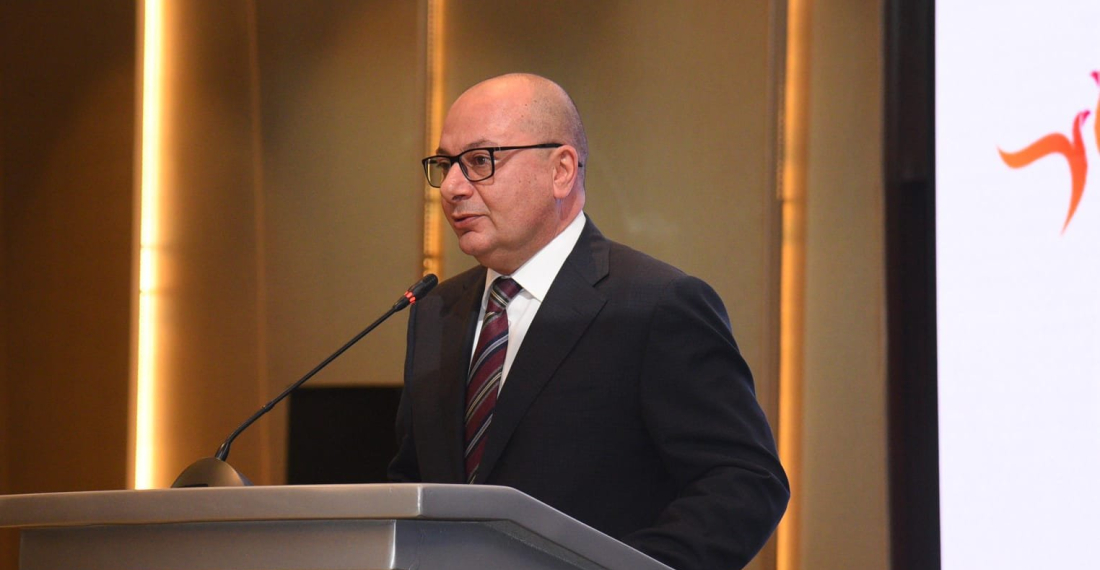
The meeting opened with a message by Azerbaijani president Ilham Aliyev. In his opening remarks, Vugar Suleymanov, Chairman of the Board of the Mine Action Agency of the Republic of Azerbaijan (ANAMA), spoke about the challenges facing Azerbaijan in the area of demining, and the action being taken, spearheaded by ANAMA, to address these issues:
I would like to express our deep gratitude for the continuous attention and strong political support given to humanitarian mine action in our country. In Azerbaijan, demining is not treated only as a technical or security activity. It is a national priority, a humanitarian duty, and one of the essential foundations of reconstruction, recovery and safe return.
These are Mr Suleimanov remarks in full:
The theme of this year’s Conference reflects Azerbaijan’s own experience very directly. In the liberated territories of our country, urban recovery does not begin with construction. It begins with making the land safe. Before a road is built, the route must be cleared. Before a school opens, the surrounding area must be safe. Before a family returns home, the neighborhood, the access roads, the water and energy lines, and the land around that settlement must be released from danger. This is why humanitarian demining stands at the very beginning of the recovery chain. It is the first practical step that allows destroyed cities and villages to become safe for people to return, rebuild and restore normal life.
Since the end of the 44-day Patriotic War, ANAMA and other institutions involved in humanitarian demining have cleared more than 298,000 hectares of land and neutralized more than 260,000 mines and other explosive remnants of war. Behind these numbers are not only operational achievements. Behind them are roads reopened, villages rebuilt, power lines restored, agricultural fields returned to use, and families given the possibility to return to their native lands.
Since November 2020, mine clearance operations have been directly linked to the reconstruction and urban recovery of the liberated territories. During this period, more than 103,000 hectares have been cleared and released specifically for residential infrastructure, enabling the construction of new settlements, housing complexes, schools, hospitals, public facilities and essential services for returning communities. In addition, significant areas have been cleared for roads, energy infrastructure, agriculture and other priority projects.
This is the real meaning of humanitarian mine action in the context of urban recovery.
Today, in the liberated territories, we see how cleared land is being transformed into modern cities, villages, roads, schools, hospitals, airports, energy facilities and public spaces.
The development of new residential areas in Aghdam, Fuzuli, Lachin, Shusha, Zangilan, Kalbajar, Khojaly and other areas is not simply a construction process. It is the restoration of life after decades of occupation and destruction.
The Aghali Smart Village in Zangilan, the new residential complexes in Aghdam, the reconstruction of Lachin, the development of Fuzuli, the international airports in Fuzuli, Zangilan and Lachin, the Ahmadbayli–Fuzuli–Shusha highway, the Horadiz–Jabrayil–Zangilan–Aghband railway line, which forms an important part of the wider Zangezur Corridor, energy substations, water infrastructure, schools and medical facilities — all of these projects demonstrate one fundamental truth: safe land is the foundation of sustainable return and resilient urban recovery.
For ANAMA, this creates a great responsibility. Our task is not only to clear land, but to ensure that clearance is aligned with national reconstruction priorities, the Great Return process, and the daily needs of people who are returning to their homes.
The Conference therefore provides an opportunity to examine mine action as a foundation for safe return, urban recovery, resilient communities and sustainable development.
During the next two days, we will discuss how humanitarian demining supports urban recovery, how donor mechanisms can be better connected to reconstruction needs, how resilient communities can be built, how policy integration can be strengthened, and technology and innovation can make operations safer and more effective.
Azerbaijan is here to learn, but we are also ready to share our experience. No country can address the mine problem alone. International cooperation, technical exchange, donor support, innovation and strong national ownership are all necessary if we want to move from contamination to recovery, and from risk to resilience.
Azerbaijan has demonstrated strong national ownership in addressing the mine problem. Since November 2020, approximately 590 million US Dollars has been allocated to humanitarian demining activities in the country. Only around 4% of this amount has come from international support, while the remaining part has been covered by the Government of Azerbaijan.
This reflects the clear commitment of our state to ensuring safe return, reconstruction and recovery. At the same time, the scale of contamination remains extremely large, and stronger international support is essential to accelerate clearance, reduce risks for civilians, and enable the timely implementation of urban recovery and development projects in the liberated territories.
Therefore, we believe that international cooperation in mine action should not be seen only as support to clearance operations. It should be understood as an investment in human security, safe return, sustainable development and long-term peace.
On behalf of ANAMA, I would like once again to thank all participants for being with us in Baku. Your presence, your expertise and your partnership are highly valued.
I am confident that this Conference will contribute to stronger cooperation, practical exchange of experience and the development of new approaches to humanitarian mine action in support of safe settlements and sustainable urban recovery.
source: commonspace.eu with ANAMA (Baku)