On Wednesday morning (4 February), the UN Security Council will convene for a briefing on the Secretary-General’s 22nd biannual strategic-level report on the threat posed by ISIL- the Islamic State in Iraq and Levant group, to international peace and security. Chris Elmore, the UK’s Parliamentary Under-Secretary of State in the Foreign, Commonwealth and Development Office, travelled to New York to chair the meeting. Britain in February holds the rotating Chairmanship of the UN Security Council.
The Secretary-General’s report, which was circulated to Council members on 31 January, says that the threat posed by ISIL has increased steadily since the previous report was issued in August 2025, becoming more complex and intensifying in multiple theatres. It notes that ISIL continues to exploit armed conflict, political instability, and weak governance and stresses that the group remains a threat to human rights and development, as well as to international peace and security more broadly.
The situation is particularly serious in Africa. The report says that ISIL affiliates, including the Islamic State Sahel Province (ISSP) and Islamic State West Africa Province (ISWAP), are asserting control over vast areas in West Africa and the Sahel, leading to significant casualties, large-scale displacements, loss of livelihoods, and ongoing interruptions of humanitarian assistance. In the Lake Chad Basin, ISWAP became more prominent, entrenching its positions across the central and southern areas of Borno State in northeastern Nigeria and intensifying raids against isolated communities in northern Cameroon and western Chad. On 25 December 2025, the US said that it had carried out an airstrike targeting ISIL operations in Sokoto State in northwestern Nigeria, in coordination with Nigerian authorities.
The Islamic State in the Greater Sahara (ISGS) has remained active in Niger, targeting security forces and civilians and clashing with Al-Qaida affiliate Jama‘a Nusrat ul-Islam wa al-Muslimin (JNIM), which the report describes as the dominant group in the Sahel. ISIL also claimed responsibility for a 28 January attack on Niger’s main airport in Niamey, which was reportedly repelled by Nigerien armed forces with assistance from Russian troops. Given the seriousness of the situation in the region, the Secretary-General’s report highlights the need for regional member states to forge unified responses to challenges they face. In this regard, it stresses the importance of preserving the cohesion of the Multinational Joint Task Force (MNJTF), a regional security coalition comprising forces from Benin, Cameroon, Chad, and Nigeria that is mandated to combat Boko Haram and ISWAP. Niger announced its withdrawal from the MNJTF in March 2025.
In Somalia, the threat posed by ISIL was significantly reduced as a result of counter-terrorism operations conducted by national security forces working with regional and international partners. ISIL in Somalia is estimated to have approximately 200-300 fighters, many of whom were killed or arrested during counter-terrorism operations. In late January, Somalia and the US carried out a series of airstrikes targeting ISIL’s Somali affiliate. In the Democratic Republic of the Congo (the DRC), the ISIL-affiliated Allied Democratic Forces (ADF) has continued to pose a substantial threat, while ISIL has increased its propaganda coverage of attacks in both the DRC and Mozambique. According to media reports, militants linked to ISIL killed at least 22 civilians in a village in eastern DRC on 25 January.
source: commonspace.eu with Security Council Report (New York) an agencies.
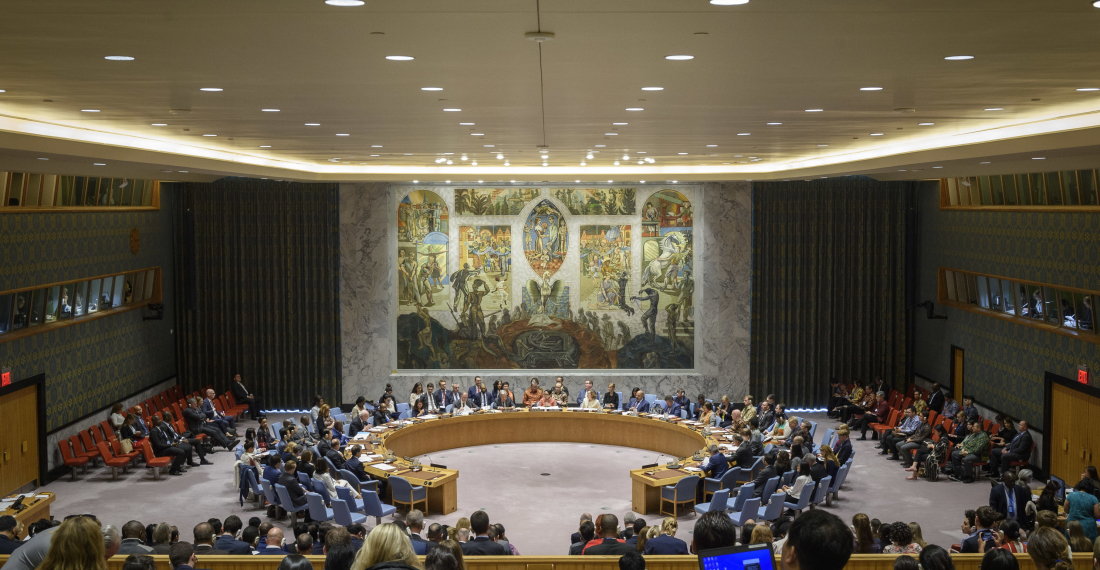
photo: UN Security Council in session (archive picture)