


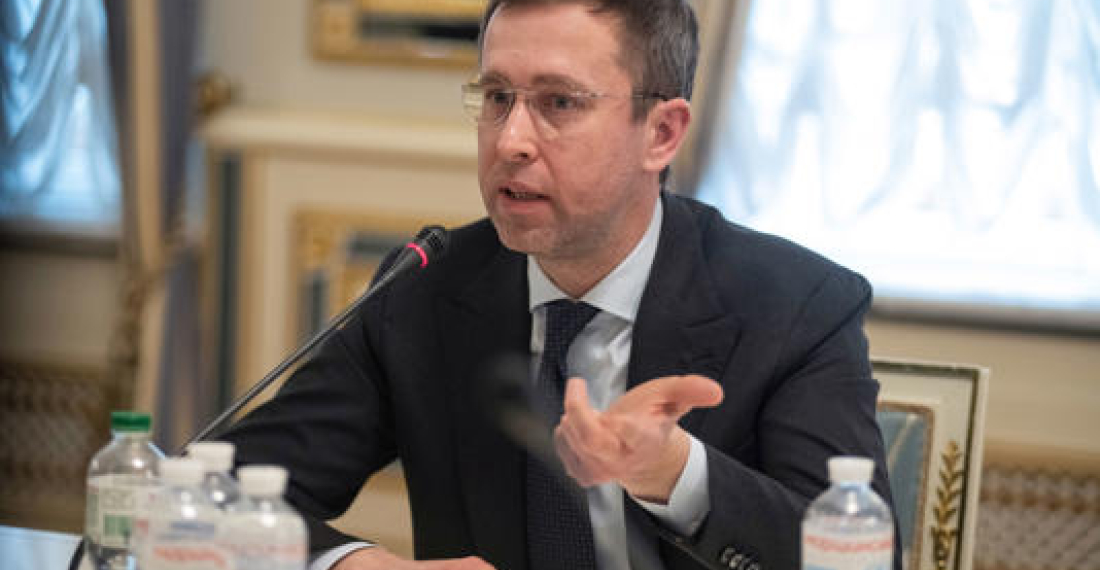
Ukraine's Parliament Confirms Serhiy Koretsky as Prime Minister Amid Wartime Government Reshuffle

Ukraine's parliament, the Verkhovna Rada, voted on Thursday (July 16) to appoint Serhiy Koretsky as the country's new prime minister, approving President Volodymyr Zelenskyy's nomination with 289 votes as part of a broader wartime government reshuffle. The appointment comes as Ukraine seeks to strengthen its leadership while facing continued Russian attacks and preparing its energy system for another challenging winter.

Koretsky, 48, took over the state-owned energy company Naftogaz in May 2025 after previously leading the state oil producer Ukrnafta. Although he has no previous political career, he has earned a reputation as an experienced crisis manager in Ukraine's energy sector, overseeing key infrastructure during repeated Russian strikes. During his address to parliament before the vote, he pledged to "do everything in his power to be useful to the state here and now," outlining priorities such as supporting the armed forces, preparing the country for winter, assisting frontline communities, and strengthening cooperation with international partners, including advancing Ukraine's accession to the European Union.

Speaking the previous day alongside European Commission President Ursula von der Leyen in Kyiv, Zelenskyy described Koretsky as "probably the most prepared person" for the position after extensive consultations. The president said the government's renewed focus would be on strengthening energy resilience and intensifying efforts to achieve a ceasefire.

Following the confirmation, von der Leyen congratulated Koretsky in a post on X, saying she looked forward to continuing the European Union's "excellent cooperation" with Ukraine. She added that she was confident he would place Ukraine's European integration "at the heart of the country's transformation effort" and assured him that he could count on the EU's "full support" as his government pursues its ambitious reform agenda.

The appointment follows the resignation of former Prime Minister Yulia Svyrydenko, whose dismissal automatically triggered the resignation of the entire cabinet. While the Parliament has already approved most of the new ministerial appointments, the foreign and defence ministries are still awaiting confirmation. Zelenskyy has nominated Interior Minister Ihor Klymenko to replace Defence Minister Mykhailo Fedorov, whose dismissal after only six months in office has become the most controversial element of the reshuffle. Fedorov, a former digital transformation minister widely credited with accelerating Ukraine's drone capabilities, modernising military procurement and promoting technological innovation, reportedly clashed with Commander-in-Chief Oleksandr Syrskyi over military reforms and mobilisation policy. 

According to Yaroslav Zheleznyak, a member of parliament, the new chiefs of the Ministry of Foreign Affairs and the Ministry of Defence are expected to be appointed at a plenary session on 18 August. 

In reaction to the protests against Fedorov’s dismissal, Zelenskyy said it was important that Ukrainians could continue to hold peaceful demonstrations and express their views despite the ongoing war.

Source: commonspace.eu with Euronews (Brussels), Atlantic Council (Washington DC), and Kyiv Post (Kyiv).


 

Related articles

Editor's choice
News
ANAMA hosts 4th International Mine Action Conference in Baku

ANAMA hosts 4th International Mine Action Conference in Baku

The 4th International Mine Action Conference is taking place in Baku, Azerbaijan, on 2 - 3 September 2026. The event is hosted by ANAMA, the Azerbaijani Mine action agency and the United Nations. The conference, which attracts hundreds of particpants from all over the world, opened with a message from president Ilham Aliyev, delivered to the coonference by senior presidential administration official, Hikmet Hajiyev. The theme of the conference is HUMANITARIAN DEMINING FOR URBAN RECOVERY; SETTING STANDARDS OF EXCELLENCE FOR SAFE SETTLEMENTS. President Aliyev in his message said, "Unfortunately, mines and unexploded ordnance continue to threaten human life and security in many countries around the world. Long after conflicts have ended, explosive ordnance continues to cause loss of life, injury to civilians, damage to infrastructure and delay reconstruction projects. In this regard, humanitarian demining is an essential commitment to safe settlements. Urban reconstruction in post-conflict areas requires the restoration of buildings, roads and public infrastructure, as well as the establishment of security and confidence. No city, village or town can be fully rebuilt, no school or hospital can function safely, no family can return to their homes with dignity, and no economic activity can develop sustainably until the land is cleared of mines and explosive remnants of war. Humanitarian demining is therefore at the heart of urban reconstruction and the creation of safe settlements. (click image to read more).

Popular

Editor's choice
Interview
Thursday Interview: Murad Muradov

Thursday Interview: Murad Muradov

Today, commonspace.eu starts a new regular weekly series. THURSDAY INTERVIEW, conducted by Lauri Nikulainen, will host  persons who are thinkers, opinion shapers, and implementors in their countries and spheres. We start the series with an interview with Murad Muradov, a leading person in Azerbaijan's think tank community. He is also the first co-chair of the Action Committee for a new Armenian-Azerbaijani Dialogue. Last September he made history by being the first Azerbaijani civil society activist to visit Armenia after the 44 day war, and the start of the peace process. Speaking about this visit Murad Muradov said: "My experience was largely positive. My negative expectations luckily didn’t play out. The discussions were respectful, the panel format bringing together experts from Armenia, Azerbaijan, and Turkey was particularly valuable during the NATO Rose-Roth Seminar in Yerevan, and media coverage, while varied in tone, remained largely constructive. Some media outlets though attempted to represent me as more of a government mouthpiece than an independent expert, which was totally misleading.  Overall, I see these initiatives as important steps in rebuilding trust and normalising professional engagement. The fact that soon a larger Azerbaijani civil society visits to Armenia followed, reinforces the sense that this process is moving in the right direction." (click the image to read the interview in full)

