Explosive-Laden Drone Found at Germany's Leipzig Airport Triggers Counterterrorism Investigation

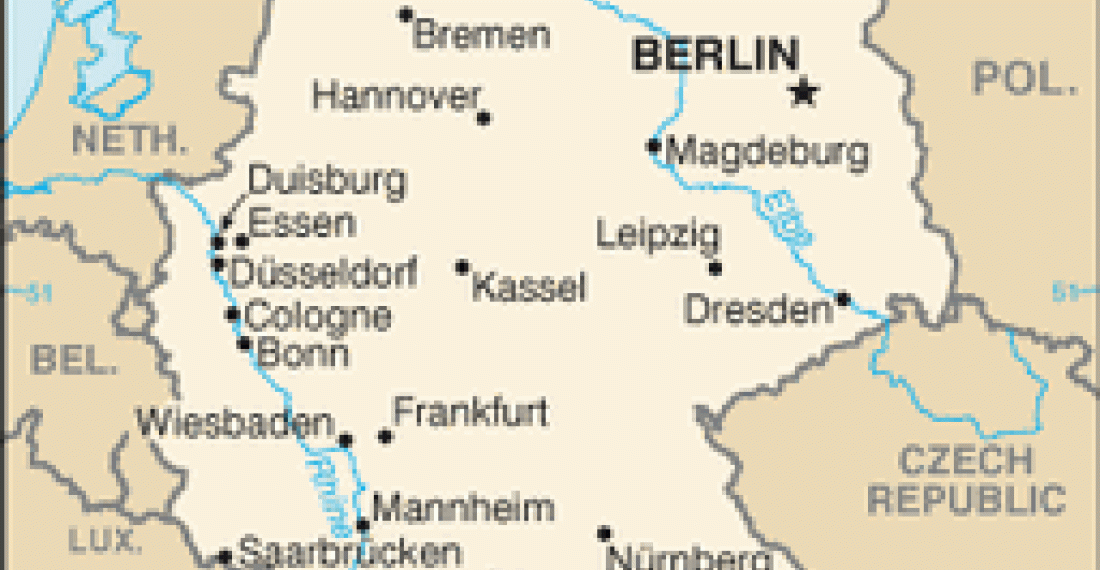
German authorities have launched a counterterrorism investigation after an airport worker discovered a drone carrying an explosive device in a restricted cargo area at Leipzig/Halle Airport late on Tuesday (August 4), prompting a temporary suspension of flight operations at one of Europe's most strategically important logistics hubs.

According to the Dresden Public Prosecutor's Office and Saxony police, the drone was found near a parked Antonov cargo aircraft operated by Ukraine. Bomb disposal specialists deployed a remotely operated robot to inspect the device before safely removing its detonator and neutralizing the threat. Officials said the detonator failed to function, preventing an explosion. German media, citing security officials, reported that the drone was discovered only a few meters from an Antonov cargo aircraft operated by Ukraine. The aircraft is part of the Antonov fleet that has been operating from Leipzig/Halle since Russia's full-scale invasion of Ukraine in 2022, after the destruction of Antonov's main base at Hostomel Airport near Kyiv. 

Leipzig has since become a crucial operating hub for Antonov Airlines, including NATO's Strategic Airlift International Solution (SALIS) programme, which provides participating countries with access to Antonov transport aircraft for military logistics and heavy cargo flights. Leipzig/Halle is also used by the German armed forces and serves as DHL's largest European cargo hub, making it an important transit point for shipments linked to Ukraine. 

The security alert forced Leipzig/Halle Airport to halt operations temporarily, diverting several incoming flights. During the disruption, a DHL cargo aircraft that had aborted its landing reportedly struck an unidentified object while climbing away from the airport. The aircraft landed safely in Hanover, where inspectors found damage to its nose. Authorities are investigating whether the airborne collision is connected to the drone incident.

Saxony Interior Minister Armin Schuster described the discovery as a "very serious security incident," while Germany's Interior Minister Alexander Dobrindt interrupted his vacation to travel to Leipzig for consultations with security officials. Authorities have not announced any arrests, but security services are reportedly treating the case as a suspected attempted attack.

The incident is not the first instance of sabotage targeting European infrastructure at the airport. Leipzig/Halle was previously linked to a July 2024 parcel fire involving an explosive device at a DHL facility, an attack that German intelligence later attributed to Russian operatives. Moscow denied involvement. Following the latest incident, Ukraine's ambassador to Germany, Oleksii Makeiev, suggested Russia could be responsible, though investigators have not identified any suspects and Russia's embassy in Berlin had not commented as of Wednesday (August 5) evening.

Source: commonspace.eu with International Business Times UK (London) and Politico.eu (Brussels).
 

Related articles

Editor's choice
News
The European Parliament approved the temporary elimination of customs duties on goods exported from Armenia to the EU in a plenary session.

The European Parliament approved the temporary elimination of customs duties on goods exported from Armenia to the EU in a plenary session.

The European Parliament, during its plenary session in Strasbourg, approved the European Commission's proposal to apply a system of trade measures for "Made in Armenia" products, which means there will be a temporary elimination of customs duties on a wide range of products imported from Armenia to the European Union.   The proposal presented by the European Commission was adopted at the plenary session of the Council of Europe with 583 votes in favor, 49 against and 39 abstentions. According to the proposal, the European Union plans to eliminate customs duties on a number of Armenian goods for a period of two years. At the same time, it is planned to establish duty-free import quotas for eight types of Armenian agricultural products. These include grapes, apricots, cherries, peaches, and cucumbers. The draft also provides for safeguard mechanisms that will allow the European Union to intervene, if necessary, if increased imports from Armenia have a negative impact on European producers. This step is due to the restrictions imposed by Russia on a number of important Armenian export products since May 2026. They relate, in particular, to alcoholic beverages, mineral waters, fruits and vegetables, as well as their transit through Russian territory. According to the European Commission, these restrictions have disrupted Armenia's traditional supply chains and significantly limited the country's access to traditional export markets. The situation has had a particularly severe impact on small and medium-sized enterprises, as well as agricultural producers, while creating challenges for Armenia's economic resilience. The EU sees the initiative as a temporary measure to support the Armenian economy and create additional opportunities for exporters to access the EU market. The next step for the proposal is formal approval by the EU Council. The regulation will enter into force the day after its publication in the Official Journal of the European Union. Let us recall that on September 2, the Council of the European Union approved the proposal to establish temporary trade liberalization measures for Armenian products and sent the draft to the European Parliament for approval. 

Popular

Editor's choice
Interview
Thursday Interview: Murad Muradov

Thursday Interview: Murad Muradov

Today, commonspace.eu starts a new regular weekly series. THURSDAY INTERVIEW, conducted by Lauri Nikulainen, will host  persons who are thinkers, opinion shapers, and implementors in their countries and spheres. We start the series with an interview with Murad Muradov, a leading person in Azerbaijan's think tank community. He is also the first co-chair of the Action Committee for a new Armenian-Azerbaijani Dialogue. Last September he made history by being the first Azerbaijani civil society activist to visit Armenia after the 44 day war, and the start of the peace process. Speaking about this visit Murad Muradov said: "My experience was largely positive. My negative expectations luckily didn’t play out. The discussions were respectful, the panel format bringing together experts from Armenia, Azerbaijan, and Turkey was particularly valuable during the NATO Rose-Roth Seminar in Yerevan, and media coverage, while varied in tone, remained largely constructive. Some media outlets though attempted to represent me as more of a government mouthpiece than an independent expert, which was totally misleading.  Overall, I see these initiatives as important steps in rebuilding trust and normalising professional engagement. The fact that soon a larger Azerbaijani civil society visits to Armenia followed, reinforces the sense that this process is moving in the right direction." (click the image to read the interview in full)