


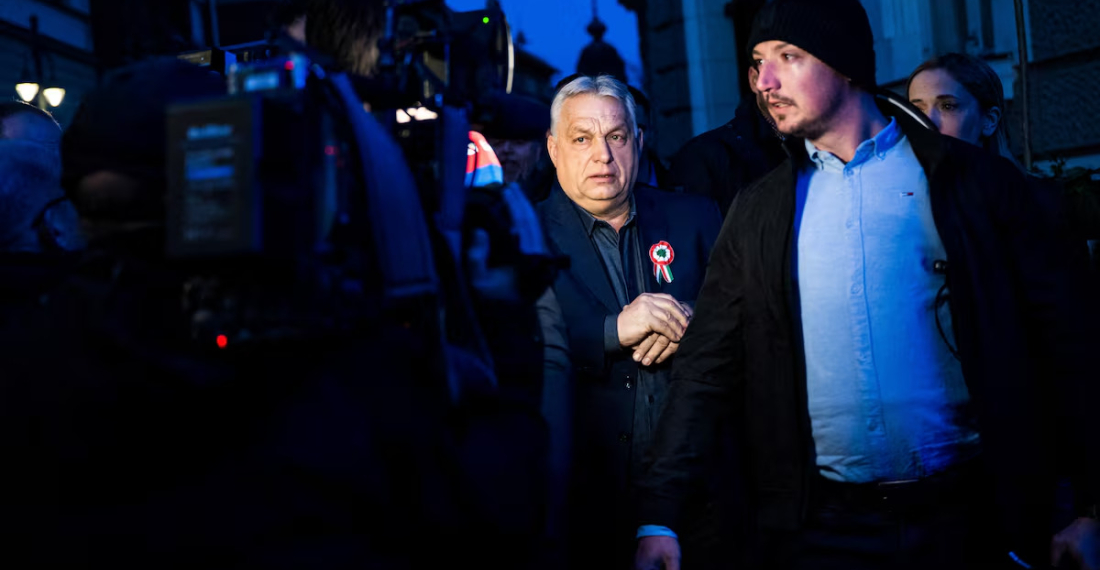
European Union leaders were unable on Thursday to persuade Hungarian Prime Minister Viktor Orbán to lift his veto on a €90 billion loan to Ukraine, officials said on Thursday (19 March).
The proposed loan would support Ukrainian military and economic operations to counter the Russian invasion for an additional two years. With Ukraine expected to run low on funds in the next month, EU leaders have criticised Orbán’s denial of the crucial aid package.
The aid package was originally agreed among EU leaders at a summit in December. Since then, Orbán has retracted his agreement to the loan’s implementation, citing a dispute over a war-damaged pipeline in Ukraine that has ceased crude oil transport to Hungary.
The dispute between Hungary and Ukraine began in January, when Russian oil transport was halted in the Druzhba pipeline, following damage caused by Russian drone attacks.
Despite this, Orbán has accused Ukrainian President Volodymyr Zelenskyy of intentionally withholding oil shipments. Zelenskyy has denied these claims.
Zelenskyy opposes the transport of Russian energy supplies through Ukrainian territory, as energy revenue has been key to Russia’s war effort. Since the start of the war four years ago, Russian forces have repeatedly attacked Ukrainian energy infrastructure.
In a letter to the European Commission on Tuesday (17 March), Zelenskyy wrote that Ukraine is “undertaking all possible efforts to repair the damage and restore operations”. Yet Orbán believes the pipeline is now functional. On Tuesday (17 March), he reiterated his opposition to the loan in a video posted to social media:
“If President Zelenskyy wants to get his money from Brussels, he needs to open up the Druzhba oil pipeline.”
Several EU officials have criticised Orbán for his stance. At the EU summit in Brussels, Dutch Prime Minister Rob Jetten declared Hungary’s veto “unacceptable” and advised other EU leaders not to give in to Orbán’s “blackmail”.
Additionally, Finnish Prime Minister Petteri Orpo has accused Orbán of “using Ukraine as a weapon” in his current election campaign ahead of elections in April, which has portrayed Zelenskyy as a threat to Hungary.
As of Tuesday (17 March), top European officials have offered Ukraine money to hastily repair the pipeline in an effort to secure Orbán’s approval of the aid package.
Source: commonspace.eu with Reuters and NPR



