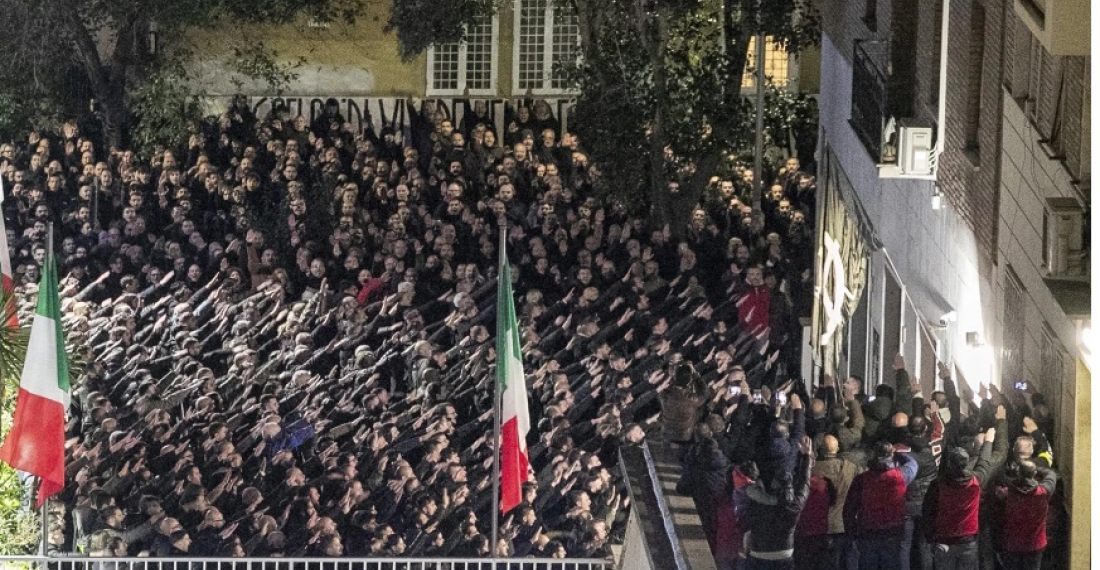
The sight of hundreds of men giving the fascist salute of raised arm during a commemoration in Rome on Sunday (7 January) has sent waves through the Italian political scene.
The men were part of a larger crowd taking part in an annual commemoration for three far-right activists who were killed in the 1970s, allegedly by far-left militants. In a video that went viral on social media, rows of black-clad men can be seen extending their right arms. They are also heard shouting "Presenti", in response to the rallying cry "For all fallen comrades!" - a slogan typical of the Italian far-right.
The rally is held every year to commemorate the 1978 killings of three teenage activists from the youth wing of the far-right Italian Social Movement (MSI).
Two were shot dead by suspected far-left militants outside MSI headquarters on Via Acca Larentia in Rome, while the third was killed by police in riots that followed the shooting. No-one was ever prosecuted for the killings, which have become widely known as the "Acca Larentia massacre".
Sunday night's scenes have been condemned by parties across the political spectrum. It has however once more opened a divide in Italian politics that has not been properly healed since the end of World War II.
Elly Schlein, the leader of the centre-left Democratic Party (PD), said the images from the rally "look like 1924", referring to the era of fascist leader Benito Mussolini and his black-shirted militias.
"What happened is unacceptable. Neo-fascist groups must be disbanded, as the constitution spells out," Ms Schlein added.
The leader of the centrist Azione party, Carlo Calenda, said that the Acca Larentia commemoration was an "unacceptable disgrace in a European democracy."
Deputy Prime Minister Antonio Tajani, the leader of centre-right party Forza Italia, said that any celebration of dictatorship should be condemned and added that "there is a law stating that you cannot make an apology for fascism in our country".
Even some members of the Brothers of Italy (FdI) party - which has its political roots in the MSI - have criticised the scenes. Giovanni Donzelli said that FdI had "nothing to do with what has happened" and that those taking part in the event were "200 idiots that the left will use to judge us".
However, Prime Minister Giorgia Meloni, who is also the leader of FdI, has so far stayed silent on the matter.
Ms Meloni has commemorated the 1978 killings in the past. In 2021, she posted a Facebook tribute to the three slain activists, saying that the killings were "a tragedy where no culprit has ever been found" and calling them "a wound that has never healed".
Her equivocation stems from her own political background. Aged 19, Ms Meloni told journalists that she considered Italy's wartime fascist leader Benito Mussolini "a good politician". She entered Italian politics as a member of the MSI.
In recent years, she has tried to reposition herself as more moderate, rejecting the label "far-right" and declaring that her party had "consigned fascism to history."
Ms Meloni won around 26% of the vote in Italy's September 2022 election
But critics point to the fact that the party logo still has the tricolour flame - long a symbol of neo-fascism - and will see in her silence on the scenes from Acca Larentia a nod to the more extremist side of her support base.
The images from the Acca Larentia commemoration went viral after they were shared by La Repubblica correspondent Paolo Berizzi, but events of this kind are not unusual in Italy.
Every year, hundreds of Mussolini supporters gather in his hometown of Predappio and hold commemorative rallies that feature fascist-era slogans and gestures.
Such events spark controversy on a regular basis, with opposition parties calling for police to investigate.
However, unlike Germany, where the use of right-wing extremist symbols is banned, Italy does not have a law that prohibits the use fascist imagery or gestures. There are buildings and monuments across Italy bearing Mussolini's name.
Laws do exist "against apology for fascism" but they are vague and rarely enforced. In 2017, an attempt at passing tighter legislation failed after right-wing parties argued the proposed bill would threaten freedom of speech.
On Tuesday, Ignazio La Russa - a key ally of Ms Meloni who, as senate speaker, holds Italy's second-highest office of state - weighed into the debate, stating that making fascist salutes was "not always a crime".
Mr La Russa, who is a known collector of fascist memorabilia and has busts of Mussolini in his home, told Italian media that there was still uncertainty over how "certain gestures" are considered if they were made in the context of a commemoration of the dead.
He added that he was looking forward to an upcoming verdict by the Court of Cassation, which is set to determine whether making the fascist salute constitutes a crime.