Azerbaijan and China sign Comprehensive Strategic Partnership

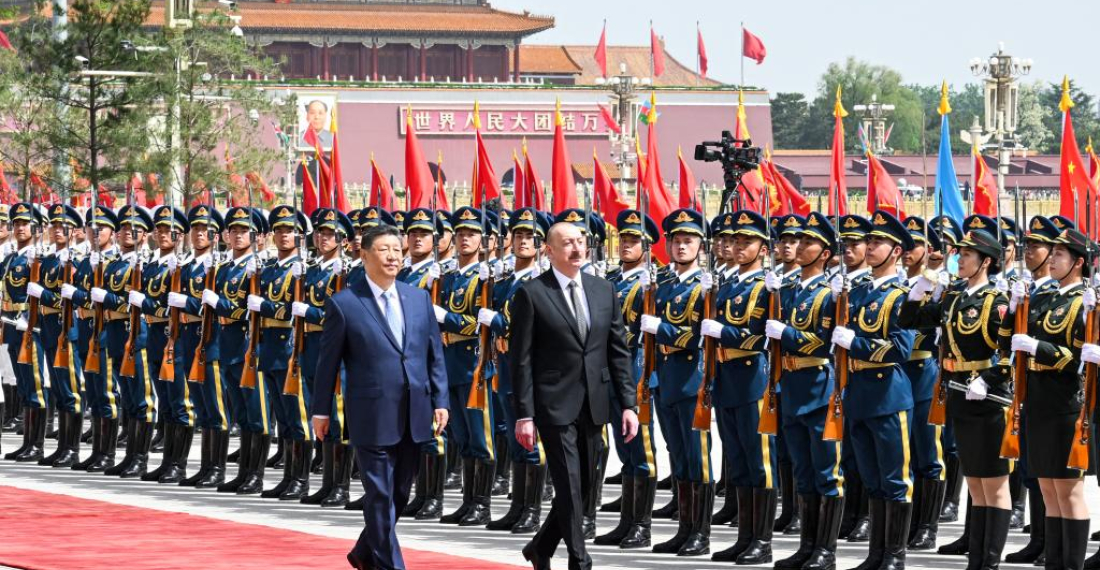
China and Azerbaijan have announced the establishment of a comprehensive strategic partnership between the two countries following talks between Chinese President Xi Jinping and Azerbaijani President Ilham Aliyev in Beijing on 23 April. During the talks, President Xi said that both sides should continuously enhance political mutual trust, deepen practical cooperation and strengthen international collaboration to open a new chapter of all-round cooperation. President Aliyev was in China for  a state visit between 22 and 24 April.

According to the Xinhua News Agency, President Xi added that China supports Azerbaijan in safeguarding its national sovereignty, independence and territorial integrity, and in continuing to follow a development path that suits its national conditions. China is willing to carry out in-depth law enforcement and security cooperation with Azerbaijan to resolutely combat the "three evil forces" of terrorism, extremism and separatism, Xi said.

He called on both sides to strengthen the alignment of development strategies, promote high-quality Belt and Road cooperation, and encourage educational, cultural, tourism, youth and sub-national cooperation.

President Aliyev said Azerbaijan and China have always respected and trusted each other in the face of changes unseen in a century, with bilateral cooperation continuously deepened, economic and trade relations developing rapidly, and local exchanges becoming closer.

According to Xinhua, Aliyev said Azerbaijan stands ready to work with China to promote the building of a comprehensive strategic partnership, expand cooperation concerning the Belt and Road Initiative, digital economy, green energy and science and technology, deepen exchanges between political parties and people of the two countries, and strengthen cooperation in international and regional affairs.

After the talks, the two heads of state signed a joint statement on establishing a comprehensive strategic partnership between the two countries, and witnessed the signing of 20 documents on cooperation in areas such as the Belt and Road Initiative, justice, green development, digital economy, intellectual property rights and aerospace.


China and Azerbaijan also signed an agreement on mutual visa exemptions for ordinary passport holders in both countries, according to the Chinese Foreign Ministry. The move comes as China has been continuously expanding visa exemptions for a growing number of countries. 

During the talks with Aliyev, Xi said China is willing to work with Azerbaijan to safeguard the international system with the United Nations at its core and the international order based on international law, firmly protect respective legitimate rights and interests, and defend international fairness and justice.

Previously on April 11 when meeting with Spanish Prime Minister Pedro Sanchez in Beijing, President Xi also said that there is no winner in a tariff war, and going against the world will only result in self-isolation, according to Xinhua. 
Source: commonspace.eu with agencies. Photo: Chinese President Xi Jinping holds a welcome ceremony for Azerbaijani President Ilham Aliyev at the square outside the east gate of the Great Hall of the People prior to their talks in Beijing, capital of China, April 23, 2025.  (Xinhua/Rao Aimin)

Related articles

Editor's choice
News
UAE says it will withdraw from Yemen, but division emerges in Yemeni presidential council

UAE says it will withdraw from Yemen, but division emerges in Yemeni presidential council

In a move seen as an attempt to de-escalate a crises with Saudi Arabia, the United Arab Emirates, on Tuesday (30th December) announced that it was heeding a call to withdraw its troops from Southern Yemen. UAE says that its presence included counter-terrorism teams that were crucial in fighting against Islamist groups. UAE sources said that parts of Yemen not controlled by the Houthis have had Al Qaeda in the Arab Peninsula (AQAP) operatives using the territory to launch attacks on Europe, the US and Middle East. UAE teams have co-ordinated with American and British special forces and intelligence. The sources added that Emirati forces and their Yemeni allies also helped reverse Houthi gains in the south. including the liberation of Aden port. The small UAE contingent has remained in place since the UAE withdrew most of its military personnel in 2019. The leading English-language newspaper in Abu Dhabi, The National, said that the main UAE force was based at Riyan Mukalla International Airport, with access to fixed-wing aircraft and helicopters, but also operated smaller contingents in the port town Balhaf and Shabwa. "It is understood it also flew a number of drones from the airbase that were able to track terrorist movements, pass information back to its allies and assisted special forces' missions." Meanwhile a division has emerged in Yemen's presidential council after four members denounced what they called the 'unilateral decisions' by the chairman. Four of Yemen’s eight Presidential Leadership Council members on Tuesday denounced an announcement by the council’s chairman accusing him of breaching the governing agreement. Tension between Yemeni leaders has been rising for weeks, underscoring the fragility of the country's already fractured political landscape and further complicating efforts to confront the Iran-backed Houthi rebels. The latest rift took an unprecedented turn on Tuesday morning, marked by a Saudi-led coalition “limited operation” striking combat vehicles Riyadh linked to the Southern Transitional Council, which has three members in the PLC. The PLC Chairman, Rashad al Alimi, on Tuesday said that he was seeking to cancel the joint defence agreement with the UAE. “What has been issued … constitutes a clear violation of the Declaration of the Transfer of Power [agreement], which explicitly stipulates that the Presidential Leadership Council is a collective body whose decisions are taken by consensus, or by majority when consensus is not possible,” the statement by the four members said. “It does not, under any circumstances, allow for unilateral decision-making on sovereign, military, or major political matters." The statement was signed by STC chief Aidarous Al Zubaidi, Faraj Al Bahsani, Tariq Saleh and Abu Zaraa al Muharrami. (click the picture to read the full article).

Popular

Editor's choice
News
UAE says it will withdraw from Yemen, but division emerges in Yemeni presidential council

UAE says it will withdraw from Yemen, but division emerges in Yemeni presidential council

In a move seen as an attempt to de-escalate a crises with Saudi Arabia, the United Arab Emirates, on Tuesday (30th December) announced that it was heeding a call to withdraw its troops from Southern Yemen. UAE says that its presence included counter-terrorism teams that were crucial in fighting against Islamist groups. UAE sources said that parts of Yemen not controlled by the Houthis have had Al Qaeda in the Arab Peninsula (AQAP) operatives using the territory to launch attacks on Europe, the US and Middle East. UAE teams have co-ordinated with American and British special forces and intelligence. The sources added that Emirati forces and their Yemeni allies also helped reverse Houthi gains in the south. including the liberation of Aden port. The small UAE contingent has remained in place since the UAE withdrew most of its military personnel in 2019. The leading English-language newspaper in Abu Dhabi, The National, said that the main UAE force was based at Riyan Mukalla International Airport, with access to fixed-wing aircraft and helicopters, but also operated smaller contingents in the port town Balhaf and Shabwa. "It is understood it also flew a number of drones from the airbase that were able to track terrorist movements, pass information back to its allies and assisted special forces' missions." Meanwhile a division has emerged in Yemen's presidential council after four members denounced what they called the 'unilateral decisions' by the chairman. Four of Yemen’s eight Presidential Leadership Council members on Tuesday denounced an announcement by the council’s chairman accusing him of breaching the governing agreement. Tension between Yemeni leaders has been rising for weeks, underscoring the fragility of the country's already fractured political landscape and further complicating efforts to confront the Iran-backed Houthi rebels. The latest rift took an unprecedented turn on Tuesday morning, marked by a Saudi-led coalition “limited operation” striking combat vehicles Riyadh linked to the Southern Transitional Council, which has three members in the PLC. The PLC Chairman, Rashad al Alimi, on Tuesday said that he was seeking to cancel the joint defence agreement with the UAE. “What has been issued … constitutes a clear violation of the Declaration of the Transfer of Power [agreement], which explicitly stipulates that the Presidential Leadership Council is a collective body whose decisions are taken by consensus, or by majority when consensus is not possible,” the statement by the four members said. “It does not, under any circumstances, allow for unilateral decision-making on sovereign, military, or major political matters." The statement was signed by STC chief Aidarous Al Zubaidi, Faraj Al Bahsani, Tariq Saleh and Abu Zaraa al Muharrami. (click the picture to read the full article).