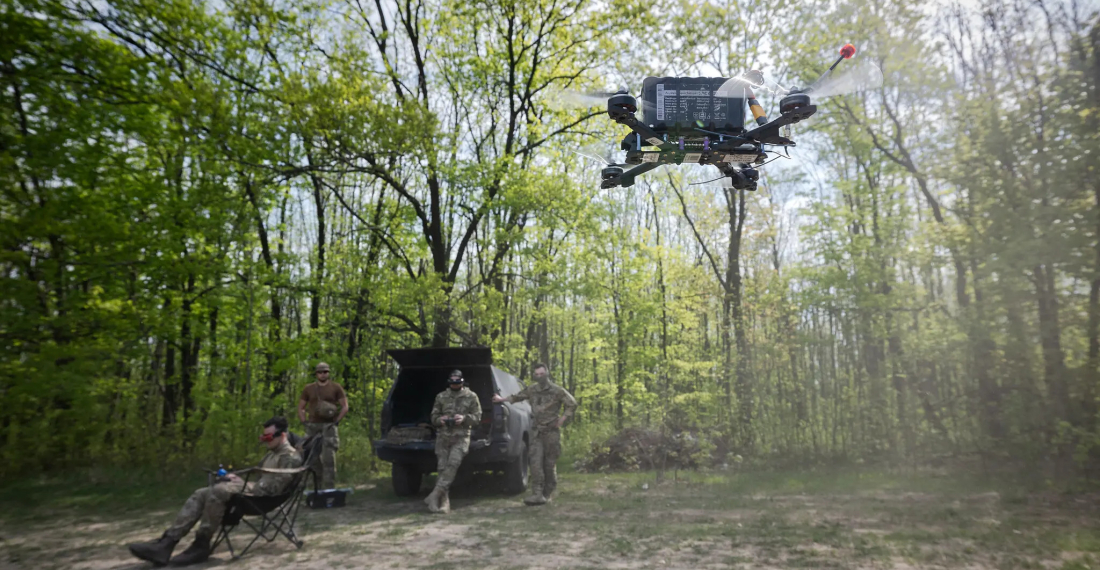
On Thursday (12 March), Ukraine’s Minister of Defence Mykhailo Fedorov announced that Ukraine will open access to its battlefield data to help train artificial intelligence (AI) models. Ukrainian military data will be made available to Ukrainian companies and firms in allied nations to train AI systems, while the Ukrainian Ministry of Defence will retain possession of underlying datasets. The decision to commit military data and drone videos towards AI system developments reflects a broader technological competition regarding technological innovation in the ongoing Russia-Ukraine war.
This announcement reflects military trends across the globe that aim to place AI systems at the forefront of military strategy. Visual data trains AI systems to recognise patterns, shapes, and behaviours on the battlefield. This training contributes to the development of precise algorithms that can operate drones to targets or analyse large pools of battlefield data.
Ukrainian Minister of Defence Fedorov sees Ukraine in a unique position, stating that it has an “array of battlefield data that is unmatched anywhere else in the world”, after four years of fighting Russia’s full-scale invasion. He hopes that releasing battlefield data for AI development will allow the Ukrainian military to “outperform Russia in every technological cycle”.
Some of the battlefield data that will be released by the Ukrainian military includes drone videos that capture attacks on soldiers and military equipment like tanks, vehicles, and surveillance footage. With access to these videos, companies will be able to recognise patterns and behaviours to incorporate into the training of AI systems for recognition and training.
According to Ukrainian officials, the use of lethal force from the Ukrainian army will still be overseen and determined by humans. Advocates say AI targeting systems could improve the precision of strikes and help analyse large volumes of surveillance data. However, permitting the use of real-life battlefield videos has also raised concerns regarding the ethics of depicting drones targeting people and leaking sensitive data.
Source: commonspace.eu with Reuters and The New York Times