


A very dangerous moment - in fiction and in fact!

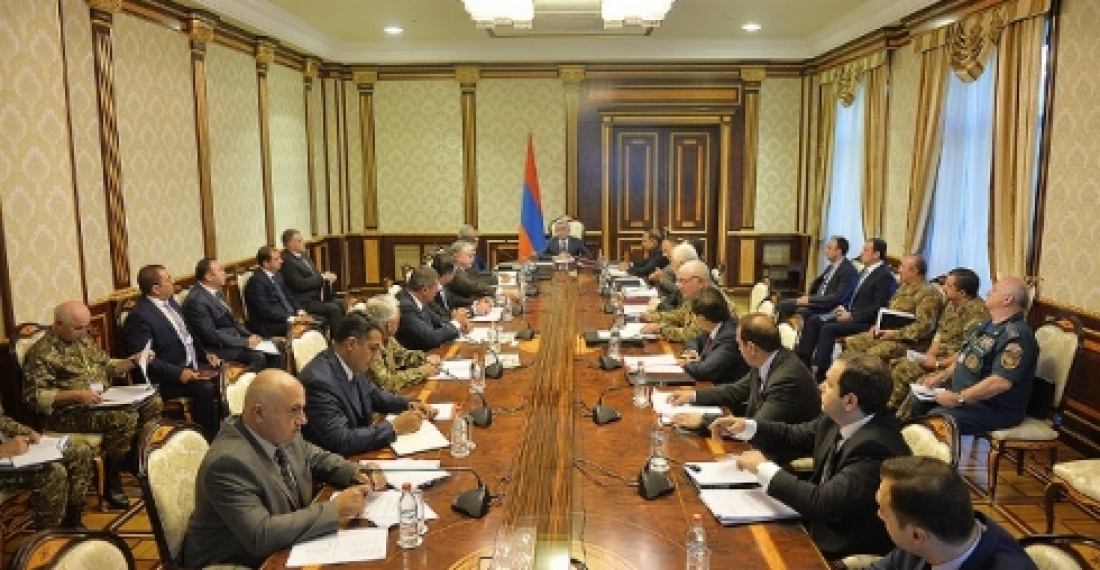
The President of Armenia Serzh Sargsyan on  Thursday evening (3 September), chaired a meeting of Armenia's National Security Council. It was part of an ongoing training exercise called "Shant 2015" that is meant to test the readiness of Armenia's command and control system in the face of agression from an unnamed adversary. The exercise involves also evacuating large numbers of civilians from areas where this fictitious conflict is supposed to be taking place. That is where fiction ends. On Thursday however, apart from reviewing and participating in the exercise, the Armenian President and his entourage also had to deal with the facts: a hightened state of tension on the front line between Armenian and Azerbaijani forces in the Nagorno-Karabakh conflict zone and across other parts of the border. It was reported that the President heard reports of the situation and gave instructions to his commanders.

Armenia continues to report incidents and casualties, especially in the northern sector of its border with Azerbaijan. It claims that Azerbaijani forces fired more than 1800 shots towards its positions in the last twenty four hours and that one soldier and three civilians were injured. It had already reported one military dead and several civilians injured the night before. Fact and fiction blended together especially in areas in Tavoush district where people were reportedly confused as to what was happening as part of an exercise and what was happening in fact. The spokesperson for the Armenian Ministry of Defence called for calm, and said there was no need to panic because whilst there was tension on the border, a lot of what was going on was simply a training exercise.

Azerbaijan is currently also holding its own training exercises, involving a large number of aircraft from Azerbaijan and Turkey. These are due to continue until next week. It also accuses Armenia of violating the cease fire, and claims that last night the rooftops of 150 houses were riddled with bullets in the village of Alibeyli in the Tovuz District and that two elderly persons were hit by schrapnel and hospitalised.

There is no doubt that this is a very dangerous moment in the Karabakh conflict.  The military exercises being held by both sides add drama to the real fighting that is ongoing and close the gap between fact and fiction. It is not going to require much for fiction to become fact.

source: commonspace.eu

photo: Armenian President Serzh Sargsyan at a meeting of the Armenian National Security Council held on 3 September 2015 as part of a large scale military exercise called Shant 2015. In the course of the meeting the President however also had to deal with a number of real incidents happening on the front line (picture courtesy of the Press Service of the Republic of Armenia).


Related articles

Editor's choice
News
Despite crisis, Lebanon takes the lead to become first country in the Middle East to abolish the death penalty

Despite crisis, Lebanon takes the lead to become first country in the Middle East to abolish the death penalty

Lebanon's parliament has voted to abolish the death penalty, a move that would make it the first country in the Middle East to formally end capital punishment. A majority of MPs in the 128-seat parliament backed the measure on Tuesday (11 August), while Hezbollah's parliamentary bloc voted against it. The legislation will now go to the cabinet before being passed to President Joseph Aoun for signing. The government has already expressed its support for the measure. Lebanon has not carried out an execution since January 2004, although courts have continued to hand down death sentences. Rights groups estimate that more than 78 people remain on death row. Under the new legislation, capital punishment will be replaced with life imprisonment with hard labour. However, the legislation does not yet set out in detail how the new sentence would be enforced. Hard labour is already written into Lebanese law but has rarely been implemented in recent years. The country's financial crisis and overcrowded prisons have limited the authorities' resources and capacity. The latest legislation follows years of campaigning by civil society groups and lawyers for the removal of capital punishment from Lebanese law. (click image to read more)

Popular

Editor's choice
Interview
Thursday Interview: Murad Muradov

Thursday Interview: Murad Muradov

Today, commonspace.eu starts a new regular weekly series. THURSDAY INTERVIEW, conducted by Lauri Nikulainen, will host  persons who are thinkers, opinion shapers, and implementors in their countries and spheres. We start the series with an interview with Murad Muradov, a leading person in Azerbaijan's think tank community. He is also the first co-chair of the Action Committee for a new Armenian-Azerbaijani Dialogue. Last September he made history by being the first Azerbaijani civil society activist to visit Armenia after the 44 day war, and the start of the peace process. Speaking about this visit Murad Muradov said: "My experience was largely positive. My negative expectations luckily didn’t play out. The discussions were respectful, the panel format bringing together experts from Armenia, Azerbaijan, and Turkey was particularly valuable during the NATO Rose-Roth Seminar in Yerevan, and media coverage, while varied in tone, remained largely constructive. Some media outlets though attempted to represent me as more of a government mouthpiece than an independent expert, which was totally misleading.  Overall, I see these initiatives as important steps in rebuilding trust and normalising professional engagement. The fact that soon a larger Azerbaijani civil society visits to Armenia followed, reinforces the sense that this process is moving in the right direction." (click the image to read the interview in full)

