


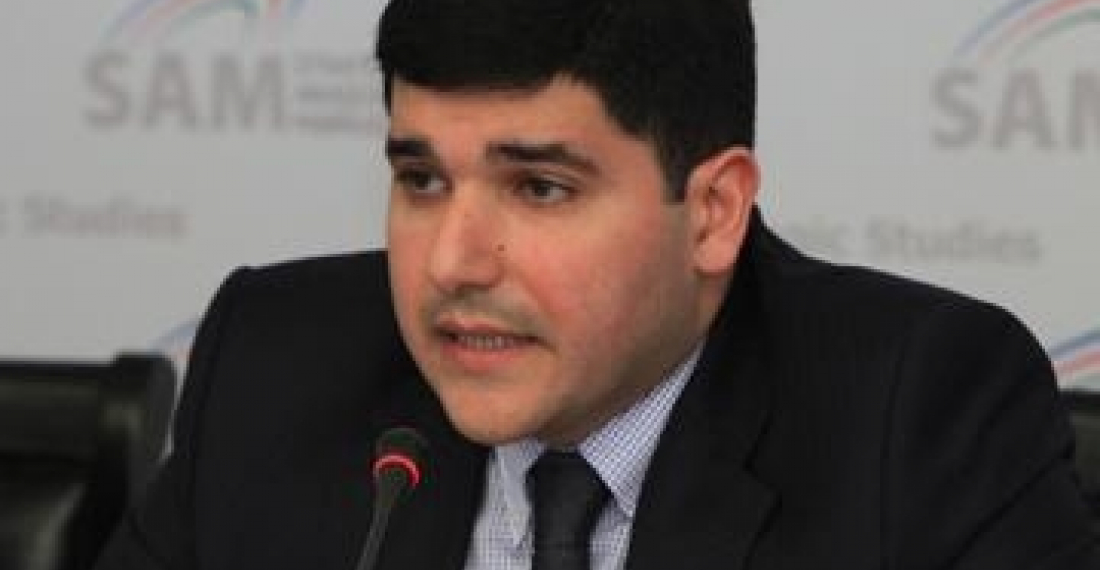
"Stop turning a blind eye to the reality and be brave enough to call things by their names." Farhad Mammedov writes in New Europe.

This op-ed by Farhad Mammadov, Director of the Center for Strategic Studies under the President of Azerbaijan is reprinted from the Brussels based newspaper "New Europe".

The issue of Ramil Safarov, the Azerbaijani officer who has been extradited to Azerbaijan and pardoned by the Presidential decree on 31 August 2012, created groundless hysteria and stir around it nowadays. The most important thing is that there is a lot of false information in what international media writes about the release of the Azerbaijani officer, and the background of this story, also the unrevealed reasons forcing the Azerbaijani officer to kill the Armenian officerremains unknown to a large public.

Azerbaijani officer Ramil Safarov and Armenian officer Gurgen Margaryan were attending the NATO-sponsored English-language courses in Budapest in 2004. Gurgen Margaryan and another Armenian officer Ayk Makuchyan, throughout the whole course, have been publicly insulting the Azerbaijani nation, flag and the memory of the victims of Khojaly genocide where Ramil lost his family members as well.

It has to be stressed that being a child, Ramil Safarov witnessed brutal killing of his family members in front of his eyes in the occupied territories of Azerbaijan, where he was born, and invasion of his home town followed by a difficult life as an internally displaced person.

Therefore, the crime perpetrated by R.Safarov was not ethnically motivated, as Armenian mass media is trying to propagate, but was a result of open provocations and insults towards the Azerbaijani nation. By pouring the propaganda of "ethnically motivated crime", the Armenian officials try to create an impression that Azerbaijan is a country where the killing of Armenian is justified, and for this reason the international community must not allow Azerbaijan to return its Nagorno-Karabakh region. In reality, few people is aware of the fact that there are more than 30.000 ethnic Armenians currently living safely in Azerbaijan, while there is no single Azerbaijani left in Armenia.

According to the decision of Budapest court, R.Safarov has been convicted to life sentence and served 8.5 years of imprisonment in Budapest. The Azerbaijani Government, after long years of negotiations with the Hungarian authorities on the extradition of R.Safarov to Azerbaijan finally agreed on his extradition on the basis of 1983 Strasbourg Convention on the Transfer of Sentenced Persons.

Upon his arrival to Azerbaijan, R.Safarov was pardoned by the Presidential decree in accordance with the Constitution of Azerbaijan which gives the right to the President to pardon any convicted person. Consequently, there has not been any violation of international or national legislation in the process of extradition and pardoning of R.Safarov. Article 12 of Strasbourg Convention states: "Each party may grant pardon, amnesty or commutation of the sentence in accordance with its Con-stitution or other laws". At the same time, item 22 of article 109 of the Constitution of the Republic of Azerbaijan states that the President has the right to "grant pardon".

The most deplorable side of this story is that those demanding today the punishment of R.Safarov and blaming Azerbaijan for the release of its officer have not demanded the sentence of the murders of 613 innocent civilians (mostly children, women and elderly persons) brutally killed by the Armenian armed forces in Azerbaijani town of Khojaly, in February 1992. They also failed to make statements on the killing of a 9 years old Azerbaijani boy, Fariz Badalov, who was shot in his head by an Armenian sniper in March 2011 and then 13 years old girl, Aygun Shahmaliyeva died in July 2011 as a result of explosiono f a booby-trapped toy sent via Tovuzchay River from the territory of Armenia.

One also wonders why there is no condemnation for the April 23, 2001 release of Varoujan Garabedian, a terrorist responsible for Orly airport attack in 1983 that killed eight civilians andconvicted to life imprisonment in France, and hisextradition to Armenia where he was not bornand did not have family connections. He was welcomed by then Armenian president Kocharian, and made into a national hero.

No one can explain also why another murderer MonteMelkonian, who was responsible for the assassination of several Turkish diplomats in Europe as well as the innocent civilians in Nagorno-Karabakh region of Azerbaijan, is glorified by the Armenian Government through erecting hismonuments across Armenia. We don't want todraw a parallel between the aforementioned terrorists and officer R.Safarov; also, we do not intend to justify a crime. Our intention is to present a wider picture of the case and factors leading it, which was deliberately kept out of sight.

We wish that those naming this extradition as a "threat to regional peace and security" would finally understand the reality that the regionalpeace and security in our region is threatened by military aggression of Armenia against Azerbai-jan, continued occupation of 1/5 territory of Azerbaijan, and ethnic cleansing of hundreds of thousands of Azerbaijani civilians. So, stop turning a blind eye to the reality and be brave enough to call things by their names.


source: This article is reprinted in full from the Newspaper New Europe as was republished by news.az.


Related articles

Editor's choice
News
Borrell tells the European Parliament that the situation in Afghanistan was critical, but the EU will remain engaged

Borrell tells the European Parliament that the situation in Afghanistan was critical, but the EU will remain engaged

Borrell underlined that the European Union will make every effort to support the peace process and to remain a committed partner to the Afghan people. "Of course, we will have to take into account the evolving situation, but disengagement is not an option.  We are clear on that: there is no alternative to a negotiated political settlement, through inclusive peace talks.
Editor's choice
News
NATO Chief says war is on Europe's doorstep, and warns against complacency

NATO Chief says war is on Europe's doorstep, and warns against complacency

Russia could attack a Nato country within the next five years, the Secretary General of NATO, Mark Rutte, said in a stark new warning. "Nato's own defences can hold for now," Rutte warned in Berlin, but conflict was "next door" to Europe and he feared "too many are quietly complacent, and too many don't feel the urgency, too many believe that time is on our side. "Russia is already escalating its covert campaign against our societies," Rutte said in a speech in Germany. "We must be prepared for the scale of war our grandparents or great-grandparents endured." Earlier this month, Russia's President Vladimir Putin said his country was not planning to go to war with Europe, but it was ready "right now" if Europe wanted to - or started a war. But similar reassurances were given by Moscow in 2022, just before 200,000 Russian troops crossed the border and invaded Ukraine. Putin has accused European countries of hindering US efforts to bring peace in Ukraine - a reference to the role Ukraine's European allies have recently played in trying to change a US peace plan to end the war, whose initial draft was seen as favouring Russia. But Putin was not sincere, Nato's secretary-general said in the German capital, Berlin. Supporting Ukraine, he added, was a guarantee for European security. "Just imagine if Putin got his way; Ukraine under the boot of Russian occupation, his forces pressing against a longer border with Nato, and the significantly increased risk of an armed attack against us." Russia's economy has been on a war footing for more than three years now - its factories churn out ever more supplies of drones, missiles and artillery shells. According to a recent report by the Kiel Institute for the World Economy, Russia has been producing each month around 150 tanks, 550 infantry fighting vehicles, 120 Lancet drones and more than 50 artillery pieces. The UK, and most of its Western allies, are simply not anywhere near this point. Analysts say it would take years for Western Europe's factories to come close to matching Russia's mass-production of weapons. "Allied defence spending and production must rise rapidly, our armed forces must have what they need to keep us safe," the Nato chief said.

Popular

Editor's choice
News
NATO Chief says war is on Europe's doorstep, and warns against complacency

NATO Chief says war is on Europe's doorstep, and warns against complacency

Russia could attack a Nato country within the next five years, the Secretary General of NATO, Mark Rutte, said in a stark new warning. "Nato's own defences can hold for now," Rutte warned in Berlin, but conflict was "next door" to Europe and he feared "too many are quietly complacent, and too many don't feel the urgency, too many believe that time is on our side. "Russia is already escalating its covert campaign against our societies," Rutte said in a speech in Germany. "We must be prepared for the scale of war our grandparents or great-grandparents endured." Earlier this month, Russia's President Vladimir Putin said his country was not planning to go to war with Europe, but it was ready "right now" if Europe wanted to - or started a war. But similar reassurances were given by Moscow in 2022, just before 200,000 Russian troops crossed the border and invaded Ukraine. Putin has accused European countries of hindering US efforts to bring peace in Ukraine - a reference to the role Ukraine's European allies have recently played in trying to change a US peace plan to end the war, whose initial draft was seen as favouring Russia. But Putin was not sincere, Nato's secretary-general said in the German capital, Berlin. Supporting Ukraine, he added, was a guarantee for European security. "Just imagine if Putin got his way; Ukraine under the boot of Russian occupation, his forces pressing against a longer border with Nato, and the significantly increased risk of an armed attack against us." Russia's economy has been on a war footing for more than three years now - its factories churn out ever more supplies of drones, missiles and artillery shells. According to a recent report by the Kiel Institute for the World Economy, Russia has been producing each month around 150 tanks, 550 infantry fighting vehicles, 120 Lancet drones and more than 50 artillery pieces. The UK, and most of its Western allies, are simply not anywhere near this point. Analysts say it would take years for Western Europe's factories to come close to matching Russia's mass-production of weapons. "Allied defence spending and production must rise rapidly, our armed forces must have what they need to keep us safe," the Nato chief said.

