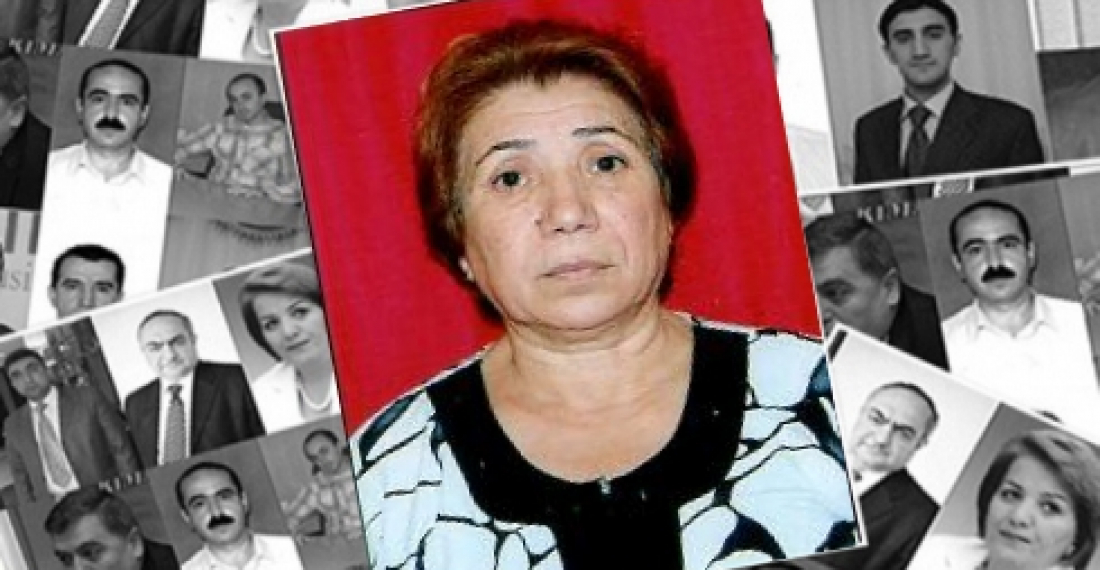
Sevda Ibrahimova "We are Muslims and can easily forget the hurt done against us"

http://www.commonspace.eu/user_upload/karabakh_interviews_collage_final.jpg


Karabakh: The big debate

Commonspace.eu today publishes the 12th in a series of twenty interviews with key personalities from Nagorno-Karabakh. The interviews give a vivid, even if sombre picture, of the attitude of Armenians and Azerbaijanis from Karabakh whose lives have been deeply affected by the conflict, and whose destiny will be at the heart of any future conflict settlement. Those interviewed sometimes use harsh language. Their opinion is almost inevitably controversial, as are sometimes their biographical notes. However it is through listening to these opinions that a path through the labyrinth that is the Karabakh conflict can be found. A full editorial policy of commonspace.eu is available at the About Us section. The next interview in the series will be with Armen Sargsyan, Head of Standing Committee on Science, Education, Culture, Youth and Sport and Head of the ARF-Dashnaktsutyun Party Faction in the Nagorno-Karabakh Republic Parliament.


Interview with Sevda Ibrahimova

Sevda Ibrahimova was born in 1949 in Seyidli village, Aghdam district, which is still under Armenian occupation and has been completely destroyed. She graduated from the Medical Technical School in Aghdam and worked in her village until 1993. Armenian military forces killed her unarmed husband and son during the conflict. After the Armenian invasion of her village she settled in Baku and lives in the dormitory. She has three children.

Biographical notes are provided by the interviewees themselves.

Can you summarize your overall position on the Karabakh conflict and the conflict resolution process:

Nagorno-Karabakh is an integral and historical part of Azerbaijan. There was no country called Armenia on the political map of the world before. To my understanding of the Nagorno-Karabakh conflict, Armenia - with the help of the international superpowers - want to annex some parts of Azerbaijan and make them their own. They stole our music and songs, our cuisine and foods. Even in the Eurovision song contest, they tried to steal our songs. When the conflict started the Armenian community in Nagorno-Karabakh were trying to get an autonomous status, and now they want to be independent. I remember a tragic event that happened in 1965, one Azerbaijani family on their way to Shusha were stopped by Armenians and killed in their car, and during this time there was peace. We see that the UN and other international organisations are keeping blind eyes to everything, they come here often but don't resolve anything. If we can't reach peace through all these missions, the last resort is the military option, but this depends on the Supreme Commander of Azerbaijan [the President].

In the long term do you want to see Nagorno-Karabakh as (a) an independent state, (b) as part of Armenia, (c) as part of Azerbaijan, (d) none of the above but in an as of yet undefined status. Comment on your choice:

(c). It is a vivid fact that Nagorno-Karabakh is part of Azerbaijan, the political history of the region and the United Nations well confirm this legal fact, so Nagorno-Karabakh must be part of Azerbaijan. I don't know if when we return to live there whether it will be peaceful or not, this is still unclear to me. But because we are Muslims and can easily forget the hurts done against us, we desire only to live peacefully with the Armenians in Nagorno-Karabakh and to coexist with them.

What is your biggest objection/concern to Nagorno-Karabakh being independent or part of Armenia or under some as of yet undetermined status that is not part of Azerbaijan:

We were attacked, I lost my husband, my son, my house, everything you can imagine in my land. So what kind of independence should I talk about being given to Armenians there through invasion of our homeland and torture, humiliation and massacre of Azerbaijanis? Armenia with its bosses pursued an official ethnic cleansing policy against Azerbaijanis. This is my objection.

Were you directly involved in the armed hostilities between 1989-94? If yes in what capacity?

At that time I was a young lady and my children were small kids. My husband was killed and then my 14 year old son, we couldn't even bury him properly according to Islamic rules. So we witnessed how the military regiment in Khojaly, Number 366, tortured and killed innocent people and that's why people including us got scared and decided to run away when Armenia attacked, so as not to become hostages or captured or killed. Our men decided to guarantee our safety by sending us away, and that's how we came here.

How do you evaluate the work of the OSCE Minsk Process?


Very bad. If I catch them [puts hands around her throat] I will strangle them! They often come here in cars visiting the region all the time but with no results. A 9-year-old child Fariz Badalov was shot by an Armenian sniper in Orta Garvand of Aghdam recently, and a young girl was killed by a bomb hidden inside a toy in a border village of the Tovuz district. All this is visible to the UN, why don't they find a way to resolve this? You have come here and witnessed this whole situation with your own eyes, and you can understand what has happened. The UN is doing the same thing - they come here, they interview the people and collect the facts - but nothing is coming out of their mission. This is a real pity. [Do you mean OSCE Minsk Group when you say UN?] They are the same. The decisions from the UN are not fulfilled, and the OSCE are also coming here with no results. If there were not other external forces behind Armenia, even I as a female am able to give a counter-response to Armenia [With violence?] Yes of course!   

Do you have a publicly expressed position on the Madrid Principles?

I am not familiar with that document. The only thing that I know is that it has no result.

Do you think that it is important/appropriate that the de facto authorities of the Nagorno-Karabakh Republic be part of the peace process facilitated by the Minsk Group? If yes should they be there instead of the Armenian Government?


That authority cannot be accepted. I cannot understand, is there a dual power in Nagorno-Karabakh? It is our region, so it must be run from Baku. For example, you came here to our house, and our house is open to you - you can stay here, drink your tea, watch our TV - imagine then that sometime later you tell me to get out of my house because you want to take my house. This is the Armenian attitude, their behavior was like this, in Shusha and other places it was like that. This is yours? [picks us Dictaphone] Can I say that this is mine? Armenians would say that now this is mine.

Sometimes the possibility is mentioned that the territories around Nagorno-Karabakh under Armenian control since 1994 should be returned to Azerbaijan as part of an interim peace agreement, leaving the issues of the status of Nagorno-Karabakh to a later date. Do you have an opinion on this issue?


This is really important. When I just picked up your belonging now [referring to Dictaphone], I had to return it back to the same place on the table. This is almost the same, they occupied the territories in front of everyone's eyes, so now they must return them. 

What is your opinion with regards to the role of Turkey, Russia, Iran, the United States, the European Union or any other country or international organisation, or the international community in general, with regards to the Karabakh conflict and its settlement:


Since the US and Russia are superpowers and the strongest international actors, they want to establish their rule over other countries. When a country wants to decide their own destiny, the US and Russia intervene. This is their self-appointed global mission. When other countries suffering similar conflicts wanted to support Azerbaijan, the superpowers try to punish them as well by using different methods. Turkey is good and a big country, if there was no Turkey the Armenians would probably have already killed all the Azeris. The Iranians have two faces, sometimes supportive to us but in most cases supportive to the other side. Officially they recognize the territorial integrity of Azerbaijan, but behind the scenes they do what they want to do against Azerbaijan and support Armenia.

How do you evaluate the role of informal, NGO-level contributions to the peace process? Do you believe that informal contacts have a useful role to play prior to or after a formal agreement?

Whatever NGO it is, if they really try to build confidence and bring justice, presenting the real facts and truths to others, I really appreciate this activity. But if they want to irritate the people to again square off against each other, of course I don't appreciate that.

Do you have a position on the desirability or not of free movement of Armenians and Azeris between their two countries before a final peace agreement?

Not before the final peace agreement.

Do you think that Armenians and Azerbaijanis will ever be able to live together peacefully in Karabakh again in the future?


It has happened five times in one century - a conflict and then resolution between the two nations - and as we are Muslims, we can come to a conciliation to live together again. Armenians understand how wonderful a place Nagorno-Karabakh is, so they will never want to leave there. 

What is your opinion on the issue of return of refugees/IDPs to Nagorno-Karabakh?
 
If we reach a final peace agreement after the return of our territories, in my understanding it will be very possible - with the help of other rich countries - to rebuild the region and encourage the people to return there. Sometimes I think, lets just get the land back so I can dig a hole there and live in it - I don't need a house - that would be enough for me, it would just be better to be back in my homeland.


(c) commonspace.eu


Read previous interviews in this series:

Artur Tovmasyan

Bayram Safarov

Masis Mayilian

Rovshan Rzayev

Vahram Atanesyan

Havva Mammadova

Gegham Baghdasaryan

Kerim Kerimli

Sergey Ghazaryan

Arif Aliyev

Hrant Melkumyan

Sevda Ibrahimova

Armen Sargsyan       

Anar Usubov             

Hayk Khanumyan


Vagif Jahangirov      

Latest

Editor's choice
Monday Commentary
Monday Commentary: PEACE IN OUR TIME?

Monday Commentary: PEACE IN OUR TIME?

Making peace between Armenia and Azerbaijan was never going to be simple, nor easy, nor quick. It is taking time, writes Dennis Sammut in this Monday Commentary. “There is a sense of realism coming from the leaders of the two countries – President Ilham Aliyev of Azerbaijan and prime minister Nikol Pashinyan of Armenia, that frankly, is necessary and welcome”, he writes. At a time when conflicts are raging all over the world – from Ukraine to the Gulf, from Africa to South Asia, the prospect that Armenia and Azerbaijan had finally, after decades of conflict that left thousands of dead and many more displaced, decided on embarking on a journey of peace was welcomed. Peace between Armenia and Azerbaijan can be top-down up to a point. Both leaders have spent political capital preparing for a peace deal. But both are aware that their people are not ready for peace yet. In fact, in Armenia, most of the elite are negative toward a peace deal with Azerbaijan. Pashinyan needs time to persuade his countryfolk. That is why 2031 is realistic. Ilham Aliyev runs a tighter shop, but he is also not immune to public opinion. Every time someone hits a landmine in Karabakh, which unfortunately happens often, peace comes into question. Which is why Aliyev chooses to sound hardline, more often than not. In pursuing the peace agenda, both Aliyev and Pashinyan need to proceed cautiously. But they are right in making peace the central issue in their agenda. It is the main issue, and the one that will define them in history. So forward, cautiously but resolutely! In pursuing the peace agenda, Aliyev and Pashinyan need to be supported clearly and unambiguously. There are too many people in Baku and Yerevan who are sitting on the sides, waiting. The international community is not doing enough. It is time to be counted. Otherwise, the spoilers will win, and the region will go back to its bad habits. (Click the image to read the full commentary).
Editor's choice
News
UN Security Council Presidential Statement on the Role of Diplomacy during Active Hostilities

UN Security Council Presidential Statement on the Role of Diplomacy during Active Hostilities

The United Nations Security Council is today expected to adopt a presidential statement on the role of diplomacy during active hostilities. The draft text, which was authored by Pakistan, underscores the importance of maintaining diplomatic engagement even after the outbreak of armed conflict, with a view to containing escalation, facilitating cessations of hostilities and ceasefires, and creating conditions conducive to peaceful political settlements. Resolution 2788 of 22 July 2025, which was initiated by Pakistan, reaffirmed the Council’s commitment to the peaceful settlement of disputes under Chapter VI of the UN Charter. A year later, on 23 July, the Council convened an open debate to review the resolution’s implementation and examine ways of making more effective use of the peaceful dispute settlement tools available under Chapter VI.   The draft presidential statement builds on previous Council products, such as resolution 2788, but it is the first to focus specifically on the role of diplomacy in containing and de-escalating active hostilities. Since the open debate in July, Council members have continued to call for intensified efforts towards de-escalation and dialogue, although differences persist over how proactively the Council should promote mediation and other peaceful means of dispute settlement, particularly in situations where the consent of the parties is contested. In his statement opening the general debate of the 81st session of the General Assembly on 22 September, Secretary-General António Guterres highlighted the devastating consequences of ongoing conflicts in Ukraine, Sudan, and the Middle East, warning that these and other crises illustrate what happens when “force outpaces diplomacy” and stressing the urgency of sustained diplomatic engagement. The negotiations on the draft presidential statement do not appear to have been particularly contentious, although Council members expressed differing views on some elements of the text. Pakistan circulated the initial draft to Council members on 14 October. Following informal consultations with Council members to address comments on the initial draft, Pakistan circulated a first revised draft on 23 October, incorporating several proposed amendments. On 29 October, Pakistan circulated a second revised draft, which it placed under silence procedure until the following day (30 October). After the US broke silence, a third revised draft was circulated on 3 November and placed under silence procedure until this morning (4 November). The draft subsequently passed silence. The agreed presidential statement emphasises the importance of maintaining direct and indirect channels of communication between parties to armed conflict to reduce the risk of miscalculation and create opportunities for sustained political engagement. (click image to read more)

Popular

Editor's choice
Monday Commentary
Monday Commentary: European-Azerbaijan relations need an intensive and multifaceted dialogue that is frank and honest

Monday Commentary: European-Azerbaijan relations need an intensive and multifaceted dialogue that is frank and honest

Last week I visited Baku, Azerbaijan. My visit was relatively short, but very intensive, and had many meetings with stakeholders and colleagues. When I arrived in Baku first time in 1996,  Azerbaijan was a different country: weak, poor, and shaken by defeat in war. For thirty year the Karabakh issue dominated the agenda: the political agenda but also the popular mindset. Now, thirty years later, Azerbaijan has returned to Karabakh, and peace with Armenia is on the horizon. It is a new era for Armenia-Azerbaijan relations, for the South Caucasus, but also for Europe.  But we cannot be complacent: the Peace agreement has been initialed but not signed; borders remain closed; TRIPP is ambitious but remains an idea; and there are spoilers who want to turn the clock back. We must not allow them, and in this Europe and Azerbaijan must work together. Europe’ vanguard organization is the European Union – it is a free union of 27 member states; it is a strong global economic force, and increasingly a diplomatic and military force too. But it remains “work in progress” and can often appear dysfunctional. It often lacks collective and institutional memory. In its dealings with Azerbaijan the EU has made many mistakes – not least opening the delegation here late – in 2008. It sometimes appears condescending. Some utterances from the European Parliament and from some quarters in some member states are not understandable even for me. They irritate the Azerbaijanis, but serve no other purpose But Azerbaijan has also not handled relations with the EU well. It has failed to respond when the hand of friendship reached out; and it confused irritating actions, sometimes by well-meaning people; sometimes by outright spoilers, with strategic action. In short, EU-Azerbaijan relations have suffered from a lack of proper dialogue. This dialogue must be frank, honest and multi-faceted involving different segments of society on both sides.   Is Azerbaijan Europe? When Azerbaijan applied to join the Council of Europe in the 1990s, there were some who opposed, saying this was not Europe. I was one of the people who argued that Armenia and Azerbaijan may be on the periphery of the continent geographically, but were European in essence. Certainly their elites. During the discussion on 4 September in Baku, my friend Farhad Mammedov, mentioned that Azerbaijan is not interested in joining the EU, and was now close to the Central Asian countries in the 5 plus 1 format. Neither things mean that Azerbaijan is not Europe. There are several European countries that are not in the EU, and do not want to be, for example Norway and Switzerland. Iceland has recently voted to stay out of the EU. The UK was a member and left. Europe is bigger than the EU, and the holding of the European Political Community summit in Baku in 2027 proves that. Despite all the rhetoric, I never heard the president of Azerbaijan  saying that Azerbaijan is not Europe, nor have I heard any European president say it either. Not wanting to join the EU and forging close relations with neighbouring regions does not make Azerbaijan any less European. It is only logical that when Europeans talk to Azerbaijan they talk like family. The conversation is often frank. It must also be honest, and Europeans need always to remember this too. A frank, honest and multi-faceted dialogue A frank, honest and multifaceted dialogue will contribute to relations between Azerbaijan and the rest of Europe: it will avoid misperception, which unfortunately is very common on both sides; it will provide a forum where problems can be discussed and resolved, and it will increase mutual trust, so that together common problems can be addressed. (click image to read the full Monday Commentary)
Editor's choice
Monday Commentary
Monday Commentary: “The barren rocks of Aden” and “These lands of Yemen are so ruthless”

Monday Commentary: “The barren rocks of Aden” and “These lands of Yemen are so ruthless”

There are two early 20th-century tunes that mark foreign attempts to occupy and “pacify” Yemen. The Scottish tune “The barren rocks of Aden” marks the mobilisation of Highland soldiers, enlisted to be deployed to the Yemeni port of Aden, that in 1837 became the last colony to be incorporated into the British Empire. The tune talks of the harshness of the terrain, but is celebratory, It was even played as a farewell tune to Sir William Luce at the parade in Sharjah celebrating his end as “British Viceroy” in the Middle East in 1966. The second tune is an Anatolian lament. As Ilker Sezer reminded us this weekend, in his weekly feature on “Turkiye Today”, it “mourns the tragic fate of Ottoman soldiers dispatched to the harsh, remote deserts of Yemen during the fall of the empire, young men who marched away from their villages and never returned home. Most of their names, and numbers, were never recorded. Yet, their fate left a mark on the Turkish psyche.” Subsequent invaders have discovered that Yemen is a grave that cannot be overcome by the strength of modern technology, and that whilst Yemeni society is splintered and divided, building a reliable alliance with Yemeni factions is difficult. These are the harsh lessons facing Saudi Arabia, as the Kingdom faces its biggest challenge in its modern history. The leadership of the Kingdom now has to respond decisively. At stake is their very credibility. This is likely to be a long and messy conflict. Saudi military objectives need to be focused: to box in the Houthis rather than destroy them. This is likely to include: (a) regaining territory lost on the Red Sea coast; (b) control over Bab el Mandeb Strait; (c) some kind of cordon sanitaire on the Saudi-Yemeni border; and if things go well (d) the capture of Sanaa. All this would not eliminate the Houthi problem, but it will contain it. In the end the Saudis will have to continue managing Yemen with a mixture of carrot and stick. For the moment, the stick is likely, but the carrot cannot be forgotten either. (click the image to read the Monday Commentary in full)