This is a commentary prepared by the editorial team of Caucasus Concise a weekly electronic newsletter prepared in collaboration with commonspace.eu.
This has been a tumultuous year for the European Union. The European project in all its different dimensions is being challenged on all fronts, and the Brexit vote in June triggered a period of self- reflection in European capitals that is likely to last for a long time.
It has therefore been something of a wonder that despite all the difficulties, the EU has managed to remain focused on developing its relations with the South Caucasus states, to a point where we can see that 2016 has been an overall successful year in this regard, and things look even brighter for next year.
Some will quickly dismiss this to the fact that bureaucracies tend to maintain momentum, at least for some time, even if the engine has been switched off. Certainly the EU bureaucracy is difficult to turn round speedily - whichever the direction it is going. There are plenty of examples of that in all areas of policy. However, to attribute the new momentum in EU-South Caucasus relations simply to bureaucratic inertia would be hugely incorrect. The bureaucrats have been with their hand on the break vis-à-vis the region for a long time. But a political will to take relations forward is emerging both within the EU, and in the three countries of the South Caucasus themselves, and good people to people relations between EU citizens and Armenians, Azerbaijanis and Georgians are helping the process considerably.
Georgia has always been the most enthusiastic supporter of relations with the EU. The Georgian Prime Minister was in Brussels last week, fresh from a convincing election victory, for a meeting of the Georgia-EU Association Council. The issue of visa liberalisation threatened to overshadow the visit, but in the end it did not. Georgia and the EU now have a substantial co-operation agenda covering a wide range of topics - there is much work to be done. EU officials admired the enthusiasm and the professionalism with which Prime Minister Kvirikashvili and his team are approaching their tasks. There was even a hint of embarrassment in the tone of EU officials, not often known for their modesty, when trying to explain the delays in the granting of visa liberalisation. (read more) The delays were technical in nature. Member states insisted that any further visa liberalisation deals could only happen if a suspension mechanism could be triggered. On this, as on many other matters, EU institutions are obliged to agree as part of a complicated decision making process. On Wednesday (7 December) they finally agreed.
The European Parliament rapporteur for the proposal, Agustín Díaz de Mera (EPP, ES), noted that "the changes agreed provide flexibility for the rapid activation of the suspension mechanism". He also underlined that the deal "will facilitate the immediate consideration of the two visa liberalization proposals for Georgia and Ukraine."
According to the deal, visa requirements may be reintroduced for a non-EU country in one or more of the following cases: a substantial increase in the number of nationals of that country refused entry or irregularly staying in the EU territory; a substantial increase in unfounded asylum applications, or a lack of cooperation on readmissions (returns of migrants). Visas could also be reintroduced in the event of threats to public policy or internal security related to nationals of the third country concerned. (read more)
The informal deal was backed by the Civil Liberties Committee on Thursday by 37 votes to 9, with 2 abstentions. The text still needs to be endorsed by the plenary of the European Parliament, probably next week, and national governments.
Assuming that no further complications emerge the Parliament should be able to vote in the changes before Christmas, and the visa liberalisation arrangement with Georgia will come into force soon after. This is hugely important from the perspective of the Georgians who see this as an important sign of acceptance within the European family.
However, discussions have been moving in a positive direction not only with Georgia, but also with Armenia and Azerbaijan. Here things were more complicated, since in Armenia and in Azerbaijan there remains a certain ambivalence, at least at official level, on relations with the European Union.
With Armenia, after the sudden Armenian decision not to sign the Association agreement with the EU in 2013, the two sides have been searching for ways to take the relationship forward. Armenia subsequently became a full member of the Eurasia Economic Union. This does not in itself constitute an obstacle to relations with the EU, but it adds complications in terms of what can actually be achieved through such co-operation. Discussions on a new framework agreement have now started, and there is a certain positive feeling on both sides these obstacles can be overcome, and that a meaningful agreement - with substance that can impact positively the people of Armenia, can be negotiated. It is early days, but it has been a good start. (read more)
With Azerbaijan too, relations reached a low ebb in 2013, and stayed like that ever since. Over the last months however, thanks not least to many people on both sides who understood the importance of change, relations between the EU and Azerbaijan have improved considerably. Now, it is possible to start discussions on a new strategic partnership with Azerbaijan, and both sides are optimistic that difficult as these discussions are likely to be, they will lead to an agreement in due course. (read more)
The European Union remains a key trading and business partners for all three countries. What is on the agenda is not simply declaratory statements but tangible measures that can improve the lives of millions of Georgians, Armenians and Azerbaijanis. The EU is also the best partner these countries can have as they pursue a modernising agenda, something that all three share and aspire for.
For Armenia and Azerbaijan the European Union is also an essential partner in their quest for a solution of the Karabakh conflict. True, the EU is not a member of the OSCE Minsk Group, and it is the co-Chair of this group that drive this process. However the EU is not a disinterested party either, and its huge experience of dealing with conflicts close to its borders, its political and economic weight, and its sheer proximity to the region, give it a stake in the peace process. (read more)
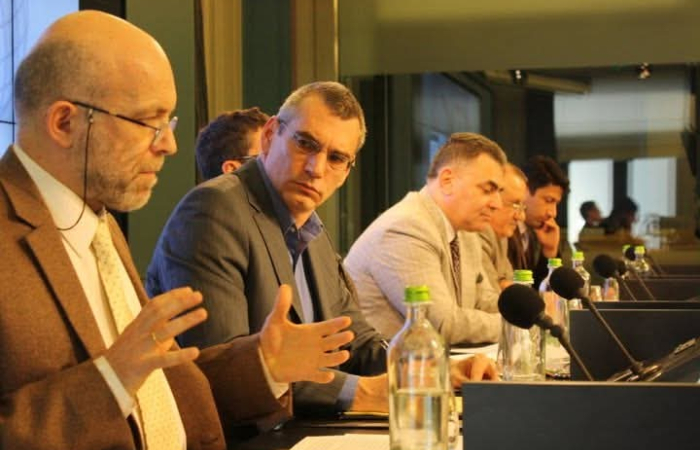
This week in Brussels two small meetings took place highlighting the EU's potential future role. On 6 December, a meeting was held in the framework of the EU supported EPNK programme to discuss peacekeeping and confidence building in the context of the Karabakh conflict and conflict resolution basis. (read more)
On 8 December, the European parliament hosted another meeting this time to discuss the human rights situation in the conflict regions on Europe's eastern borders, including Nagorno-Karabakh. (read more)
At both meetings, Armenian and Azerbaijani stakeholders worked with European counterparts to discuss and develop new ideas which can support the peace process. These were modest initiatives but, they were positive steps. Even such small positive steps were practically impossible only a few weeks ago.
There are those in different places, and for a wide variety of reasons, who do not want to see the European Union's relations with the South Caucasus develop. But for the first time we see a momentum both in the EU and in the region for these relations to go forward. There will be spoilers on the way, but they are less influential than before, and it seems that the tide is turning against them. The visa liberalisation decision will make a huge impact not only in Georgia but also in the wider region, and will prove, as one MEP, Kati Piri, tweeted, "when a country delivers, the EU keeps its promises".
The relations of the European Union with Georgia, Armenia and Azerbaijan are on different trajectories and move at different speeds but in all cases remain fragile - subject to a multitude of internal and external factors that can impact them negatively. Yet as we approach the end of 2016 we can see some important positive signs. The foundations are now there to take this work forward in 2017 and beyond.
source: This is a commentary prepared by the editorial team of Caucasus Concise a weekly electronic newsletter prepared in collaboration with commonspace.eu. To subscribe please send an email to caucasus.concise.newsletter@gmail.com
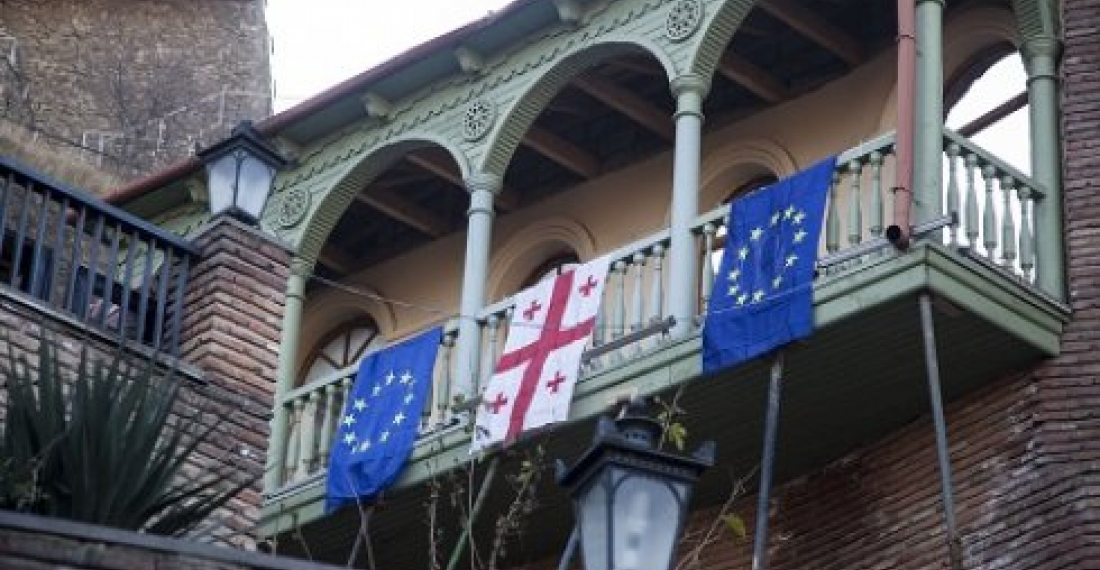
picture: Georgian and EU flags appear on the balcony in Old Tbilisi as news emerges that a final decision on visa free travel for georgians to EU countries may be imminent. (picture courtesy of agenda.ge)