


This is a Flash Analysis published on 3 January 2026 by the European Policy Centre in Brussels. Chris Kremidas-Courtney is a Senior Visiting Fellow at the European Policy Centre.
As 2026 barely takes its first breath, we are already drifting back into an age where great powers manage their own neighbourhoods and look away from everyone else’s. It’s a world order that prizes control over legitimacy and stability over justice until neither one survives.
The most immediate consequence of the US strike on Venezuela may be felt not in Latin America, but first in Ukraine. As foreshadowed in the Trump administration’s National Security Strategy, Washington is intent on rooting its power firmly in the Western Hemisphere while potentially leaving Russia and China greater freedom of action in their ‘backyards’.
Seen through this lens, the strike on Venezuela looks more like part of a broader reversion to regional spheres of influence. The emerging message is that the United States will enforce primacy close to home but its willingness to underwrite security beyond its hemisphere is increasingly transactional and politically fragile. This is a 21st-century version of the 1823 Monroe Doctrine, in which US hemispheric dominance was paired with strategic disengagement from Europe’s wars. It is also the world Putin has long argued for.
It is hard to see an upside for Europe, but there may be one small silver lining. Prior to the strike, Caracas had been demonstrating how a sanctioned regime could survive and adapt by embedding itself into alternative economic and financial networks backed by China, Russia and Iran. That resilience was undermining the credibility of sanctions as a systemic tool, on which the EU relies far more heavily than the United States. By decapitating the Maduro regime, Washington has reasserted that sanctions are not an end state, but a step on an escalation ladder that can still culminate in the use of force.
Yet this restoration of the credibility of sanctions comes at a great cost. It risks signalling to other revisionist or embattled regimes that force is the ultimate arbiter. All eyes are now on Moscow, since, as former US National Security Council official Fiona Hill testified in 2019, Russia had informally offered to end its support for Venezuela in exchange for US acquiescence on Ukraine. Meanwhile, online advocates in China are calling on their regime to emulate the US and take similar steps against Taiwan.
Worse still, Venezuela is now politically hollowed out. Any opposition figure who emerges now could be instantly labelled a US proxy. It is not yet clear what the thinking is in Washington about the day after, but the precedents of Iraq and Afghanistan are not encouraging.
Once again, Washington has demonstrated its ability to act decisively – but also reminded us of its lack of staying power. For Ukraine, that distinction may prove fatal unless Europe can step up and support Kyiv more decisively in 2026.
Source: This is a Flash Analysis published on 3 January 2026 by the European Policy Centre in Brussels. Chris Kremidas-Courtney is a Senior Visiting Fellow at the European Policy Centre.
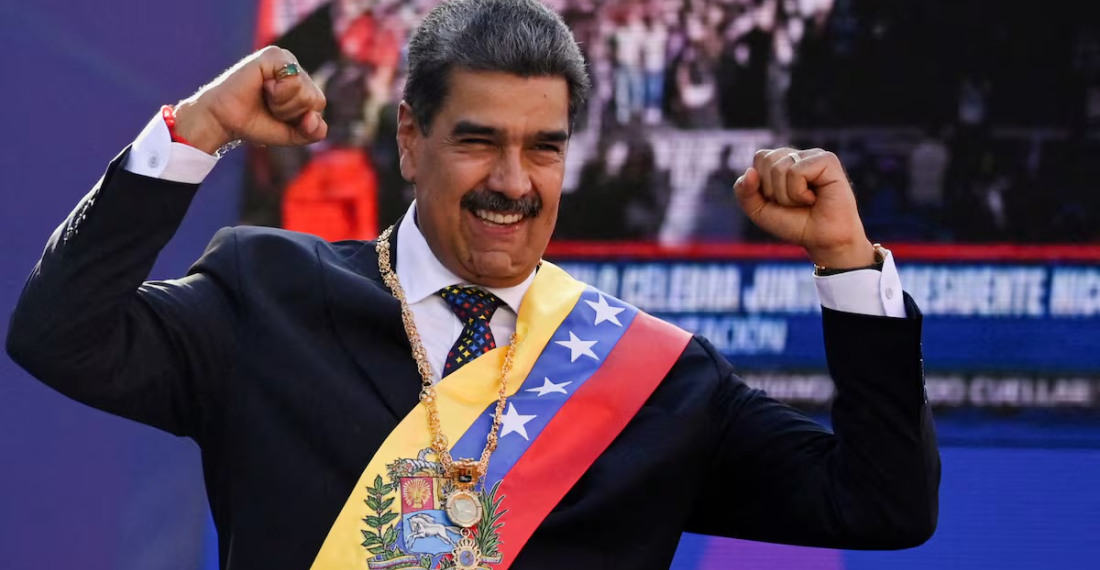
Photo: Nikolas Maduro (archive picture).
The views expressed in opinion pieces and commentaries do not necessarily reflect the position of commonspace.eu or its partners



