


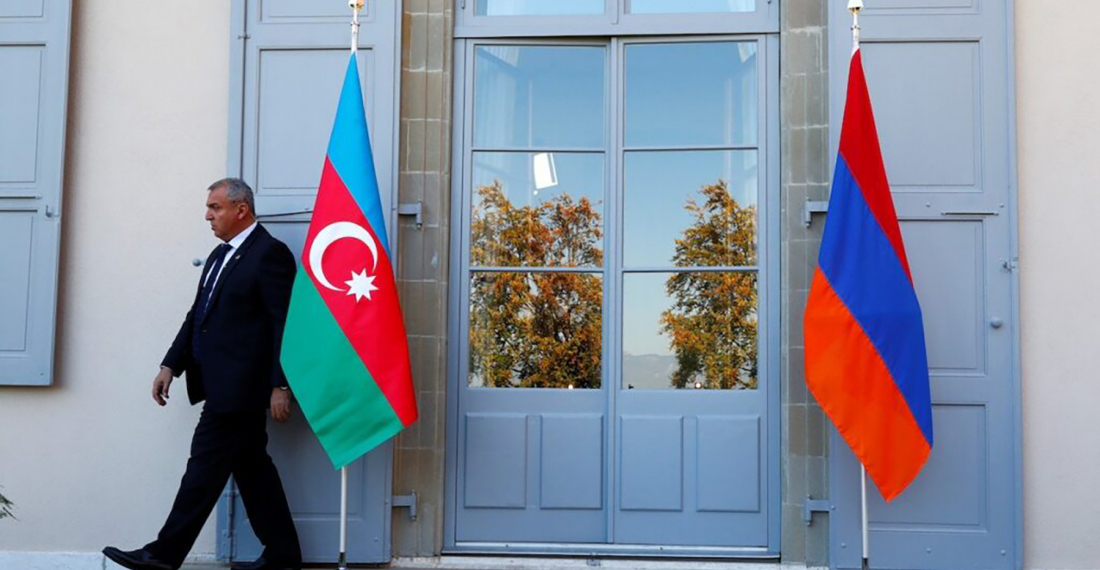
Opinion: The Ukraine war may hasten Armenia-Azerbaijan peace process

The three countries of the South Caucasus (Armenia, Azerbaijan, and Georgia) are holding a vigilant and mostly balanced stance amidst the Russia-Ukraine war. The dangerous security situation in the wider region and Russia’s still strong political and military influence over the South Caucasus leave these countries few choices in this critical geopolitical upheaval. The region, along with the entire post-Soviet space, is pregnant to a different power balance in the wake of the ongoing war, although it is at the moment premature to say how different this balance and regional interstate politics will look after the war. One major issue to be affected by the outcomes of the current situation and, importantly, by the unprecedented confrontation between the West and Russia is the Armenia-Azerbaijan peace process.

The peace talks between Armenia and Azerbaijan prior to the Ukraine crisis had been maintained mostly through the mediation of Russia, but there was some coordination between Moscow and its Western partners in this process. Primarily the European Union (EU) and France sought to play a more active mediating role between the two Caucasian republics and organized two meetings of their leaders (one physical meeting in Brussels on December 14, 2021, and one online on February 4, 2022). This role of the Western actors appeared mostly as complementary to the Russia-mediated peace process and made an important contribution to the progress in the negotiations. Against this background, we witnessed a diminished role of the Minsk Group of the Organization for Security and Cooperation in Europe (OSCE), co-chaired by Russia, France and the United States and coordinated the Armenia-Azerbaijan negotiations prior to the 2020 Second Karabakh War.

The unprecedented low in the Russia-West relations caused by the Russia-Ukraine war cannot help but be reflected also in the Armenia-Azerbaijan peace process. One major implication of the present situation is related to the Minsk Group. It is now safe to say that this mission became part of history. This is so despite the fact that in recent years the former Armenia-Azerbaijan conflict used to be a rare case in which the approaches of the West and Russia overlapped. Although the two sides would have to come to the table for addressing some pressing international issues, a practical cooperation between them within the Minsk Group is highly unlikely to be possible in the near future.

Meanwhile, the need for the Minsk Group might disappear soon, if the existing positive trends between Armenia and its Turkic neighbors persist. Although the situation succumbed into violence and humanitarian tragedies in the European flank of the post-Soviet space in February, the Armenian-Azerbaijani peace process marked some promising developments which suggest that peace and reconciliation between the sides would be on the horizon.

On March 2, Armenia’s Prime Minister Nikol Pashinyan declared that launching negotiations on a peace treaty with Azerbaijan are on his government’s agenda along with other major issues including opening regional communications, delimitation and demarcation of the Armenia-Azerbaijan border. Importantly for regional peace efforts, both Armenia and Azerbaijan have confirmed their readiness to sign a peace treaty and putting an end to their enmity and hostilities. It is now plausible to expect that the sides may succeed to accomplish such a treaty recognizing their territorial integrity in the near future.

In early March, the Armenian government also announced the start of the work on the reconstruction of the Armenian section (43 km) of Yeraskh-Julfa-Ordubad-Meghri-Horadiz railway. The Minister of Territorial Administration and Infrastructure Gnel Sanosyan confirmed that Armenia allocated funds for geodetic work to start the construction works on this section. Following the Sochi and Brussels summits of the Armenian and Azerbaijani leaders, the first practical steps have been thus made by the Armenian side towards the realization of the railway linkage which Azerbaijan calls “Zangazur corridor”.

Some progress was also marked in the normalization process of the Armenia-Turkey relations. The Minister of Foreign Affairs of Armenia Ararat Mirzoyan positively assessed the second meeting of the Armenian and Turkish special representatives held on February 24 in Geneva and noted that the sides focused on more specific issues in these talks. Earlier Turkish President Recep Tayyip Erdogan positively talked about this process with Armenia and said his country could open its borders with its neighbor and reestablish diplomatic ties if Yerevan maintains a commitment to the ongoing normalization process between the two countries.

Thus, against the backdrop of the Russia-Ukraine war, Armenia and Azerbaijan look committed to overcome the challenges in their relations and realize the peace opportunities created after the Second Karabakh War. Although we might see little to no coordination between the West and Russia in the mediation of this process after the ongoing war, at this juncture this does not look likely to create big challenges for the Armenia-Azerbaijan peace process. In contrast, this offers a chance for Baku and Yerevan to promote bilateral contacts without any third-party mediation which would open a new and important chapter in the thirty-years old peace negotiations.


source: This op-ed was prepared for KarabakhSpace.eu by Dr Vasif Huseynov, a Senior Advisor at the Center of Analysis of International Relations (AIR Center) and Adjunct Lecturer at Khazar University in Baku, Azerbaijan.
photo:  
 The views expressed in opinion pieces and commentaries do not necessarily reflect the position of commonspace.eu or its partners

Related articles

Editor's choice
News
Borrell tells the European Parliament that the situation in Afghanistan was critical, but the EU will remain engaged

Borrell tells the European Parliament that the situation in Afghanistan was critical, but the EU will remain engaged

Borrell underlined that the European Union will make every effort to support the peace process and to remain a committed partner to the Afghan people. "Of course, we will have to take into account the evolving situation, but disengagement is not an option.  We are clear on that: there is no alternative to a negotiated political settlement, through inclusive peace talks.
Editor's choice
News
NATO Chief says war is on Europe's doorstep, and warns against complacency

NATO Chief says war is on Europe's doorstep, and warns against complacency

Russia could attack a Nato country within the next five years, the Secretary General of NATO, Mark Rutte, said in a stark new warning. "Nato's own defences can hold for now," Rutte warned in Berlin, but conflict was "next door" to Europe and he feared "too many are quietly complacent, and too many don't feel the urgency, too many believe that time is on our side. "Russia is already escalating its covert campaign against our societies," Rutte said in a speech in Germany. "We must be prepared for the scale of war our grandparents or great-grandparents endured." Earlier this month, Russia's President Vladimir Putin said his country was not planning to go to war with Europe, but it was ready "right now" if Europe wanted to - or started a war. But similar reassurances were given by Moscow in 2022, just before 200,000 Russian troops crossed the border and invaded Ukraine. Putin has accused European countries of hindering US efforts to bring peace in Ukraine - a reference to the role Ukraine's European allies have recently played in trying to change a US peace plan to end the war, whose initial draft was seen as favouring Russia. But Putin was not sincere, Nato's secretary-general said in the German capital, Berlin. Supporting Ukraine, he added, was a guarantee for European security. "Just imagine if Putin got his way; Ukraine under the boot of Russian occupation, his forces pressing against a longer border with Nato, and the significantly increased risk of an armed attack against us." Russia's economy has been on a war footing for more than three years now - its factories churn out ever more supplies of drones, missiles and artillery shells. According to a recent report by the Kiel Institute for the World Economy, Russia has been producing each month around 150 tanks, 550 infantry fighting vehicles, 120 Lancet drones and more than 50 artillery pieces. The UK, and most of its Western allies, are simply not anywhere near this point. Analysts say it would take years for Western Europe's factories to come close to matching Russia's mass-production of weapons. "Allied defence spending and production must rise rapidly, our armed forces must have what they need to keep us safe," the Nato chief said.

Popular

Editor's choice
News
NATO Chief says war is on Europe's doorstep, and warns against complacency

NATO Chief says war is on Europe's doorstep, and warns against complacency

Russia could attack a Nato country within the next five years, the Secretary General of NATO, Mark Rutte, said in a stark new warning. "Nato's own defences can hold for now," Rutte warned in Berlin, but conflict was "next door" to Europe and he feared "too many are quietly complacent, and too many don't feel the urgency, too many believe that time is on our side. "Russia is already escalating its covert campaign against our societies," Rutte said in a speech in Germany. "We must be prepared for the scale of war our grandparents or great-grandparents endured." Earlier this month, Russia's President Vladimir Putin said his country was not planning to go to war with Europe, but it was ready "right now" if Europe wanted to - or started a war. But similar reassurances were given by Moscow in 2022, just before 200,000 Russian troops crossed the border and invaded Ukraine. Putin has accused European countries of hindering US efforts to bring peace in Ukraine - a reference to the role Ukraine's European allies have recently played in trying to change a US peace plan to end the war, whose initial draft was seen as favouring Russia. But Putin was not sincere, Nato's secretary-general said in the German capital, Berlin. Supporting Ukraine, he added, was a guarantee for European security. "Just imagine if Putin got his way; Ukraine under the boot of Russian occupation, his forces pressing against a longer border with Nato, and the significantly increased risk of an armed attack against us." Russia's economy has been on a war footing for more than three years now - its factories churn out ever more supplies of drones, missiles and artillery shells. According to a recent report by the Kiel Institute for the World Economy, Russia has been producing each month around 150 tanks, 550 infantry fighting vehicles, 120 Lancet drones and more than 50 artillery pieces. The UK, and most of its Western allies, are simply not anywhere near this point. Analysts say it would take years for Western Europe's factories to come close to matching Russia's mass-production of weapons. "Allied defence spending and production must rise rapidly, our armed forces must have what they need to keep us safe," the Nato chief said.

