


The bloody six-week conflict that erupted between Azerbaijan and Armenia on September 27 in the Nagorno-Karabakh region resulted in significant territorial gains for Azerbaijani forces. It was no secret that since the early 2000s Azerbaijan had been steadily building up its armed forces. The defeat of the self-proclaimed republic of Nagorno-Karabakh, an unrecognized Armenian populated territory within Azerbaijan's borders, revealed serious military-technical problems on the Armenian side, which triggered mass anti-government riots in Armenia itself. The recent Russia-brokered ceasefire agreement between Baku and Yerevan halted the ongoing bloodshed and enabled the deployment of Russian peacekeepers in the conflict zone. It also marked a significant shift in regional geopolitics.
The Moscow-crafted truce, which guarantees the existence of a small Armenian enclave in Karabakh, may be seen as a victory sign for Russia, but in fact, it may be a sign of the Kremlin's declining influence near its southern borders. For some, Russia’s decision to deploy its military forces on Azerbaijani soil, something that the Kremlin has been seeking since 1994, shifted the regional balance of power in its favor. However recent developments suggest that the West's ignorant position left Turkey as the only other player in the region and as a result of the active intervention of Turkey alongside Azerbaijan in the conflict, Russia is now not the only major power in the South Caucasus region. Therefore, the ceasefire agreement signed on November 10 acknowledges official Ankara as another top player in the region. Moreover, Russia’s restraint throughout the war, and President Vladimir Putin’s statement that “the Nagorno-Karabakh region is an inseparable part of Azerbaijani territory” made many in Armenia question Moscow’s role as a security provider and staunch ally. The growing dissatisfaction in Armenia may further threaten Moscow’s economic, military, and political leverage over its long-term ally.
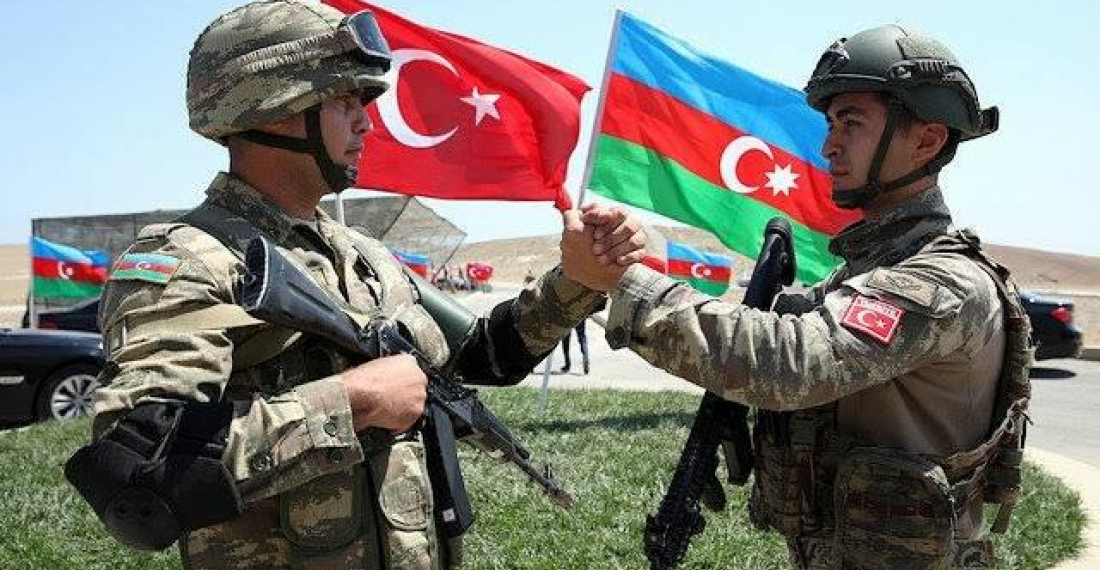
On the other hand, Turkey’s deep military partnership with neighboring Azerbaijan, and its decision to openly support the latter during the fighting in the Nagorno-Karabakh conflict zone significantly asserted Ankara's role in the conflict and the region. Such support to Azerbaijan yielded certain political benefits, like the new corridor through Armenian territory to the Azerbaijani Nakhichevan exclave that sets a direct land bridge between Turkey and Azerbaijan. As a result, political and economic links between the two countries are set to flourish shortly In September, as tensions increased in the Nagorno-Karabakh conflict zone, Armenian mass media accused Turkey of supplying Azerbaijan with a new generation of indigenous combat drones In fact, discussions between Ankara and Baku on the acquisition of armed drones were reportedly held at least as early as June 2020, during Azerbaijani Defense Minister Zakir Hasanov’s official visit to the Turkish capital. Moreover, in January–February 2020, Azerbaijan’s defense-related imports from Turkey increased by 39.85 percent, year on year, reaching $88.675 million. According to data from the Stockholm International and Peace Research Institute (SIPRI), fueled by billions of dollars in oil and gas sales, Azerbaijan’s military spending over the past decade totaled $24 billion. In the same period, also according to SIPRI, Armenia spent $4.7 billion.
Indeed, Turkish made Bayraktar TB-2 combat drones and Israeli-made loitering munitions wreaked havoc on Armenian forces, destroying a vast proportion of the Russian-made battle tanks, heavy artillery, air-defense systems, and armored vehicles, and inflicting large-scale casualties. In fact, it was predictable that the advanced military technology and weaponry imported from different countries (including Czech Republic, Slovakia, and Spain) throughout these years has changed the balance of power in favor of official Baku by squeezing Russian-made weaponry out of the Azeri arms market. Also, the vulnerability of the Russian air-defense systems against combat drones triggered debates in the Western media about whether the Russian air defense-systems are generally overrated.
Obviously, Russia's three-decades extended ineffective mediation policy in the Nagorno-Karabakh conflict, culminating in the Lavrov plan, paved the way for a greater Turkish role that gave Azerbaijan more space for maneuver. Besides, the deepening Baku-Ankara relations during the war enabled the latter to join the peacekeeping mission in Karabakh alongside Moscow. Thus, Turkey intervened in Russia's presumed "sphere of influence", as Moscow once did by sending troops to Syria in 2015. Therefore, the current tensions between Moscow and Ankara in the Nagorno-Karabakh are the logical continuation of the confrontation between them.
This nuance again highlights that Russia and Turkey are not partners but big competitors in the MENA, Black Sea, and now in the South Caucasus regions, often backing rival sides. However, in the case of the Nagorno-Karabakh conflict, Russia seemingly prefers to avoid taking any side, or directly intervene, in order not to provoke harsh anti-Russian sentiments both in Armenia and Azerbaijan as well as not to provoke new Western sanctions, as was the case when it intervened in Georgia, and Ukraine.
source: Fuad Shahbazov is an independent analyst based in Baku, Azerbaijan @fuadshabazov
photo: A Turkish soldier greets an Azerbaijani colleague during recent military exercises between the two countries (photo courtesy of TRT Istanbul)
The views expressed in opinion pieces and commentaries do not necessarily reflect the position of commonspace.eu or its partners



