


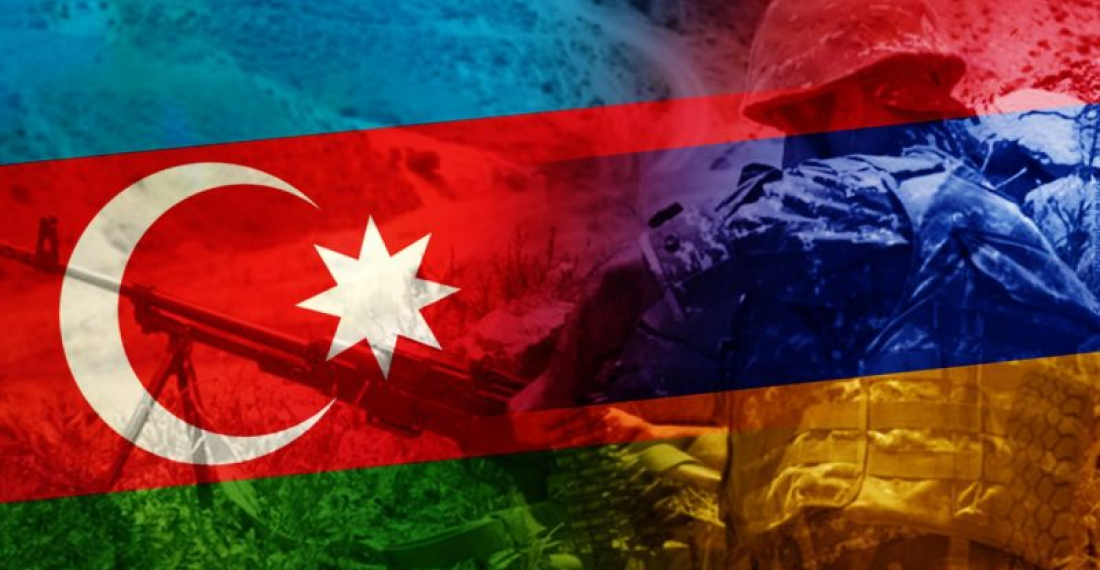
"Time is not on the side of peace between [Armenia and Azerbaijan] and never has been," writes Onnik James Krikorian for commonspace.eu. "The wounds of the past are still raw and will continue to fester unless there is concrete progress, whether through the efforts of the European Union, United States, or Russia." He adds that "in such an environment, it is imperative for local and international actors to become proactive again, with absolutely no space for complacency or hope for a new but unsustainable status quo to emerge."
Next month will mark the 29th anniversary of the 1994 ceasefire agreement between Armenia and Azerbaijan that ostensibly brought an end to the first Karabakh war. Almost to the day, it will also be 2.5 years since the November 2020 trilateral ceasefire statement halted what most refer to as the second Karabakh war. Despite initial hopes, the current peace process appears to have stalled.
This current failure to end another sorry chapter in relations between Armenia and Azerbaijan does not bode well for the future, to put it mildly.
Time is not on the side of peace between the two warring nations and never has been. The wounds of the past are still raw and will continue to fester unless there is concrete progress, whether through the efforts of the European Union, United States, or Russia. Furthermore, last year’s full scale invasion of Ukraine by Moscow further complicates the situation.
Though this could never have been foreseen as the ink dried on the 2020 trilateral statement, 2021 was arguably a lost opportunity to work on a peace treaty given clarity over a new balance of power in the region. Instead, much of civil society, with some exceptions, remained silent while others picked fault with the ceasefire statement rather than work to make it function or use it as a foundation to build upon.
And despite some promising signs and statements from the governments themselves throughout 2021 and in 2022 – even following September fighting that left around 300 dead – rhetoric is becoming alarmingly reminiscent of the past. Meanwhile, regardless of the reasons, Armenia has still not started construction on its section of a railway line to Nakhichevan, and Karabakh still remains under siege.
Fears of current process resembling "forum shopping"
Though claiming they are ready for peace, both Armenia and Azerbaijan understandably view each other with suspicion. Yerevan claims Baku is gearing up for a new war along with the expulsion of the Karabakh Armenians while Azerbaijan accuses Armenia of delaying the signing of a treaty. Last week, regional analyst Benyamin Poghosyan also concluded that a peace deal is unlikely in 2023.
Indeed, despite hopes for a framework peace agreement last year, there are also now some fears emerging that the current peace process resembles “forum shopping” at best or imitation at worst.
But if the ‘status quo’ was untenable before 2020 it is even more so now. Any window of opportunity that did open is now beginning to close – if it has not done so already. The stakes are higher too, highlighting the urgency of a concrete breakthrough in the coming months.
Karabakh, for example, is now almost totally geographically isolated and finds itself in a situation totally different from before September 2020. Lacking a viable land border with a powerful security patron, it cannot ever become another South Ossetia or Abkhazia. The protests on the Lachin Corridor and the recent installation of an Azerbaijani checkpoint on the road highlights that clearly.
Several key dates on the horizon also raise further concerns.
Yerevan municipal elections, the fate of Russian peacekeepers past 2025, and elections in Karabakh
This autumn, for example, Yerevan will hold municipal elections. With 38.5% of the population located in the capital, no government has ever been willing to lose control of the city which is why it took until 2009 before residents were allowed to elect a city council and indirectly a mayor. Before then, both Ter-Petrosyan and Kocharyan appointed loyalists.
With the incumbent, Pashinyan-loyalist Hrachya Sargsyan, resigning last month and no replacement chosen by the city council, it would appear that Armenian Prime Minister Nikol Pashinyan has no intention of relinquishing control over the social, political, and economic hub of the country either. Sargsyan’s predecessor, Hayk Marutyan, was dismissed after falling out with Pashinyan following the 2020 war.
But this is not the only date on the horizon – 2025 is too, when uncertainty still surrounds the future of the Russian peacekeeping contingent in Karabakh after its first term expires. Baku says it may not agree to another and given the implied wording of the 2020 ceasefire statement, this would presumably mean handing full control of the Lachin Corridor to Azerbaijan unless otherwise agreed.
As mentioned earlier, this could already be happening. And aside from existing fears of potentially mass depopulation unless Stepanakert and Baku enter meaningful talks, there will also be elections in Karabakh earlier the same year, something likely to irk Azerbaijan enough to react harshly to.
Decreasing water resources in Karabakh and national Armenian elections in 2026
In addition to the issue of the Russian peacekeeping contingent, two other events risk making the already unstable situation worse. With Azerbaijan rebuilding and repopulating the regions surrounding the former Nagorno Karabakh Autonomous Oblast (NKAO), security will become a major concern as the physical distance between the two populations inevitably narrows.
This is likely to see increased competition over land and water resources. Water levels are already dropping in Karabakh’s Sarsang reservoir, a resource important not only for Stepanakert but also Azerbaijani farmers. Though dialogue on this did occur last year, these levels are now perilously low as local electricity demand outstrips supply given disruption of energy supplies passing through Lachin.
And what happens in 2025 will definitely impact the following year when Armenia goes to the polls to elect a new parliament. If Pashinyan’s peace agenda fails to bear fruit then he potentially faces a serious challenge by the opposition, especially if it can find a figurehead untainted by the previous regimes in order to capitalise on the current government’s diminishing popularity.
In advance of the 2025 deadline and the 2026 elections, therefore, this perhaps leaves the end of 2023 or an unpredictable 2024 to sign a peace treaty. Meanwhile, in Azerbaijan, failure to truly end the conflict, as claimed over two years ago, could see even more ‘coercive diplomacy’ exerted by Baku.
In such an environment, it is imperative for local and international actors to become proactive again, with absolutely no space for complacency or hope for a new but unsustainable status quo to emerge. Even if the international community once again shifts its focus from conflict resolution to conflict prevention as it did a decade ago, the 2020 Karabakh war demonstrated how ineffective that was as strategy.
source: Onnik James Krikorian is a journalist, photojournalist, and consultant from the U.K. who has covered the Armenia-Azerbaijan conflict since 1994.
photo: United World International
The views expressed in opinion pieces and commentaries do not necessarily reflect the position of commonspace.eu or its partners



