


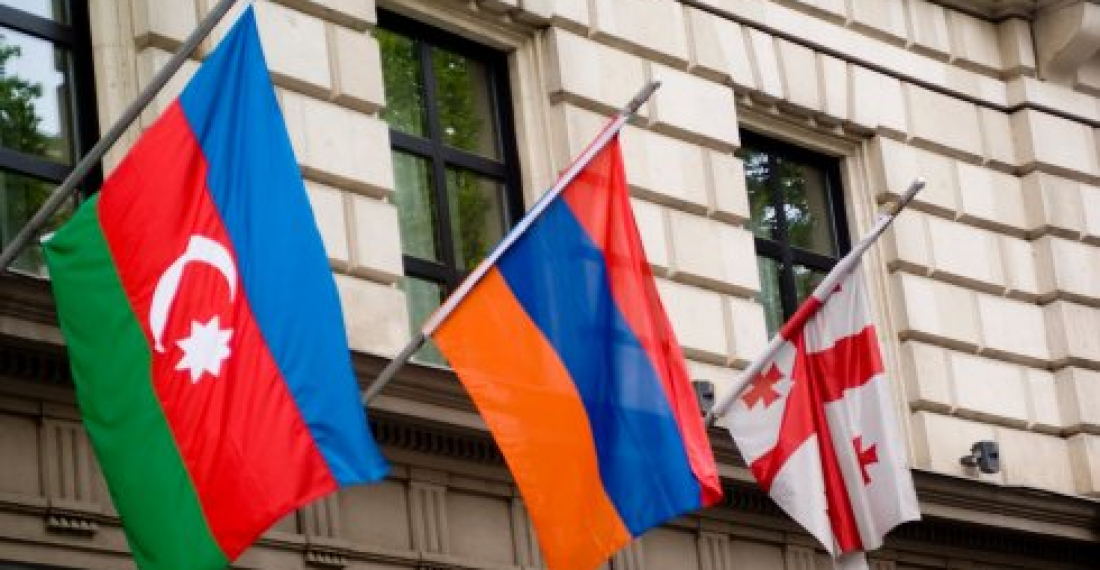
"All three South Caucasian republics need to be very cautious in their foreign policy choices", argues Benyamin Poghosyan in this op-ed on commonspace.eu
The South Caucasus is facing multiple security challenges with no clear path to overcome them in the foreseeable future. The conflicts in Nagorno Karabakh, Abkhazia and South Ossetia are hampering any efforts to have an inclusive regional cooperation, and are the key reasons for the strained Russia - Georgia relations and absence of relations between Armenia, Turkey and Azerbaijan. Meanwhile, there are no immediately apparent ways to move towards the settlement of these conflicts. Russia deployed military bases in both Abkhazia and South Ossetia, and demanded from Georgia to accept the geopolitical facts on the grounds. As for Tbilisi, it is hard to imagine any Georgian government that will be ready to accept the independence of these regions. Thus, the current stalemate will continue, unless there are some tectonic shifts in Georgian domestic politics, or a sharp decline of Russian influence in the South Caucasus.
The Karabakh conflict had some momentum towards resolution in 2009 - 2011, but after the failed June 2011 Kazan summit no substantive negotiations have been held. The four-day war in April 2016 made any breakthrough even less likely. Currently the efforts of the OSCE Minsk group is focused on launching confidence building measures including enlargement of OSCE monitoring mission staff and the establishment of the ceasefire violations investigative mechanisms. However, despite two years of intensive work, and several high level summits, no progress has been made in those issues.
The best case scenario for Karabakh conflict in the near future is the prevention of large scale hostilities, and continuation of the negotiation process. The recent political upheaval in Armenia resulted in the resignation of Prime Minister Serzh Sargsyan on April 23 (Sargsyan was Armenian President in 2008 - 2018 and had been elected as the Prime Minister by Parliament on April 17), and the likely election of the leader of the Protest Movement Nikol Pashinyan as Armenia's next Prime Minister on May 1 will bring very little if any changes in Armenia's position in Karabakh issue. President Aliyev has been re-elected for his fourth, extended 7 year term, as President of Azerbaijan on April 11. Thus, no changes can be expected also in the Azerbaijani position.
Armenia - Turkey relations are at an impasse too. Turkey's refusal to ratify Armenian - Turkish protocols signed in October 2009 before any progress can be made in Karabakh negotiations (by which the Turkish side understands the removal of Armenian forces from at least two regions of the security zone around Karabakh), effectively put on hold any possibility of moving forward the normalization process. In March 2018 former Armenian President Serzh Sargsyan declared Armenia - Turkey Protocols null and void, thus closing the chapter of so called "football diplomacy".
Another key feature of regional geopolitics is the competing integration projects and transit routes. Armenia is a member of Collective Security Treaty Organization and Eurasian Economic Union, meanwhile managing to sign a Comprehensive and Enhanced Partnership Agreement with the EU in November 2017, and keeping channels open for cooperation with NATO through implementation of an Individual Partnership Action Plan. Georgia signed an Association Agreement with the EU in 2014, and continues its efforts to move forward in its path towards Euro-Atlantic integration. However, neither EU nor NATO is ready to discuss a membership option for Georgia in the foreseeable future. Azerbaijan rejects both membership into Eurasian Economic Union and Association Agreement with the EU, seeking to balance between different actors.
At the same time the South Caucasus is a key location for multinational transit projects. The main players here are Azerbaijan and Georgia which are involved in both East - West and North - South routes. East - West route includes gas and oil pipelines; Baku - Tbilisi - Jeyhan, Baku- Tbilisi - Erzurum, TANAP, railroads; Baku - Georgian Black Sea ports and Baku - Tbilisi - Kars. The launch of the Trans-Caspian International Transport Route which starts from China, runs through Kazakhstan, Caspian Sea, Azerbaijan, Georgia and further to European countries either via the Georgian Black Sea ports, or BTK railway, has the potential to include the South Caucasus into China's hallmark Belt and Road Initiative, thus increasing the transit potential of the region. Azerbaijan is actively pursuing the launch of a North - South corridor which envisages the connection of India's Mumbai with Northern Europe via Iran, Azerbaijan and Russia. Just recently Azerbaijan and Iran connected their railroad systems, thus making a significant step to realize this project.
Due to the position of Azerbaijan and Turkey, Armenia is excluded from all above mentioned projects. However, since 2016 Armenia has been involved in negotiations with Iran, Georgia, Bulgaria and Greece to launch the Persian Gulf - Black Sea multimodal transport corridor which will connect Iran with Europe via Armenia and Georgia.
All these transit routes will have significant impact on the South Caucasus geopolitics potentially altering the balance of power.
The developments in the Middle East also have a direct impact on regional security dynamics. The rise of religious extremism is a source of concern for Azerbaijan. Radical Sunni and Shia movements can penetrate into Azerbaijan and transform political Islam into a key threat for President Aliyev's rule. The rising tensions in the region between Israel and Iran have a potential to transform Syria into a proxy battlefield between Tehran and Tel - Aviv. With another Israel - Hezbollah war looming in Lebanon, President Trump readiness to announce the US withdrawal from the Iranian nuclear deal and the establishment of Russia - Turkey - Iran alliance, the developments in the Middle East are becoming one of the key factors influencing the security dynamics of the South Caucasus.
Thus, from a short-term perspective, the regional security architecture will remain volatile. The growing Russia - West rivalry and Moscow's efforts to foster its influence in the post-Soviet space may complicate the situation further, requiring all three South Caucasian republics to be very cautious in their foreign policy choices.
source: Dr. Benyamin Poghosyan is the Executive Director of the Political Science Association of Armenia. He contributed this op-ed to commonspace.eu
The views expressed in opinion pieces and commentaries do not necessarily reflect the position of commonspace.eu or its partners



