


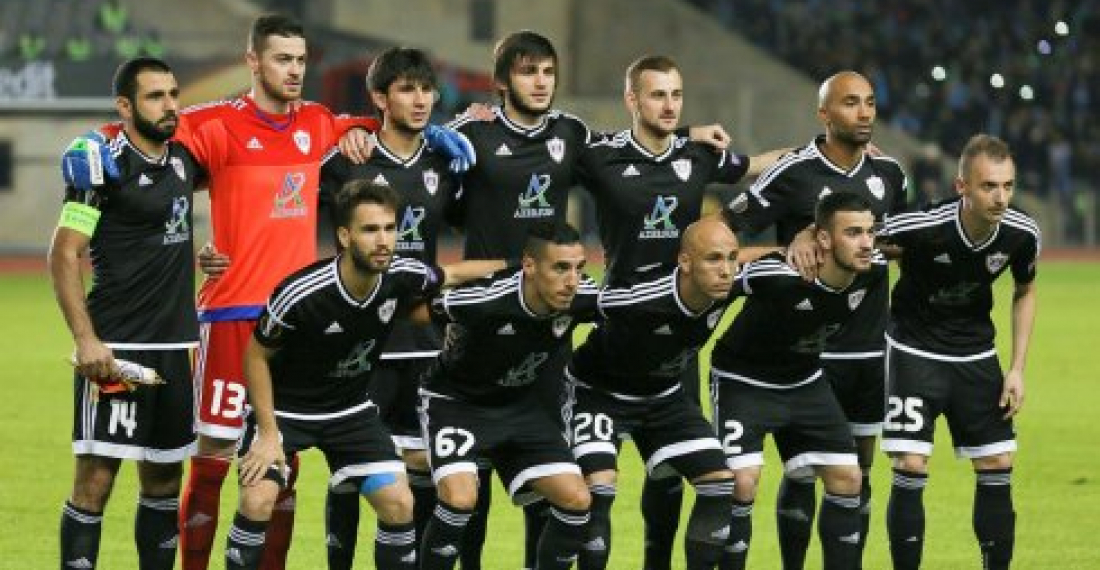
Qarabag FC will play Chelsea tonight in the Champion's league. Mirbahram Asimbayli reflects on the wider significance of this sports event in this op-ed for commonspace.eu
Today, 12 September 2017 is a historical moment for European football. A 'refugee club' will be hosted by one of the most famous football clubs, Chelsea FC, at Stamford Bridge. The match against Chelsea will be the first away challenge for Qarabag FK in the group stage of the Champions' League. In the last few years, Europe has faced a refugee crisis in the wake of the ongoing violent civil war in Syria. Now, this sports event will remind the world of the often forgotten refugees and internally displaced people of the Southern Caucasus.
Qarabag FK, an Azerbaijani football club from Agdam, was established in 1951. While it had different names, such as 'Mehsul', 'Shafaq' and 'Cooperative society' under Soviet Azerbaijan, the club became the 1988 champion of Azerbaijan SSR championship with its present title. "Qarabag" is the Azerbaijani transliteration of "Karabakh", the territory that gives its name to the conflict between Azerbaijan and Armenia, as a result of which the former lost around 20 percent of its internationally recognized territories (Nagorno-Karabakh region and seven adjacent districts) to the latter. On July 23th, 1993, Agdam, one of the largest towns in Karabakh, was invaded and destroyed; all essential buildings -hospitals, schools, shops, houses etc. including the Imarat Stadium -were bombed by Armenian forces with the military support of Russia. As the population of Agdam, fled eastwards within Azerbaijan, what was once one of the richest cities of Azerbaijan became a 'ghost town'. In the Karabakh War, Agdam was the district with the highest number of casualties: more than six thousand residents died defending their homes. I recently interviewed a war veteran who lived in one of the villages now under Armenian control, as part of my academic research. He recalled:
'They burned everything and everywhere. Football was luxury in those days when we had to live in tents and old Soviet wagons. I just could not understand why they burnt the graveyards: my parents were already dead, - and he smiles,- You know, not only us, but also snakes, whose nests were burnt too, became refugees, to be correct, internally displaced people. The people from the UN were sometimes bringing presents to our kids, UEFA balls. Today, we have everything and our children play with those balls in the Champions League.'
Qarabag FK did not only lose its home, but also former coach and player Allahverdi Bagirov who created his own battalion and saved many Azerbaijanis from the Khojali Massacre. He was killed by an anti-tank mine and posthumously awarded the title of National Hero of Azerbaijan.
The fans of Qarabag FK , internally displaced people as a result of the Karabakh War, did not take refuge in another country, but resettled in Baku and other cities of Azerbaijan. They did not come to Europe as refugees, but their team is, to play in Europe's most prestigious football championships. Defeating Copenhagen in the play-off round of the UEFA Champions League, the 'horsemen' (as the club is sometimes called) have become the first Azerbaijani club to qualify for the group stage. While in the 90s, Qarabag FK faced many financial and moral constraints due to the war, the club experienced a healthy growth after gaining sponsorship from Azersun, an Azerbaijani-Turkish holding company. Gurban Gurbanov (Gurban means sacrifice in Azeri), from a village called Tala in the north-west of Azerbaijan, took the position of manager in 2008 and has led the club to successful results both at home and in Europe.
In his interview to the news agency Lent.az, he remembers his childhood:
'I did not experience football as a child. We even did not have a proper ball; we were putting fabric into old volleyball balls and playing with them'.
Soon "the horsemen" will play against Chelsea in London. That brings memories of the time when the Soviet leader Nikita Khrushchev was on a trip to the United Kingdom in 1956, he gave a Qarabag horse called Zaman ("time" in Azeri) from Agdam as a present to Queen Elizabeth II. In 2012, a Qarabag horse participated, as "a refugee", in the Royal Windsor Horse Show at the Diamond Jubilee celebrations of Elizabeth II.
Not surprisingly, the successes of Qarabag FK hold certain important political implications. Playing in the Champions League offers a little consolation for the refugees and internally displaced people who lost their homes, relatives and happiness. There are around one million displaced Azerbaijanis as a result of the conflict, including those from Agdam.
The success of Qarabag FC however also has implications for the wider geo-strategic context. The most important international actor in the conflict remains Russia, which is more interested in the management of the conflict, rather than its solution. In Ukraine, Moldova, Georgia and Azerbaijan, by providing military, economic and political support to different actors, and taking advantage of the quest for separatism, the Kremlin undermines the sovereignty and independent foreign policy choices of those states. In the Karabakh case, one of the most important hindrances for both Armenia's and Azerbaijan's integration with Europe is Russia's strategic use of the conflict.
The success of Qarabag FK as an Azerbaijani team irritated the Russian media, while their western counterparts were excited about the participation of a refugee team in the Champions League. Qarabag FK challenges the Russian strategy of manipulating separatism in Eurasia as a means to stopping the European integration of post-Soviet states
I am writing the last sentence of this short op-ed sitting in a café opposite the beautiful Armenian church in center of Baku. Qarabag FK's accomplishment can be celebrated by not only Azeri refugees and internally displaced people, but also by the ethnically Armenian citizens of Azerbaijan living in Nagorno-Karabakh. Azerbaijanis and Armenians lived together peacefully for centuries. Once the occupation ends, both Azerbaijani and Armenian children can play football in Imarat and other stadiums in Karabakh together. Then, Azerbaijani and Armenian footballers of Qarabag FK will occupy the headlines of the Western newspapers representing the South Caucasus as part of wider Europe, instead of a conflict zone. Thus, I believe football and particularly, Qarabag FK, represents an amazing opportunity for public diplomacy.
Mirbahram Azimbayli is an Azerbaijani graduate student at Oxford University. He was born in the town of Agdam, and has been for most of his life a refugee from the Karabakh conflict. He contributed this op-ed for commonspace.eu
photo: Qarabag FK (archive picture)



