


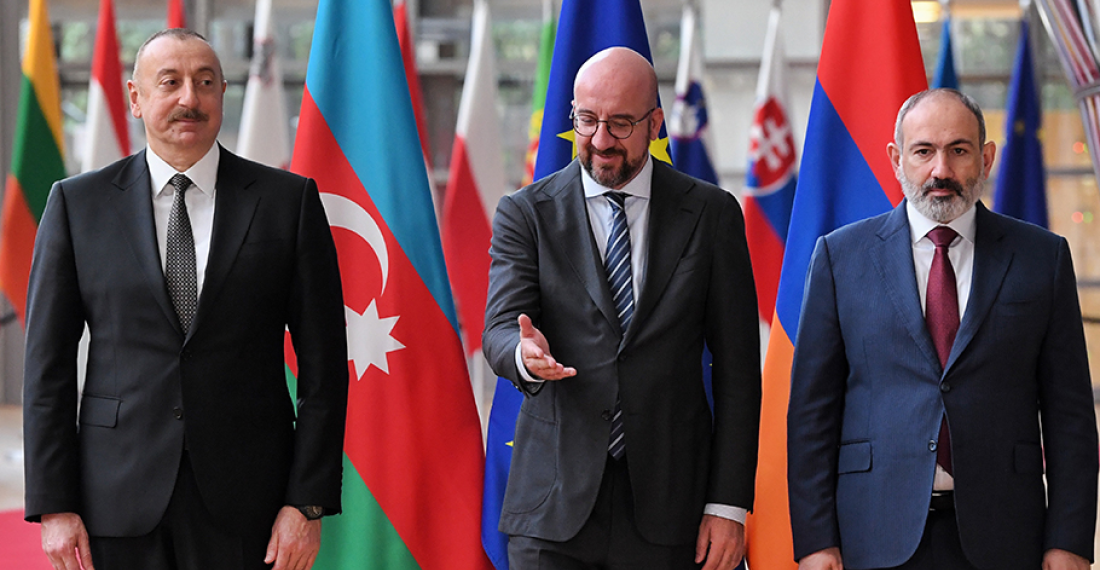
Despite two rounds of talks in Washington D.C. and Brussels, the mutual recognition of the principle of territorial integrity seems to be a bottleneck in Azerbaijan-Armenia negotiations. To avoid past mistakes, such recognition should be accompanied by more specific commitments, such as constitutional changes, stopping financing separatism, and sending soldiers to serve in Karabakh, argues Nurlan Mustafayev in this op-ed for commonspace.eu.
It is widely understood that the final peace treaty between Azerbaijan and Armenia should not leave any room for abusive interpretation in the future. Otherwise, it may lead to the repetition of the same "miatsum" movement in 1988 – an attempted incorporation of Azerbaijan’s Karabakh region into Armenia proper – that resulted in the Armenia-Azerbaijan war in 1991-1994.
In this respect, Azerbaijan apparently wants Armenia to explicitly recognize Karabakh as part of Azerbaijan. Armenia is ostensibly not willing to do so. The new Brussels formula on "unequivocal commitment to the 1991 Almaty Declaration and the respective territorial integrity of Armenia (29,800 km2) and Azerbaijan (86,600 km2)" seems to be a compromise. But it is a shaky compromise that may prove to be toothless in practice.
Armenia, in its turn, wants the "rights and security of Armenians in Karabakh" as an exception to the territorial integrity principle. In Armenia’s thinking, "rights" under this new formula are not limited to "minority rights" as such, but encompass the right to self-determination and possible secession. In effect, this formula is a second iteration of the so-called "Madrid Principles", disguised under a newly-refined wording. This new formula is dangerous as it opens a door for new separatism in Azerbaijan.
In Azerbaijan’s thinking, "rights" in this context means only "minority rights" (e.g. cultural and educational rights), which have well-established limits under international law without any possibility of secession. In addition, this formula inadvertently excludes the rights of ethnic Azerbaijanis who lived in the former "Mountainous Karabakh Autonomous District", who constituted about 30% of the local residents, before 1988.
The principle of territorial integrity is the most critical issue for Azerbaijan
Considering Armenia’s occupation of Azerbaijan’s Karabakh region and adjacent seven regions in the past, the principle of territorial integrity is the most critical issue for Azerbaijan. The reality is that mere declarations do not prevent aggression in practice. For instance, Russia guaranteed the security of Ukraine in the Budapest Memorandum in 1994, and Armenia recognized Azerbaijan’s territorial integrity in the Alma-Ata Declaration dated 1991. However, these declarations did not prevent Russia’s and Armenia’s territorial ambitions against their neighbors. Considering such risks, the Armenia-Azerbaijan peace treaty should be based on the principles of territorial integrity and non-intervention with clear and specific commitments.
The principle of territorial integrity in international law means that one state will not invade and occupy the territory of another state. Likewise, the principle of non-intervention means that one state will not interfere in the internal affairs of another state, for instance, by financing and supporting separatist groups in other states. These complementary principles are essential for the resolution of this conflict. In this sense, to avoid past mistakes, Armenia’s recognition of Azerbaijan’s territorial integrity should be accompanied by concrete legal and practical commitments:
1. Armenia’s Declaration of Independence in 1990 refers to the “joint decision of the Armenian SSR Supreme Council and the Artsakh National Council on the Reunification of the Armenian SSR and the Mountainous Region of Karabakh,” thus being a foundational principle of Armenia’s State. On July 13, 1992 the Armenia’s Parliament adopted a resolution that prohibited the Armenian government from recognizing Karabakh as part of Azerbaijan. The Armenian Constitution adopted in 1995, in turn, takes the Declaration of Independence as the foundational document for Armenia’s modern statehood. In effect, Armenia’s constitutional documents conceive Karabakh as a part of Armenia de jure. Azerbaijan rightly perceives such legal provisions in Armenia’s highest constitutional documents as a territorial claim against itself.
In addition, Armenia’s laws in elections, trade, customs, infrastructure, energy, and utilities deem Karabakh as part of Armenia. For instance, the goods produced in Karabakh have long been considered as goods produced in Armenia for the purpose of exports. Notably, Robert Kocharyan and Serzh Sargsyan, as former citizens of the Azerbaijan SSR of ethnic Armenian origin in Karabakh, were allowed to hold the highest office in Armenia because the Armenian government conceived Karabakh as its legal part. Thus, Armenia’s recognition of Azerbaijan’s territorial integrity must be accompanied by changes in its constitutional documents and the formal repeal of the “unification” of Karabakh and Armenia.
2. Armenia should also cease financing the local administration in Karabakh, which is under its military and civilian control. The fact is that Armenia annually transfers about $350 million (10% of its annual budget) to finance such activities in Karabakh. It is a massive financial and economic support, and a clear instance of financing separatism in Azerbaijan. Equally, Azerbaijan should be ready to gradually undertake financing the salaries and pensions of legitimate ethnic Armenian residents in Karabakh in the future.
3. Armenia should also withdraw its army units, formal and informal, from Karabakh and commit to not sending its soldiers and contractors in disguise to serve in Karabakh. At present, according to the International Crisis Group’s report (22 April 2022), Armenia has about 12,000 soldiers in Karabakh, which is a huge security risk for Azerbaijan. The presence of armed units under Armenia’s control and direction in Karabakh clearly violates the principle of territorial integrity. All such forces should be withdrawn to Armenia proper.
Unless the final peace treaty fully reflects these commitments, the principles of territorial integrity and non-intervention will likely hang by a thread and become subject to contestation once again under a changed geopolitical condition in the future. However, having these specific commitments in the peace treaty would provide objective criteria for evaluating any breaches of the territorial integrity principle and other peace treaty terms essential for durable relations between Azerbaijan and Armenia.



