Opinion : Peace in the Caucasus is Not a Zero-Sum Game

When Armenia and Azerbaijan signed a peace declaration in Washington on August 8, one would have expected headlines hailing a historic step forward between two nations long trapped in cycles of hostility.

Instead, much of the coverage deals through the prism of great-power rivalry: Was this the beginning of Russia’s retreat from the South Caucasus? Was Moscow being “kicked out” of its backyard? Is it a conspiracy against Iran? For many commentators, such narratives are less grounded in sober analysis and more in wishful thinking.

This agreement is not about pushing anyone out—it’s about pulling a troubled region toward stability.

Of course, Russia would prefer to hold the keys to every corridor, every railway, every energy route. Which power wouldn’t? But no serious policymaker in Moscow, Teheran, or even Washington can ignore today’s reality: no single actor can monopolize the South Caucasus anymore. In fact, a calmer South Caucasus serves Russia’s own interests. Each new clash between Armenia and Azerbaijan chips away at Moscow’s credibility, leaving it with collateral damage to its reputation whether it intervenes or stands aside. It’s worth recalling that the Armenian–Azerbaijani conflict was one of the catalysts for the Soviet Union’s very collapse.

Iran, too, is watching uneasily, especially at the prospect of American companies managing stretches of the Armenia border. But what real alternative does Tehran have to offer? On the ground, Azerbaijan and Iran have already struck a deal to build a railway linking Nakhchivan with mainland Azerbaijan. And thanks to the TRIPP initiative, Iran will, for the first time, enjoy long-sought rail access to Armenia via Nakhchivan—a logistical breakthrough that had been on wish lists for decades but was previously unworkable.

Far from isolating Iran, the new dynamics could even accelerate the long-discussed North-South Corridor, a strategic link binding Iran and Russia through Azerbaijan. That project, until now, has remained more ambition than reality.

The fact that this peace memorandum was brokered under Donald Trump also softens the edges for Moscow and Tehran. Unlike his predecessors, Trump does not carry the banner of “liberal hegemony” or interventionist doctrine—the very instincts that have historically triggered alarm in both Russia and Iran.

As for the dissolution of the OSCE Minsk Group, which for 30 years presided over a frozen conflict without thawing it: let’s be honest, no one in Moscow, Paris, or Washington is truly shedding tears over the demise of this obsolete mechanism.

The bottom line is that the peace declaration should not be misread as a geopolitical zero-sum game.

For neighbors and outside powers alike, the real test lies ahead—whether they cling to coercive habits that failed for decades, or instead embrace the new opportunities a more stable South Caucasus presents.

source: Yalcin Mammadov contributed this op-ed to commonspace.eu

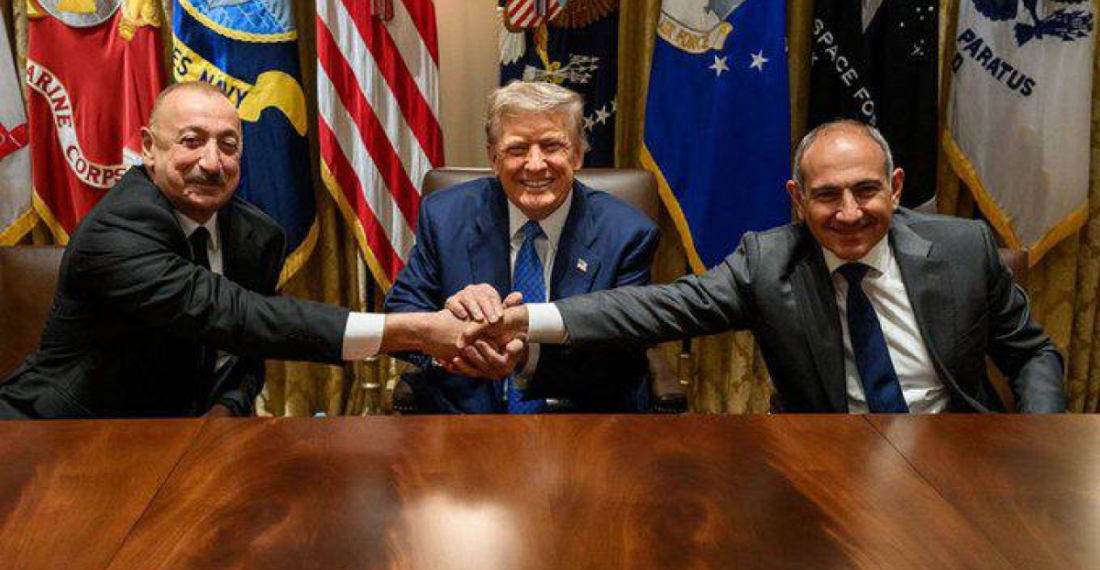
photo: President Trump with the Armenian and Azerbaijani leaders at the White House  on 8 August 2025. 

The views expressed in opinion pieces and commentaries do not necessarily reflect the position of commonspace.eu or its partners

 

Related articles

Editor's choice
News
Borrell tells the European Parliament that the situation in Afghanistan was critical, but the EU will remain engaged

Borrell tells the European Parliament that the situation in Afghanistan was critical, but the EU will remain engaged

Borrell underlined that the European Union will make every effort to support the peace process and to remain a committed partner to the Afghan people. "Of course, we will have to take into account the evolving situation, but disengagement is not an option.  We are clear on that: there is no alternative to a negotiated political settlement, through inclusive peace talks.
Editor's choice
News
Mystery surrounds the crash of a Turkish airline in Georgia which resulted in the death of 20 Turkish Airforce personnel

Mystery surrounds the crash of a Turkish airline in Georgia which resulted in the death of 20 Turkish Airforce personnel

​ Twenty Turkish Airforce personnel died when a military plane crushed on the Georgian side of the Azerbaijan - Georgia border on Tuesday (11 November). The C130 took off from Ganja and was heading to Merzifon, transporting service members that had participated in Azerbaijan's Victory Day celebrations. Half an hour after takeoff, the aircraft lost altitude and broke apart in mid-air over a mountainous area on the Georgian border. Lockheed C130 Hercules have been in service with Turkey since the 1960s and are considered among the most reliable in their class. However, some of these aircraft are 50–60 years old. In October, the Turkish Ministry of Defense announced plans to replace them with new C130J Super Hercules models, with deliveries expected to begin in the coming years. All aircraft fragments have already been collected for technical examination. The cause of the crash has not yet been officially determined. A Turkish expert and retired military officer Coşkun Başbuğ noted on CNN Türk, a technical malfunction "should be ruled out" as the cause of the crash. "Various possibilities should be considered, but the first thing to consider is that the C-130 is a time-tested military transport aircraft, the last known incident involving which occurred in 1982." "A technical malfunction should be ruled out as the cause of the crash. The same applies to weather conditions, as the relevant authorities would have reported bad weather. The remaining theories include a mid-air collision, sabotage, or an attack," he emphasized. Former Turkish Armed Forces Logistics Commander and retired Army General Erdoğan Karakuş stated in an interview with Turkish television that although the C-130 aircraft are old, they have undergone a complete modernization in Turkey, and their technical condition is thoroughly inspected before each flight. The Turkish Air Force is expected to operate the C-130 aircraft until 2040. ​

Popular

Editor's choice
News
Mystery surrounds the crash of a Turkish airline in Georgia which resulted in the death of 20 Turkish Airforce personnel

Mystery surrounds the crash of a Turkish airline in Georgia which resulted in the death of 20 Turkish Airforce personnel

​ Twenty Turkish Airforce personnel died when a military plane crushed on the Georgian side of the Azerbaijan - Georgia border on Tuesday (11 November). The C130 took off from Ganja and was heading to Merzifon, transporting service members that had participated in Azerbaijan's Victory Day celebrations. Half an hour after takeoff, the aircraft lost altitude and broke apart in mid-air over a mountainous area on the Georgian border. Lockheed C130 Hercules have been in service with Turkey since the 1960s and are considered among the most reliable in their class. However, some of these aircraft are 50–60 years old. In October, the Turkish Ministry of Defense announced plans to replace them with new C130J Super Hercules models, with deliveries expected to begin in the coming years. All aircraft fragments have already been collected for technical examination. The cause of the crash has not yet been officially determined. A Turkish expert and retired military officer Coşkun Başbuğ noted on CNN Türk, a technical malfunction "should be ruled out" as the cause of the crash. "Various possibilities should be considered, but the first thing to consider is that the C-130 is a time-tested military transport aircraft, the last known incident involving which occurred in 1982." "A technical malfunction should be ruled out as the cause of the crash. The same applies to weather conditions, as the relevant authorities would have reported bad weather. The remaining theories include a mid-air collision, sabotage, or an attack," he emphasized. Former Turkish Armed Forces Logistics Commander and retired Army General Erdoğan Karakuş stated in an interview with Turkish television that although the C-130 aircraft are old, they have undergone a complete modernization in Turkey, and their technical condition is thoroughly inspected before each flight. The Turkish Air Force is expected to operate the C-130 aircraft until 2040. ​