The Ministerial Council of the Organisation for Security and Co-operation in Europe (OSCE) will have its annual meeting in Vienna on 4-5 December. Foreign Ministers from the 57 member states, which also include the United States and Canada, and the Central Asian republics, and 11 partner countries, will congregate to discuss the future of European Security at a time when many believe that war in Europe over the next decade is likely. Ukraine is just a rehearsal for Russia’s ultimate ambitions.
British diplomacy used to describe the OSCE as “the organization to manage Russia”. It has not done a good job of that, but this task remains paramount.
The Ministerial Council will be the last major business of this year’s chairmanship, Finland, and will launch the new Chairmanship for 2026, Switzerland.
The OSCE has been moribund for some time, and Russia’s invasion of Ukraine in February 2022, nearly ended it. But Europe still needs the OSCE, and there is hope that it will take a new lease of life in 2026.
The Helsinki Final Act
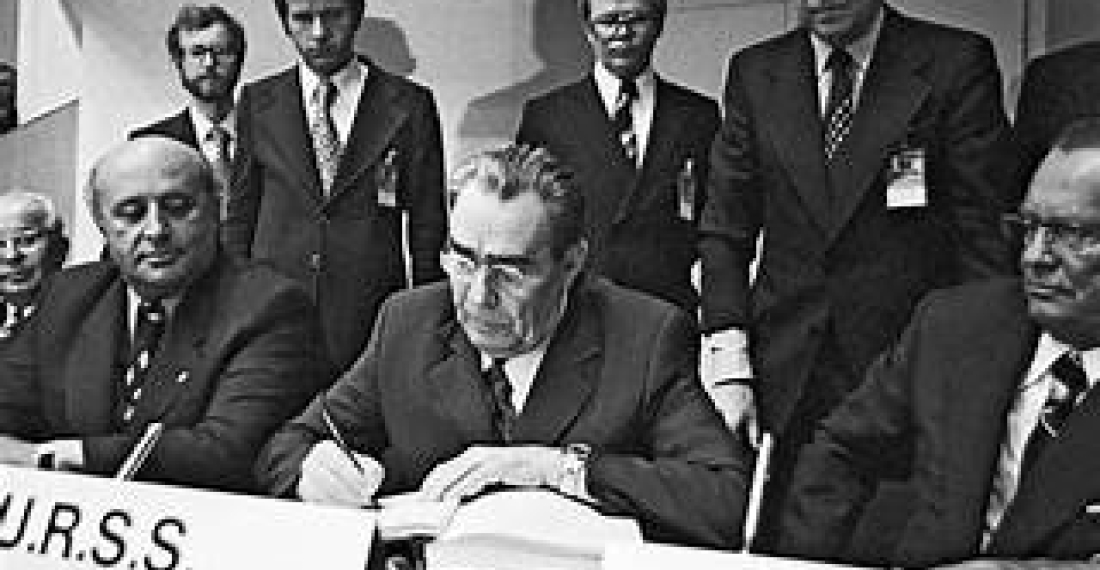
On its website, the OSCE says that it “works for stability, peace and democracy, through political dialogue on shared values and joint action. The basis for this is the principles agreed in the 1975 Helsinki Final Act and subsequent political decisions.” 2025 was the 50th anniversary of the Helsinki Final Act, which many in Europe see not only as the symbol of peace in Europe, but also as the beacon for the future. The Helsinki Final Act, adopted on 1 August 1975, “was a settlement on the territorial integrity of European states during the Cold War. But more than that, it linked the security of the international system with environmental sustainability, economic opportunity, and human rights. Agreement was forged on the 'freedom of thought, conscience, religion or belief, for all without distinction as to race, sex, language or religion,' and provided for equality for national minorities.”
For the OSCE to remain relevant it must remain inspired by that Act, but must accept that the present reality is different, and forge a new trajectory.
The last two Chairmanships of the OSCE, Malta in 2024 and Finland in 2025 were largely stop-gap efforts. Their job was mainly to keep the OSCE alive and intact at a time when the very existence of the organisation was in question. In this, they largely succeeded, but now there are expectations that the Swiss in 2026 can launch a new beginning. It will not be easy.
Switzerland has held the OSCE Chairmanship twice before, successfully. It has the experience, a wide network of embassies, and an able team in Bern, to successfully start what is likely to be a long and laborious journey. The new Chairman-in-office is Swiss Federal Foreign Minister Councillor, Ignazio Cassis. Cassis is also the current Vice President of the Swiss Confederation, and is fluent in Italian, English, German and French.
Quite unusual also is the fact that currently the General Secretary of the OSCE is a Turk. Feridun Sinirlioğlu is an experienced Turkish diplomat, who has held the position for a year. Between them, Cassis and Sinirlioğlu will have to craft out the new OSCE, but in the end, it will largely depend on the will of the member states, including Russia.
The Ministerial Council
Finland decided not to follow precedent, and not hold the Ministerial Council in Helsinki. According to the OSCE, “the decision to hold the Ministerial Council in Vienna instead of Helsinki reflects a commitment to reducing travel-related burdens for participating States and the Secretariat and minimising the environmental impact of the event.” However, the Finns probably also wanted to avoid the embarrassment of having to host Russian Foreign Minister, Sergei Lavrov, in their capital. Lavrov has in the past put a lot of obstacles in the path of the OSCE, but he also does not want to break it. The Russians are comfortable with the consensus rule of the OSCE, and they will drag their feet. So, progress on any issue will inevitably be slow. But the OSCE Ministerial Meeting will give an indication of Russia’s intentions, even if they are likely to be subtle signs.
Most of the time in the Ministerial Council will be taken by set-piece speeches by the 57 ministers, an opportunity for countries to set their stall. But behind-the-scenes meetings will take place which are more substantial.
This year will see Armenia and Azerbaijan for the first time since the early 1990s sitting not as enemies, even though not exactly as friends yet. The Ministerial Council will finally put an end to the ominous Minsk Group. The fact that the OSCE in the end played no part in ending the Armenia-Azerbaijan conflict is a failure from which lessons need to be learnt.
A new, reborn, OSCE, must understand that its core task remains European peace and security. It should resist the temptation of “looking busy” with a lot of secondary things. After peace and security return to Europe, it can consider other tasks. But we are far away from that yet.
Source: Monday Commentary is written every week by Dr Dennis Sammut, Director of LINKS Europe and Managing Editor of commonspace.eu
Photo: Soviet leader, Leonid Brezhnev, signing the Helsinki Final Act on 1 August 1975.