


Richard Giragosian reflects on Nikol Pashinyan's recent speech in Stepanakert and discusses how it fits in wider pan-Armenian processes, in this commentary for commonspace.eu
Through the years of mediated peace talks over the Nagorno Karabakh (Artsakh) conflict, there was rarely any confusion over the diplomatic positions of the negotiating sides. And despite the deep divide between Armenia/Karabakh and Azerbaijan, their rather entrenched policies offered little space for any real compromise or concession. At the same time, the absence of political will also posed an additional obstacle, further cementing a daunting diplomatic deadlock in the peace process.
Yet more recently, the dynamics of that deadlock have changed considerably, but surprisingly, in a very unlikely way. More specifically, the sudden and surprising developments in the peace process stem not from any modification from the Azerbaijani side, but rather from a set of unexpected differences with the earlier "status quo." And although Azerbaijan remains firmly anchored to its offer of no more than "the highest degree of autonomy," while the Armenian position is clearly predicated on a rejection of any return to Azerbaijani control, three significant developments are now contributing to a new context, with inherent implications for the course of diplomacy.
Developments in Armenia
The first of these new developments is the impact from the change of government in Armenia in 2018. The most notable result was the replacement of previous Armenian negotiators with a fresh team from the Pashinyan government comprised of younger interlocutors with both less experience and even less connection to the conflict. And from a broader perspective, the change of leadership in Armenia, coupled with a notably "free and fair" parliamentary election in December 2018, also encouraged many to expect a greater degree of political will from the Armenian side.
At the same time, for Azerbaijan, the forced resignation of the previous Armenian government, and the replacement of President Serzh Sargsyan with Prime Minister Nikol Pashinyan, was both a threat as well as an opportunity. The threat to Azerbaijan, which was also shared by Russia for that matter, stemmed from the rare success of non-violent "people power" over an entrenched elite. Given the nature of the Azerbaijani system of rule, with state legitimacy relying more on patronage and authoritarian rule than by free pluralistic elections, the Armenian model is first and foremost an inherent threat. Yet it is also an opportunity for Azerbaijan, to seek a new opening for concessions or compromise, and also to leverage its advantage of experience over a new team of Armenian negotiators.
A Renewed Risk of "War by Accident"
Yet even as the peace process has accelerated, marked by more meetings and greater diplomatic engagement, any genuine expectations by Azerbaijan that Pashinyan will deliver concessions are likely to be dashed. And even more dangerously, that disappointment from a likely failure of gaining any compromise may lead to greater frustration in Baku. And under that scenario, Azerbaijan would only feel justified to simply walk away from diplomacy and resume a strategy based on the threat of "force of arms." In this way, the risk of "war by accident," based on miscalculation and threat misperception, may be even greater, with an even more deadly intensity, especially after the lure of repeating an April 2016 offensive.
An Unexpected Division
A second development that has introduced a new dynamic shift in the delicate peace process is the new divergence of interests between Armenia and Karabakh. Beyond the basic fact that with the fall of the previous Armenian government, Karabakh lost many of its patrons and protectors, the lack of connections between the Pashinyan government and Karabakh also sparked concern from the very beginning. Moreover, most of the new Armenian government are untested, inexperienced and rather unknown figures for the Karabakh authorities. And the unpredictable nature of the still new Armenian government has sparked an unprecedented degree of uncertainty in Karabakh.
Against that backdrop, however, both the Armenian and Karabakh leaders have attempted to follow a policy of reassurance, aimed at stressing unity, commitment and even shared values. But this effort has been insufficient to fully resolve the differences and divisions on both sides.
The lingering nature of division, which also stems from a more natural divergence of interests, is also due to the fundamental connection between domestic Armenian politics and the Karabakh issue, especially as supporters of the previous Armenian government and critics of the current Pashinyan government have sought to mobilize the issue as a rallying cry against Pashinyan, both politically and personally.
The Role of Former President Robert Kocharian
This mobilization against the Armenian leadership was most evident in the case of former President Robert Kocharian, whose role as a former leader of both Karabakh and Armenia has served as a symbolic rallying point for various vested interests who are under threat from the Pashinyan government.
For Kocharian's supporters, the current Armenian government is perceived as engaging in a political vendetta or seeking revenge on the former leader, arguing that his prosecution is actually persecution. And even while many political figures and forces supporting Kocharian are united more by their stand against Pashinyan and less by any real affiliation or allegiance to Kocharian, the situation is especially dangerous as it is utilizing Karabakh as a new battleground to oppose the Armenian government.
The Pashinyan Response: Political Prudence or Populist Posturing
In the initial period of the successful change of government, the new Armenian leadership was enthusiastic for a similar demonstration of empowered "people power" in Karabakh. After that effort fell flat, even triggering a serious backlash, Armenian Prime Minister Nikol Pashinyan has been more cautious. Yet that caution was long seen as a temporary tactical retreat rather than as a strategic shift, avoiding direct confrontation but never fully resolving the impasse.
Most recently, however, the division between Armenia and Karabakh is coming to a head. With looming elections in Karabakh due next year, the Armenian side has already begun its own preparations to influence the discourse. And in a widely anticipated policy announcement, Prime Minister Pashinyan offered his own vision of the relationship between Armenia and Karabakh.
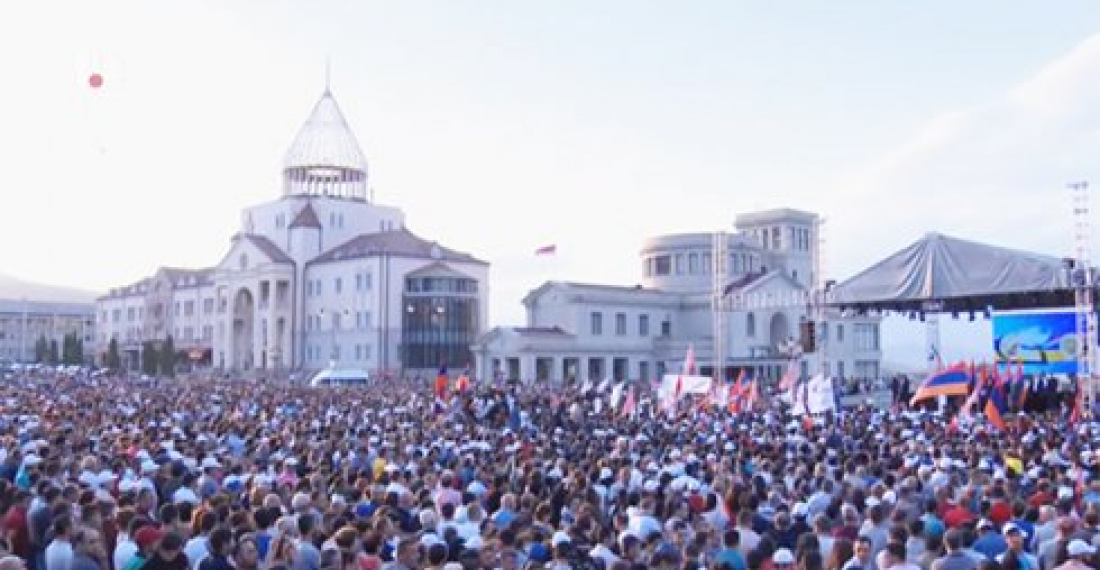
That policy address, coming in a speech in Karabakh on 5 August before several thousand in the Karabakh capital Stepanakert, was a chance for Pashinyan to choose between political prudence and populist posturing. Unfortunately, he seems to have opted for both, at times conveying statesmanship and strategic vision, while often returning to an appeal to the populism and "revolutionary" zeal that marked his earlier path to power.
For example, while the location was important, the timing of the speech with the ceremonial start of the seventh "Pan-Armenian Games" was even more indicative of the prime minister's intent. He stressed a set of ambitious, long-term "strategic goals" aiming through the year 2050, marked by rapid economic growth and capped by an impressive, if not impractical surge in Armenia's population, to a near doubling to over 5 million.
And regarding the Karabakh conflict, he stated that "any solution reached as a result of negotiations that will be considered acceptable for the governments of Armenia and (Karabakh) Artsakh can be regarded as acceptable only if it is popularly endorsed by people in Armenia and Artsakh."
Yet this populist messaging was also offset by more realistic and buttressed by more prudent policies, such as a condemnation of violence in politics, a strong stress on free and fair elections as the sole source for political and state legitimacy, and a strident endorsement of the imperatives to combat corruption and uphold the rule of law, while ensuring the independence of the judiciary.
But the apparent choice of a contradiction between populism and prudence was not the only notable element of the speech, as it seems likely that the Armenian government will only continue to maintain this apparent contradiction as a feature of "constructive ambiguity" in its diplomatic posture and policy stance regarding the peace process.
Source: This commentary was prepared for commonspace.eu by Richard Giragosian, director of the Regional Studies Center (RSC), an independent "think tank" in Yerevan, Armenia. (director@regional-studies.org)
Photo: participants at a pan-Armenian rally in Nagorno-Karabakh listen to a speech by prime minister Nikol Pashinyan of Armenia on Monday, 5 August 2019. (picture courtesy of asbarez.com)
The views expressed in opinion pieces and commentaries do not necessarily reflect the position of commonspace.eu or its partners



