


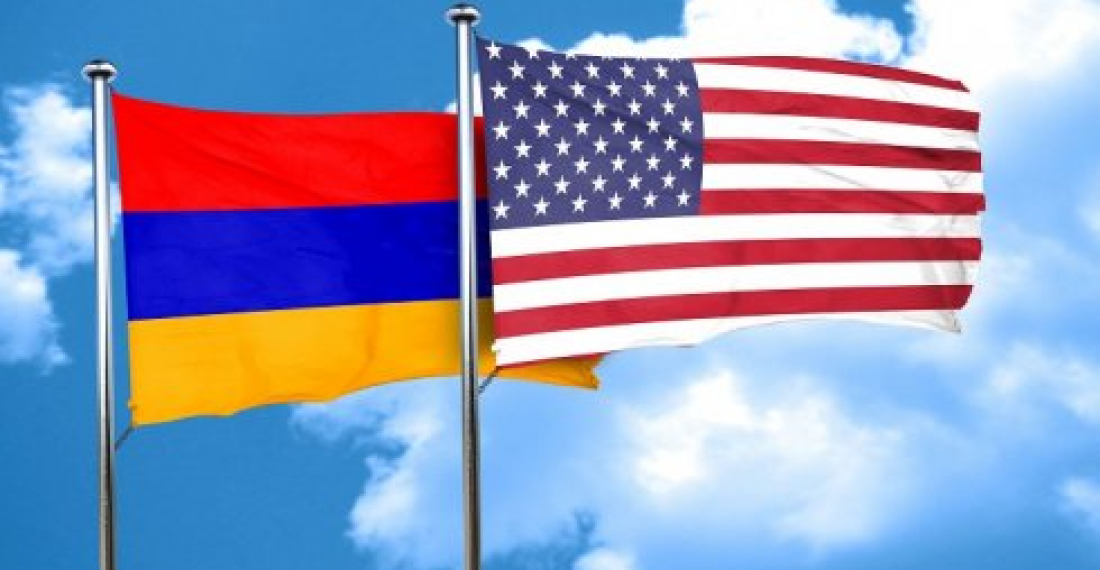
Opinion: None of the US strategic goals in the South Caucasus coincide with the Armenian national interest

Ahead of next month's visit by prime minister Nikol Pashinyan to the US, Benyamin Poghosyan assesses the potential for US-Armenia relations in this op-ed for commonspace.eu

Relations with the United States are of significant importance for Armenia. Despite the relative decline in the US position as the only world super power, Washington still remains the number one global power in the world. The US is a Minsk Group Co-chair country, actively involved in the Karabakh conflict settlement process, and it exerts great influence in the neighborhood of Armenia. America is also home for the most influential part of Armenian Diaspora, which may play a key role in bringing desperately needed investments into the Armenian economy. It also can be a source for albeit a modest, yet significant, process of repatriation of Armenians from the Diaspora to the motherland, thus alleviating the demographic challenges faced by Armenia.

Since the collapse of the Soviet Union, the US has perceived its relations with Armenia through the lenses of its overall policy towards the Former Soviet Union and Russia. Armenia is part of the South Caucasus, where the current US administration has three key goals.   

The first is the region's involvement in the policy of "maximum economic pressure" against Iran. Both Armenia and Azerbaijan are bordering Iran, and Georgia also may play a role as an alternative route for Iran towards Europe via Armenia and the Black Sea. The US policy aims at decreasing the region's relations with Iran as much as possible, and securing a free hand in using the region in different kinds of anti-Iranian activities.

The second goal of the current US administration is the facilitation of the launch of the Southern Gas Corridor, which will bring Azerbaijani gas to Europe circumventing Russia, as was the case with Azerbaijani oil delivered through the Baku - Tbilisi - Ceyhan pipeline. The US has much less enthusiasm now regarding the capabilities of Azerbaijan to strategically decrease Europe's gas dependency on Russia, as it transpires that Baku has only the potential to pump into Europe a maximum 20 billion cubic meters gas annually. However, despite the decreased significance of Azerbaijani gas for Europe, its still matters for the US to have alternative routes of gas supply to Europe.

The third factor influencing US policy in the region is the policy of containment and deterrence of Russia. Despite the seemingly warm attitude of President Trump towards Russia and President Putin, the current US administration has adopted a very tough policy towards Russia, putting various new sanctions in place and providing lethal weapons to Ukraine and Georgia. The South Caucasus, as a part of the former Soviet Space, is included in this containment of Russia policy. Washington aims to prevent any possible increase of Russian influence in Georgia and Azerbaijan, and to decrease Russian involvement in Armenia.

How do these three key goals correspond to Armenia's vital national interests?

Given that Armenia has not settled its relations with Azerbaijan and Turkey - and most probably this will not be the case for at least a decade - any deterioration in its relations with Iran, or significant destabilization in a neighboring country, will have serious detrimental effects on Yerevan. Iran, alongside with Georgia, is one of the two land corridors connecting Armenia with the world. The Iran - Armenia gas pipeline, despite the fact that its Armenian part is owned by Gazprom, provides Armenia with a vital alternative for gas supplies. It has 2.2 billion cubic meters annual capacity, enough to cover all of Armenia's natural gas needs. For now, the pipeline is used only to supply gas for electricity. As a result in 2018 Armenia imported some 567 million cubic meters gas from Iran and exported 1 billion 839 million kw hour electricity. Armenia also values Iran's position on the Karabakh conflict. A Shia Muslim country, Iran has a balanced approach, de facto supporting the current status quo. Thus, Armenia can not afford to support US policy towards Iran, and has to maneuver a thin line of not annoying the US too much, and simultaneously, at least preserving the current level of relations with Iran.

The launch of the Southern Gas corridor will have a negative impact on Armenia. It will definitely increase the strategic potential of Azerbaijan, foster the latter's relations with the European Union and the US, and bring additional financial resources which may widen the gap in the level of military expenditure of Armenia and Azerbaijan. Given the fact that Armenia, Azerbaijan and Karabakh appear to be preparing for the next round of large scale hostilities, these developments do not please Armenia.

The containment of Russia policy, with a possible decrease of Russian influence in the South Caucasus, could not make Armenia and Karabakh safer either. Definitely, Armenia should continue its multi-vector foreign policy, not putting all eggs into one basket. The active cooperation with NATO through the Individual Partnership Action Plans, the 2017 Comprehensive and Enhanced Partnership Agreement with the EU, and the recent intensification of relations with China, are all moves in this direction. However, at least for the upcoming decade, none of them could bring Armenia the minimum level of security guarantees provided by its strategic alliance with Russia. Thus, Yerevan simply cannot participate in any US sponsored anti - Russian policies in the region without jeopardizing the security of Nagorno Karabakh, and possibly Armenia itself. The possible significant decrease of Russian influence in the region will have the same effects.

Thus, none of the US current administration's three strategic goals in the region overlap with Armenia's national interest. Of course, it does not mean that Armenia should not have relations with the US, and should not make efforts to develop them. The main issues for Armenia are the US approach on Karabakh conflict and securing a positive US administration attitude towards bringing American investments to Armenia.

Given the existence of an Armenian community in the US numbering up to two million, concentrated mainly in California and in Boston and DC area, as well as their active lobbying organizations, Armenia has channels to influence both the US Congress and executive branch. The current campaign to prevent the cancellation of the US State Department funding for  demining projects in Nagorno Karabakh is a good example of what can be done.

The September 2019 visit of the Armenian Prime Minister to the US and planned September 22 meeting with the Armenian community of Los Angeles in the city's Grand Park, is a step in the right direction. Given the upcoming 2020 US elections, a manifestation of the level of influence of Armenia's leadership over the Armenian Diaspora in the US could give some leverage to both Armenia and Armenian lobbying in their relations with the legislative, and to some extent to the relations with the executive branch of the US Government. However, the results and effects of this leverage should not be overestimated. It may help Armenia to solve issues on a tactical level, but will not bring Armenia closer to the US strategically. 

source: Dr. Benyamin Poghosyan is Executive Director of the Political Science Association of Armenia and Founder and Chairman of the Center for Political and Economic Strategic Studies in Yerevan. He contributed this op-ed to commonspace.eu

The views expressed in opinion pieces and commentaries do not necessarily reflect the position of commonspace.eu or its partners


Related articles

Editor's choice
News
Key European countries back Denmark in the face of Trump's continuing insistence on taking over Greenland

Key European countries back Denmark in the face of Trump's continuing insistence on taking over Greenland

 Six major European countries have declared their support to Denmark following renewed insistence by the US that it must have control over Greenland. "Greenland belongs to its people, and only Denmark and Greenland can decide on matters concerning their relations," said the leaders of the UK, France, Germany, Italy, Poland, and Spain, in a joint statement, issued on Tuesday (6 January), together with Denmark. On Sunday, Donald Trump said the US "needed" Greenland - a semi-autonomous region of fellow Nato member Denmark - for security reasons. He has refused to rule out the use of force to take control of the territory, and Danish Prime Minister Mette Frederiksen warned on Monday that an attack by the US would spell the end of Nato. The issue of Greenland's future resurfaced in the wake of the US military intervention in Venezuela, during which elite troops went in to seize the country's President Nicolás Maduro and take him to face drugs and weapons charges in New York. Following the raid, Trump said the US would "run" Venezuela for an unspecified period of time. He also said the US was returning to an 1823 policy of US supremacy in its sphere of influence in the Western hemisphere - and he warned a number of countries the US could turn its attention to them. The US military raid in Venezuela has reignited fears that the US may consider using force to secure control of Greenland. A day after the raid, Katie Miller - the wife of one of Trump's senior aides - posted on social media a map of Greenland in the colours of the American flag, alongside the word "SOON". On Monday, her husband Stephen Miller said it was "the formal position of the US government that Greenland should be part of the US". In an interview with CNN, he also said the US "is the power of Nato. For the US to secure the Arctic region, to protect and defend Nato and Nato interests, obviously Greenland should be part of the US." Asked repeatedly whether the US would rule out using force to annex it, Miller responded: "Nobody's going to fight the US over the future of Greenland." Stressing they were as keen as the US in Arctic security, the seven European signatories of Tuesday's joint statement said this must be achieved by Nato allies, including the US "collectively" - whilst "upholding the principles of the UN Charter, including sovereignty, territorial integrity and the inviolability of borders". Greenland's Prime Minister Jens-Frederik Nielsen welcomed the statement and called for "respectful dialogue". "The dialogue must take place with respect for the fact that Greenland's status is rooted in international law and the principle of territorial integrity," Nielsen said. Trump has claimed that making Greenland part of the US would serve American security interests due to its strategic location and its abundance of minerals critical to high-tech sectors. Greenland, which has a population of 57,000 people, has had extensive self-government since 1979, though defence and foreign policy remain in Danish hands. While most Greenlanders favour eventual independence from Denmark, opinion polls show overwhelming opposition to becoming part of the US.
Editor's choice
News
Donald Tusk: "One for all, and all for one! Otherwise we are finished."

Donald Tusk: "One for all, and all for one! Otherwise we are finished."

Europe is rattled by events in Venezuela, and there are serious concerns that US disregard for international law may have consequences close to home.  The BBC diplomatic correspondent, James Landale, said, the question is how Europe may respond in the longer term to America's military operation in Venezuela. Will it provide a catalyst for the continent to take greater responsibility for its own security in the face of so much instability from what many see as an unreliable ally? Polish prime minister, Donald Tusk, appears to have answered the question, saying on social media: "No-one will take seriously a weak and divided Europe: neither enemy nor ally. It is already clear now. "We must finally believe in our own strength, we must continue to arm ourselves, we must stay united like never before. One for all, and all for one. Otherwise, we are finished." The US seizing of Venezuela's leader has faced strong criticism from both America's friends and foes at an emergency meeting of the United Nations Security Council, held on Monday, 5 January. Many member states agreed with the US that Nicolás Maduro had been an illegitimate and repressive leader. But many also condemned the US military action as a breach of international law and the UN Charter, and they demanded a democratic transition that reflected the will of the Venezuelan people. (click the image to read the full article).

Popular

Editor's choice
News
Key European countries back Denmark in the face of Trump's continuing insistence on taking over Greenland

Key European countries back Denmark in the face of Trump's continuing insistence on taking over Greenland

 Six major European countries have declared their support to Denmark following renewed insistence by the US that it must have control over Greenland. "Greenland belongs to its people, and only Denmark and Greenland can decide on matters concerning their relations," said the leaders of the UK, France, Germany, Italy, Poland, and Spain, in a joint statement, issued on Tuesday (6 January), together with Denmark. On Sunday, Donald Trump said the US "needed" Greenland - a semi-autonomous region of fellow Nato member Denmark - for security reasons. He has refused to rule out the use of force to take control of the territory, and Danish Prime Minister Mette Frederiksen warned on Monday that an attack by the US would spell the end of Nato. The issue of Greenland's future resurfaced in the wake of the US military intervention in Venezuela, during which elite troops went in to seize the country's President Nicolás Maduro and take him to face drugs and weapons charges in New York. Following the raid, Trump said the US would "run" Venezuela for an unspecified period of time. He also said the US was returning to an 1823 policy of US supremacy in its sphere of influence in the Western hemisphere - and he warned a number of countries the US could turn its attention to them. The US military raid in Venezuela has reignited fears that the US may consider using force to secure control of Greenland. A day after the raid, Katie Miller - the wife of one of Trump's senior aides - posted on social media a map of Greenland in the colours of the American flag, alongside the word "SOON". On Monday, her husband Stephen Miller said it was "the formal position of the US government that Greenland should be part of the US". In an interview with CNN, he also said the US "is the power of Nato. For the US to secure the Arctic region, to protect and defend Nato and Nato interests, obviously Greenland should be part of the US." Asked repeatedly whether the US would rule out using force to annex it, Miller responded: "Nobody's going to fight the US over the future of Greenland." Stressing they were as keen as the US in Arctic security, the seven European signatories of Tuesday's joint statement said this must be achieved by Nato allies, including the US "collectively" - whilst "upholding the principles of the UN Charter, including sovereignty, territorial integrity and the inviolability of borders". Greenland's Prime Minister Jens-Frederik Nielsen welcomed the statement and called for "respectful dialogue". "The dialogue must take place with respect for the fact that Greenland's status is rooted in international law and the principle of territorial integrity," Nielsen said. Trump has claimed that making Greenland part of the US would serve American security interests due to its strategic location and its abundance of minerals critical to high-tech sectors. Greenland, which has a population of 57,000 people, has had extensive self-government since 1979, though defence and foreign policy remain in Danish hands. While most Greenlanders favour eventual independence from Denmark, opinion polls show overwhelming opposition to becoming part of the US.

