


The lifting of sanctions enable Iran to resume its historical quest for influence in the South Caucasus. But with Russia and Turkley well-entrenched in the region, and with increasing EU engagement the task will not be easy for the Iranians argues Emil Avdaliani in this op-ed.
For centuries Iran was a regional power. Powerful Iranian dynasties such as the Achaemenids, and the Sasanians in ancient times, and the Safavids and Kajars in the 17th and 18th centuries. aspired to achieve a major role in the Middle East, the South Caucasus and the southern parts of Central Asia. The Cold War period was followed by the sanctions imposed by western countries in response to Tehran's nuclear program, Iran was constrained in its efforts to project its economic and political influence in its neighbouring regions.
The sanctions officially started being lifted in early 2016 and, despite its rhetoric, the Trump administration is unlikely to reverse the Iran nuclear deal in the near future. Iran now sees avenues for projecting its economic and political clout in its neighborhood, and in particular the South Caucasus region.
One of Iran's foreign policy imperatives is to increase its gas exports and trade relations with Europe. There are opportunities for this cooperation as the EU is worried about Russian predominance in the European gas market. Iranian gas could be a very good tool to assuage European fears, but to export its gas Iran would need access to the Black Sea ports, such as Batumi and Poti in Georgia.
To this end, Iranian officials often meet their Georgian counterparts to discuss trade corridors. For example, on June 6th the heads of the Georgian, Iranian and Azerbaijani railways discussed launching a new South-West Transport Corridor, where, as they stated, Georgia will play a vital transit role connecting the Persian Gulf and India to Europe.
Tehran has also often expressed its willingness to use the Trans-Anatolian Gas Pipeline and the Trans-Adriatic Pipeline. Moreover, Iran intends to increase its trade with the South Caucasus countries. For example, it stated on several occasions that trade with Georgia, Armenia and Azerbaijan would grow from approximately $1 billion to more than $2.5 billion.
As a result, Iran has made progress establishing itself on the Black Sea coast. In late 2016 it was agreed that Iran and Georgia construct through a joint venture various oil-reproduction facilities near Georgia's Black Sea town of Supsa, on approximately 1.2 square kilometers of land.
However, despite some successes there are big constraints which Iran will continue facing in the South Caucasus given that Russia, as well as Turkey are already deeply entrenched in the region and well represented both militarily and economically. Russia for instance successfully obstructs any Iranian moves to establish independent/new pipelines or railways to Armenia and Georgia. A sign of this was seen some years ago when talks started on building a large-scale transit gas pipeline from Iran through Armenian territory to Georgia. Moscow quickly blocked the move through its influence on the Armenian government. The Kremlin even bought the majority of shares in the existing Armenia-Iran transit pipeline to effectively forestall any further initiatives on this front.
Tehran and Yerevan also held talks on the possibility of constructing a $3.7 billion railway through Armenia to Georgia's Black Sea coast. However here too the project stalled because of difficulties in finding finances for the project. In reality though, Russia owns most of Armenia's railway infrastructure, and is therefore in a position to block any Iranian initiative. Another reason why this project did not materialize could be that neighboring Azerbaijan already has the necessary pipeline infrastructure in place, and the new Baku-Tbilisi-Akhalkalaki-Kars railway will strengthen Iran's willingness to use the Azerbaijan route.
Another area of involvement for Iran could be the simmering Nagorno-Karabakh conflict. In the early 1990s there were some unsuccessful attempts by the Iranian government to mediate the conflict. Since both Armenia and Azerbaijan border on Iran it is quite natural that Tehran seeks to play a bigger role in the Nagorno-Karabakh conflict settlement process. However, Russia which still is a dominant power in the process, would oppose any Iranian initiatives which can diminish Moscow's role.
There is also a purely military aspect to the Russo-Iranian competition. Russia continues to be a dominant military power in the region, with active military bases in Armenia, Abkhazia and South Ossetia, as well as total control of strategic Caucasus mountain passes. This in turn further limits Iran's regional ambitions.
Despite rivalry Iran and Russia can also cooperate
However, despite the disputes over influence in the South Caucasus and elsewhere, Russia and Iran have shown they can cooperate too. Economics is one sphere where co-operation is possible, for example in the development of the North-South transport corridor, where Moscow and Tehran have joined forces with Baku.
Moscow and Tehran are also willing to co-operate to obstruct western presence in the region. Both also loath Turkish influence in the region, and the growing military cooperation between Ankara, Tbilisi and Baku. A similar concern is the expansion of NATO's role, primarily in Georgia.
Russian thinking on this aligns fully with that of the Iranians, as both fear western encroachment in their areas of influence. Tehran and Moscow are both worried that the EU might eventually engulf all the South Caucasus states. Georgia is already an EU Associate member, and Brussels is expecting to sign enhanced co-operation agreements with Baku and Yerevan later this year. The presence of Europe on Iran's northern border, through trade and EU soft-power tools will as a result be quite significant.
Thus, the lifting of the sanctions against Iran certainly helps the country enjoy more maneuverability in its economic and political interaction in the South Caucasus although it will nevertheless face substantial resistance from Russia and Turkey, whilst all three will face increasing competition from western countries and institutions.
source: Emil Avdaliani teaches history and international relations at Tbilisi State University and Ilia State University. He contributed this op-ed for commonspace.eu
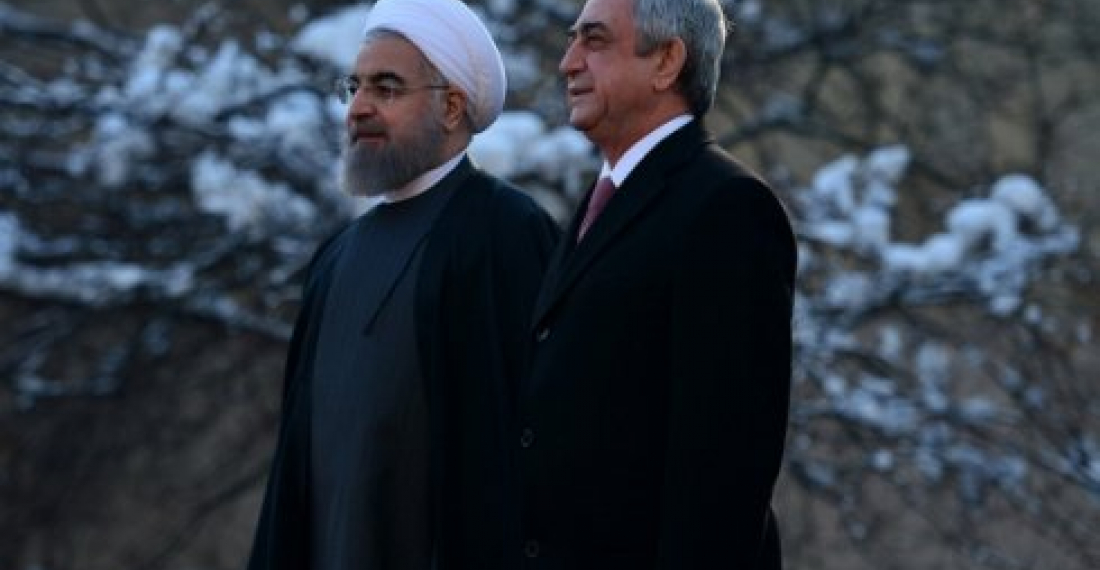
photo: Iranian President Hasan Rohani at a welcoming ceremony during his visit to Armenia in December 2016, together with the Armenian President Serzh sargsyan (picture courtesy of the press service of the President of Armenia)



