


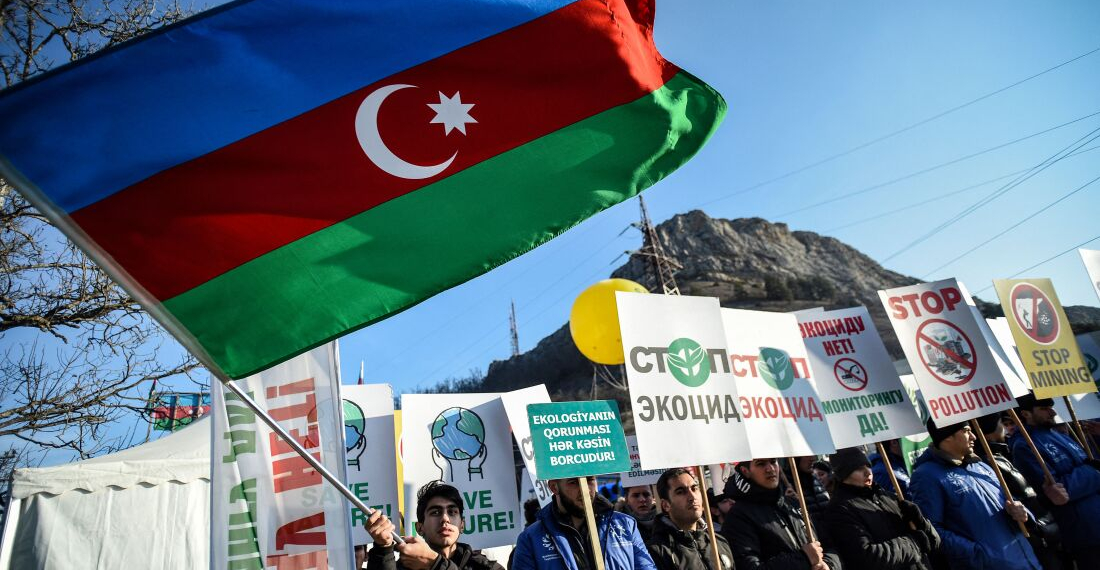
“As the host country of COP29, we have become the target of a coordinated, well-orchestrated campaign of slander and blackmail”, said President Ilham Aliyev of Azerbaijan during his inauguration speech at the climate conference on 12 November. This conference was the largest international event ever organised in Azerbaijan and the South Caucasus. Bringing together 80 presidents, vice presidents, and prime ministers, the conference had 72,000 registered participants from 196 countries. Azerbaijan has concentrated all its efforts over the past year since it received the mandate of hosting this event to make it as well-organized and successful as possible. In parallel, the country has had to deal with information attacks from multiple sources over the past year.
Some observers claimed that Azerbaijan is unfit to host a summit on climate conference given its role as an oil and gas exporting country, although Azerbaijan's share of global oil production is 0.7%, its share of global gas production is 0.9%, and its share in global gas emissions is only 0.1%. This criticism is still being raised as if all previous climate conferences were held in non-oil countries.
In response to this criticism, Hikmet Hajiyev, a foreign policy advisor to President Aliyev, said that “almost all countries that have hosted COP events so far have, in one way or another, been producers of fossil fuels. Before us, COPs were held in European countries, such as Katowice, Poland, one of the world's largest coal producers, and in Glasgow, UK, another major coal production site. Therefore, the focus should be on contributing to result-oriented discussions, not mutual accusations”. Indeed, it is the reality of today’s world which is one of the reasons why the international community needs climate conferences to discuss and implement green transition.
Azerbaijan is one of the countries that directs its revenues from fossil fuels to finance the country’s green transition. The region’s largest renewable projects are being implemented in Azerbaijan which facilitates also shifting from fossil fuel to electricity exports. Over the past few years, Azerbaijan has reached a number of international agreements for joint production and export of green energy products.
In partnership with the EU, Azerbaijan is developing an electricity cable beneath the Black Sea to link Caspian Sea wind power to the continent. The Caspian-Black Sea-Europe Green Energy Corridor, established by Azerbaijan, Georgia, Romania, and Hungary under a 2022 agreement, will transport up to four gigawatts of Azerbaijani wind energy to Europe via a 1,195-kilometer submarine cable.
On the sidelines of COP29, Azerbaijan reached another agreement that will help the increase of green energy exports. Azerbaijan, Kazakhstan, and Uzbekistan signed a landmark strategic partnership agreement in Baku to jointly develop and transmit green energy via a clean energy cable beneath the Caspian Sea, connecting to European markets through the Black Sea. The leaders of the three countries emphasised the project’s transformative potential for regional cooperation, renewable energy integration, and climate action, with plans to leverage their vast wind and solar energy resources. The project launches the construction of a green energy corridor connecting Central Asia, the Caucasus, and the Black Sea region. It is important that all three countries have significant projects in the implementation phase for the production of renewable energy.
Partly due to the depletion of its fossil fuel resources, transitioning from reliance on conventional energy sources to alternative energy is a priority in Azerbaijan’s national energy policy. Renewable energy is projected to account for 30 per cent of Azerbaijan’s electricity generation by 2030. The country’s renewable energy potential is estimated at 135 GW onshore and 157 GW offshore, with plans in Baku to develop solar, wind, and hydropower stations totalling around 6 GW by 2030. Additionally, Azerbaijan has secured contracts and memorandums of understanding for renewable energy projects totalling 10 GW.
The liberated Karabakh region of Azerbaijan is the area where the region’s most ambitious green energy plants are being constructed. In 2023, Masdar from the UAE launched a 230-megawatt solar power plant, the largest in the region, while ACWA Power from Saudi Arabia is building a 240-megawatt wind power station. At COP29, an agreement was signed with BP to construct a 240-megawatt solar power station in Azerbaijan’s Jabrayil district, which will help decarbonise the Sangachal oil and gas terminal. Azerbaijan has also opened lawsuits against Armenia at the international courts for damaging the environment in the formerly occupied territories during the occupation period and preventing Azerbaijan from accessing or developing its energy resources in this region.
Meanwhile, Azerbaijan acknowledges the limitations of the green transition. It is a commonly accepted fact that the world will continue to rely on fossil fuels until a full shift to green energy is achieved. This is why even the European Union, a major advocate for the green transition, has signed new contracts for the importation of oil and gas. Similarly, in 2022, the European Commission requested that Azerbaijan increase its gas production and double the exports to the EU as part of Europe’s efforts to reduce dependency on Russia. This calls into question the logic of stigmatizing Azerbaijan for being a fossil fuel producer as the host of COP29.
In conclusion, the criticism against Azerbaijan and the calls for boycotting the climate conference lacked objective grounds. Azerbaijan is clearly making significant strides in supporting the global shift toward green energy, while its share in global oil/gas production is minimal. With ambitious projects like the Caspian-Black Sea-Europe Green Energy Corridor, putting green energy production as amongst the country’s national priorities, and collaborations with its neighbours from Central Asia, Azerbaijan is not only advancing its renewable energy sector but also helping diversify Europe’s energy sources.



