


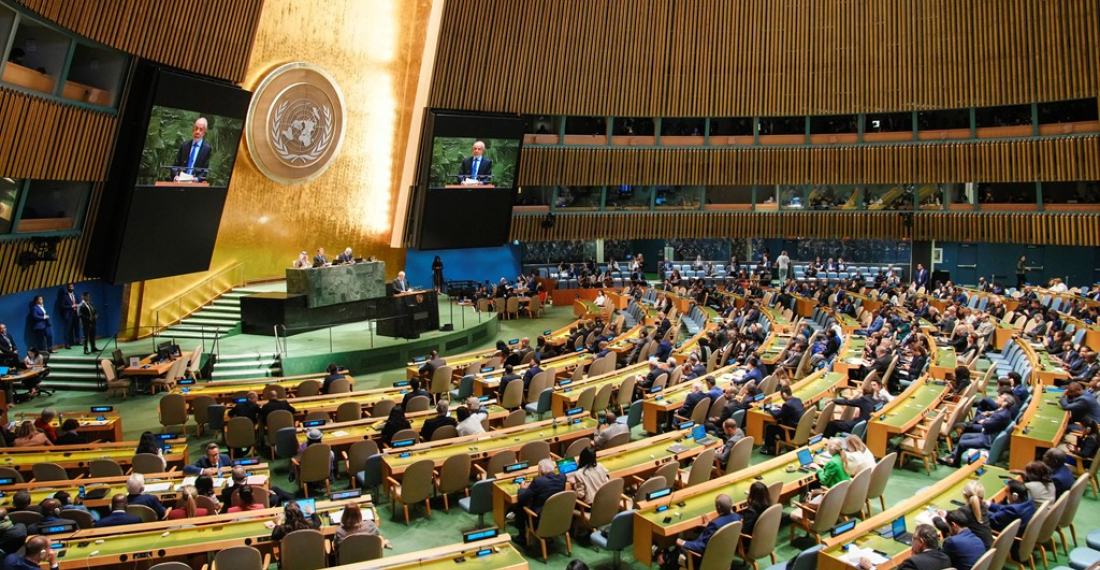
On Tuesday (23 September), the high-level General Debates opened at the 80th UN General Assembly in New York under the theme “Better together: 80 years and more for peace, development and human rights.” The title may sound uplifting, almost celebratory, but beneath the polished words lies a chilling undertone: a desperate plea for unity. The General Debates unfold during a time when the world order faces multiple challenges: global conflicts at their highest level since World War II, genocide and famine in Gaza, humanitarian crises in Sudan and Yemen, a grinding war in Ukraine, bombings in the Middle East, accelerating climate breakdown, deep cuts to international aid and among many others a dangerous surge in human rights and international law violations.
Wars and crises defining the moment
By supporting Israel’s bombings across the Middle East and its genocide in Gaza, the West has shredded the credibility of the “rules based” order it purports to lead. Some European countries have recognised the statehood of Palestine ahead or during the UNGA, further isolating Israel and its closest ally, the United States. However, while recognition is a step in the right direction, Ivana Kottasová notes in her article for CNN that “recognition does not change the reality on the ground.” On paper, the UN and these states envision a future Palestine consisting of East Jerusalem, the occupied West Bank, and Gaza. In reality, that vision is collapsing.
The International Organization for Migration stated in April 2025 that 90% of homes in Gaza are destroyed or damaged, and much of the infrastructure including schools, hospitals, universities, water and sanitation networks, roads, government offices, cultural centres, and places of worship, have been reduced to rubble, stripping the society of the very institutions it needs to function. East Jerusalem has long been annexed by Israel while the West Bank resembles a set of small islands divided by Israeli illegal settlements and cut off from each other by checkpoints controlled by the Israel military. In addition, an independent United Nations inquiry has recently concluded that Israel is committing genocide against Palestinians in Gaza. Israel’s war in Gaza has claimed the lives of at least 70,000 Palestinians, with thousands of civilians still unaccounted for under collapsed buildings. Thousands of children have been left orphaned; many people have been left mutilated, and at least 400 civilians have died due to malnutrition after Israel’s blockade on humanitarian aid.
During the General Debates, Turkish President Recep Tayyip Erdoğan, President of Chile Gabriel Boric, Colombian President Gustavo Petro, French President Emmanuel Macron, South African President Cyril Ramaphosa, Qatari Emir Sheikh Tamim, Lebanese President Joseph Aoun, and Jordan’s King Abdullah II all used their speeches to demand a ceasefire in Gaza and an end to the killing of Palestinians. Whether their plea, alongside the recent wave of recognitions of Palestinian statehood, will translate into meaningful action remains uncertain.
In Sudan and Yemen, humanitarian crises deepen, receiving a fraction of global attention despite the millions displaced and at risk of starvation. Sudan has been plunged into a civil war between the Sudanese Armed Forces and the Rapid Support Forces since April 2023. More than 10 million people have been displaced, and according to the UN more than 25 million people are suffering from violence, food insecurity and are in dire need of humanitarian aid in Sudan. In Yemen, after 10 years of conflict an estimated 14 per cent of the population is currently displaced and more than 18.2 million people are in need of humanitarian assistance. Tens of thousands are already living in famine-like conditions and five million more are acutely food insecure.
Russia’s relentless war in Ukraine continues to terrorise civilians. Ukrainian president Volodymyr Zelenskyy argued in his speech at the UNGA on Wednesday (24 September) that “even during bloodshed, there isn’t a single international institution that can truly stop it. That’s how weak these institutions have become. What can Sudan, or Somalia, or Palestine, or any other people living through war, really expect from the UN or the global system? For decades, just statements and statements.” The harsh reality is that if countries do not uphold the international laws, international institutions cannot effectively maintain the world order. The credibility of the multilateral system rests not on simple rhetoric but on the willingness of states to enforce the rules they claim to defend.
Systemic threats: climate and erosion of aid
Beyond wars, structural challenges are eroding the very foundations of global stability. Climate change stands as one of humanity’s greatest existential threats, yet some world leaders still deny its reality. The crisis is already here, driving food insecurity, mass migration, and increasingly violent weather patterns that fall hardest on the Global South, the very regions that have contributed the least to global warming. There is no denying the link: wars and the accelerating militarisation of our world go hand in hand with rising global emissions. As South African President Cyril Ramaphosa reminded the UNGA on Tuesday (23 September), “We must act decisively to silence all guns, everywhere, to realise the goal of sustainable development and global peace.” Yet instead of scaling up cooperation to decrease the risks of climate change, many states are cutting back. Financial aid budgets shrink, leaving humanitarian agencies overstretched and underfunded.
The retreat is most striking in the United States, where recent cuts to USAID and other foreign assistance programmes have stripped vulnerable communities of critical lifelines. For countries in the Global South, already bearing the brunt of rising temperatures, droughts, and floods, this withdrawal is nothing short of devastating. It signals not only a failure of solidarity, but a betrayal of responsibility by those most historically accountable for greenhouse gas emissions. The US may be retreating from its support for the UN, but this vacuum creates space for the countries hardest hit by climate change to rise as architects of a new global order. As Finnish President Alexander Stubb reminded the UNGA on Wednesday (24 September), a shifting dynamic is underway: “the balance of power [is moving] towards the South and East. Many countries, especially in Africa, Asia, and Latin America, are becoming or have become key players in determining the direction of the new world order.”
A crossroads moment
The theme “Better together” is, at its core, an appeal to countries’ shared humanity. Eighty years after its founding, the UN stands at a crossroads. The institution that once embodied post-war hope now struggles to uphold a fractured world order. Yet its warning should not be dismissed. The General Debates may not yield the breakthroughs urgently needed, but they serve as a stark reminder: without unity, peace, development, and human rights risk becoming empty words on fading UN banners. Today’s crises are deeply interconnected. They demand collective action, for, in President Zelensky’s words, “people are waiting for action.”



