


Deployment of the EU monitoring mission to Armenia: A view from Azerbaijan

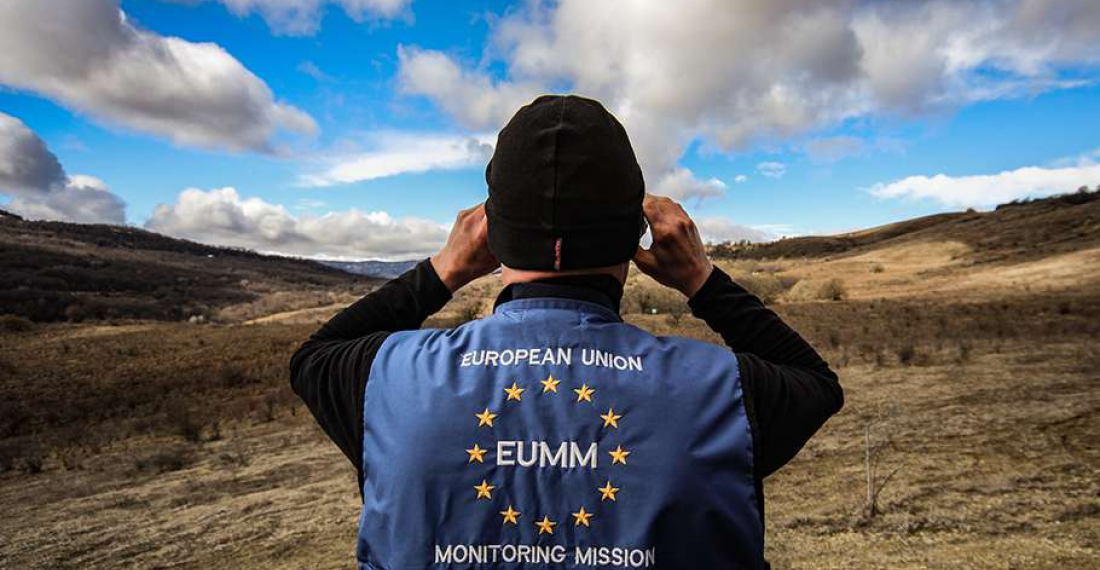
On January 23, the Council of the European Union (EU) agreed to establish a civilian monitoring mission in Armenia’s border areas in order to “ensure an environment conducive to normalization efforts between Armenia and Azerbaijan”. The deployment of the mission has caused mixed reactions in the two countries and frustrated Russia, writes Vasif Huseynov in this op-ed for commonspace.eu. He writes that Baku's reaction to the deployment of the EU mission is "ambivalent and can be analyzed along three major lines."

From the Russian perspective, Armenia is a military ally of Russia within the Collective Security Treaty Organization (CSTO), and hence Russia was pushing for the deployment of a CSTO mission instead of that of the EU. Although the Armenian leaders sought to assuage Russia’s concerns by declaring that “the political vector” of Yerevan is not changing, it would hardly suffice to assure the Kremlin. Many local observers anticipate a further degradation in relations between the two allies, which would have significant implications not only for Armenia’s security but also for the Armenia-Azerbaijan peace process. In Baku, therefore, the reaction to the deployment of the EU mission is ambivalent and can be analyzed along three major lines.

Above all, for Baku, the fact that the new mission was deployed to the region without prior consultations and without their consent, is distressing. The previous mission - which was deployed for two months (October 20 – December 19, 2022) - had been agreed in the EU-mediated Prague summit of the Armenian and Azerbaijani leaders on October 6, and Baku made a commitment to cooperate with the mission. This mission was not extended, but then replaced with a larger mission for a longer period without an agreement with Baku.

The Azerbaijani government views this as a manipulation, particularly from the French side, and warns that this would have a negative impact on the peace process. Azerbaijani experts also question the nature of this “France-imposed” mission since the EU demonstrated silence and inactivity when Azerbaijani borders were violated, and its border areas attacked during the thirty years of the Armenian occupation period.

In this sense, there is a contradiction between the declared goal of the mission (i.e. creating an environment conducive for the normalization efforts) and the modus operandi of the adoption of this decision (i.e. the exclusion of one side that is directly concerned). This is therefore likely to have a negative impact also on the EU track of the Armenia-Azerbaijan peace negotiations which have already faced big challenges after the intervention of the Russian side.

Secondly, Baku is concerned that the EU monitoring mission might be exploited by Armenia to avoid its obligations under the trilateral statement of November 10, 2020. There are a number of issues that had been agreed under this statement but remain unimplemented by the Armenian side. This includes, primarily, the re-opening of transportation routes, Armenia’s provision of a land passage between the western parts of Azerbaijan and the Nakhchivan exclave, as well as Armenia’s withdrawal of its armed forces from Azerbaijani territories. 

For Baku, the experience of the previous mission - the actual deployment of which the Ministry of Foreign Affairs described as being “accompanied by serious deviations from the agreements reached in Prague, following biased approaches taken by some EU member-states” - creates concerns that the new mission would also cause some complications. The efforts of some EU countries, in particular France, to protect Armenia at all costs even when it is at odds with the international law (as in the case of the French parliament’s recognition of the separatist regime in Karabakh as an independent state) suggest that Armenia might benefit from this mission, staying stubborn in its refusal to implement its obligations.

Last but not least, the fact that the European Union is increasing its presence in the region and acting more assertively is a very important development for the South Caucasus. This would help regional countries to more confidently counter threats posed to their national security from various directions. The deployment of an EU mission to a second country in the region, after Georgia, is therefore a manifestation of the EU’s growing engagement with the South Caucasus. The EU should however not disregard its implications for the Armenia-Azerbaijan peace process. The mission would deliver positive outcomes only if the process is accompanied by meaningful and substantive negotiations and the practical implementation of previously reached agreements, including those on transportation routes.

The resumption of the EU-mediated talks between Baku and Yerevan as well as reactivating the efforts to sign a peace treaty between the two sides would help de-escalate tensions in the region and create a more favorable environment for peace and reconciliation. A complete de-escalation will however hardly be possible without the settlement of the present crisis in the Karabakh region of Azerbaijan created by Moscow's installation of a Russian oligarch as de-facto leader of the separatist regime. The EU has unfortunately limited instruments and leverage to address this crisis, even after the deployment of a long-term monitoring mission to the Armenia-Azerbaijan border.
source: This op-ed was prepared for commonspace.eu by Dr Vasif Huseynov, Head of Department at the Centre of Analysis of International Relations (AIR Centre) and Adjunct Lecturer at Khazar University in Baku, Azerbaijan. 
photo: EU Monitoring Mission in Armenia, Radar Armenia
The views expressed in opinion pieces and commentaries do not necessarily reflect the position of commonspace.eu or its partners

Related articles

Editor's choice
News
Borrell tells the European Parliament that the situation in Afghanistan was critical, but the EU will remain engaged

Borrell tells the European Parliament that the situation in Afghanistan was critical, but the EU will remain engaged

Borrell underlined that the European Union will make every effort to support the peace process and to remain a committed partner to the Afghan people. "Of course, we will have to take into account the evolving situation, but disengagement is not an option.  We are clear on that: there is no alternative to a negotiated political settlement, through inclusive peace talks.
Editor's choice
News
NATO Chief says war is on Europe's doorstep, and warns against complacency

NATO Chief says war is on Europe's doorstep, and warns against complacency

Russia could attack a Nato country within the next five years, the Secretary General of NATO, Mark Rutte, said in a stark new warning. "Nato's own defences can hold for now," Rutte warned in Berlin, but conflict was "next door" to Europe and he feared "too many are quietly complacent, and too many don't feel the urgency, too many believe that time is on our side. "Russia is already escalating its covert campaign against our societies," Rutte said in a speech in Germany. "We must be prepared for the scale of war our grandparents or great-grandparents endured." Earlier this month, Russia's President Vladimir Putin said his country was not planning to go to war with Europe, but it was ready "right now" if Europe wanted to - or started a war. But similar reassurances were given by Moscow in 2022, just before 200,000 Russian troops crossed the border and invaded Ukraine. Putin has accused European countries of hindering US efforts to bring peace in Ukraine - a reference to the role Ukraine's European allies have recently played in trying to change a US peace plan to end the war, whose initial draft was seen as favouring Russia. But Putin was not sincere, Nato's secretary-general said in the German capital, Berlin. Supporting Ukraine, he added, was a guarantee for European security. "Just imagine if Putin got his way; Ukraine under the boot of Russian occupation, his forces pressing against a longer border with Nato, and the significantly increased risk of an armed attack against us." Russia's economy has been on a war footing for more than three years now - its factories churn out ever more supplies of drones, missiles and artillery shells. According to a recent report by the Kiel Institute for the World Economy, Russia has been producing each month around 150 tanks, 550 infantry fighting vehicles, 120 Lancet drones and more than 50 artillery pieces. The UK, and most of its Western allies, are simply not anywhere near this point. Analysts say it would take years for Western Europe's factories to come close to matching Russia's mass-production of weapons. "Allied defence spending and production must rise rapidly, our armed forces must have what they need to keep us safe," the Nato chief said.

Popular

Editor's choice
News
NATO Chief says war is on Europe's doorstep, and warns against complacency

NATO Chief says war is on Europe's doorstep, and warns against complacency

Russia could attack a Nato country within the next five years, the Secretary General of NATO, Mark Rutte, said in a stark new warning. "Nato's own defences can hold for now," Rutte warned in Berlin, but conflict was "next door" to Europe and he feared "too many are quietly complacent, and too many don't feel the urgency, too many believe that time is on our side. "Russia is already escalating its covert campaign against our societies," Rutte said in a speech in Germany. "We must be prepared for the scale of war our grandparents or great-grandparents endured." Earlier this month, Russia's President Vladimir Putin said his country was not planning to go to war with Europe, but it was ready "right now" if Europe wanted to - or started a war. But similar reassurances were given by Moscow in 2022, just before 200,000 Russian troops crossed the border and invaded Ukraine. Putin has accused European countries of hindering US efforts to bring peace in Ukraine - a reference to the role Ukraine's European allies have recently played in trying to change a US peace plan to end the war, whose initial draft was seen as favouring Russia. But Putin was not sincere, Nato's secretary-general said in the German capital, Berlin. Supporting Ukraine, he added, was a guarantee for European security. "Just imagine if Putin got his way; Ukraine under the boot of Russian occupation, his forces pressing against a longer border with Nato, and the significantly increased risk of an armed attack against us." Russia's economy has been on a war footing for more than three years now - its factories churn out ever more supplies of drones, missiles and artillery shells. According to a recent report by the Kiel Institute for the World Economy, Russia has been producing each month around 150 tanks, 550 infantry fighting vehicles, 120 Lancet drones and more than 50 artillery pieces. The UK, and most of its Western allies, are simply not anywhere near this point. Analysts say it would take years for Western Europe's factories to come close to matching Russia's mass-production of weapons. "Allied defence spending and production must rise rapidly, our armed forces must have what they need to keep us safe," the Nato chief said.

