


In recent years, Azerbaijan’s relationship with Russia and Russia-led multilateral frameworks has entered a period of growing ambiguity. Statements by prominent Russian ideologues and narratives circulating in Russian state media increasingly question the sovereignty and independent foreign policy choices of post-Soviet states, including Azerbaijan. Against this backdrop, Baku faces a legitimate and timely question: what tangible political or strategic value does continued membership in the Commonwealth of Independent States (CIS) actually provide?
The problem is not confined to rhetoric alone. The gap between political declarations made at the highest level and the actions of Russian state institutions has become increasingly visible. This contradiction was clearly exposed following the October 2025 meeting between Presidents Ilham Aliyev and Vladimir Putin on the sidelines of the CIS summit in Dushanbe. While the meeting was widely perceived in Azerbaijan as an opportunity to stabilize bilateral relations after the tragic Azerbaijan Airlines crash in December 2024, subsequent developments cast serious doubt on Moscow’s willingness – or ability – to honor the assurances given.
Despite Putin’s public apology and his promise that the investigation would be completed objectively, with legal responsibility assigned and compensation provided, no meaningful progress followed. On the contrary, the Russian Investigative Committee’s decision to close the criminal case, later formalized in correspondence signed by its chairman, directly contradicted the explanations offered by the Russian president in Dushanbe.
This situation inevitably raises broader questions about the attitude of Russia to Azerbaijan, the commitments it makes at the highest level, and overall, the present situation in the Russia-Azerbaijan relations. Another important question it raises is related to the CIS. If presidential-level understandings reached during CIS summits are not implemented in practice, the organization’s relevance as a platform for political dialogue and confidence-building becomes questionable. The CIS was originally conceived as a mechanism to manage post-Soviet cooperation through consultation and coordination. Yet repeated failures to ensure follow-through risk reducing it to a ceremonial forum rather than a meaningful multilateral institution.
Azerbaijan’s cautious approach to the CIS has long reflected this reality. Baku does not recognize the organization or its executive bodies as independent subjects of international law, nor does it treat CIS decisions as binding. Instead, Azerbaijan views the CIS primarily as a consultative framework among sovereign states. This is further underscored by the fact that Azerbaijan has joined many of the organization’s foundational documents, including the CIS Charter, with reservations and special conditions.
In practice, Azerbaijan’s foreign policy has consistently prioritized bilateral engagement over institutionalized multilateralism within the post-Soviet space. This approach has not been limited to relations with Russia but extends to Azerbaijan’s broader regional and international diplomacy. Bilateral formats allow for clearer accountability, defined obligations, and greater protection of national interests – advantages that are notably absent in the CIS context. This factor was specifically mentioned by President Aliyev in May 2024, when he was given a question about the likelihood of Azerbaijan to join the Eurasian Economic Union (EAEU). He talked about the problems member countries face within the EAEU and said Baku prefers to maintain its relations with other post-Soviet states in bilateral format.
Another factor undermining the rationale for continued CIS participation is Russia’s treatment of citizens from partner countries. Reports of ethnic discrimination, heavy-handed law enforcement practices, and hostile rhetoric toward migrants and minorities have become a persistent feature of Russia’s domestic environment. Azerbaijan was shocked by the violent raids Russia’s special security forces carried out against ethnic Azerbaijanis in Yekaterinburg in June 2025 that resulted in the extrajudicial killing of two brothers, and injuries to several others, with dozens detained. Such behavior contradicts the declared principles of partnership and mutual respect that supposedly underpin CIS cooperation. For Azerbaijan, continued participation in a framework where its citizens may face discriminatory treatment inevitably raises political and moral concerns.
Equally damaging is the discourse promoted by certain Russian ideologues who openly challenge the sovereignty of neighboring states and frame regional relations in terms of coercion rather than consent. Such narratives do not merely offend diplomatic sensibilities; they actively undermine trust and complicate the prospect of constructive cooperation. Sustainable partnerships cannot be built when sovereignty is treated as conditional or negotiable. Russia’s state-linked propogandists like Vladimir Solovyov and Alexander Dugin have openly called for military operations against Azerbaijan in response to Baku’s sovereign decisions in foreign policy.
Against this backdrop, the unresolved aftermath of the AZAL crash has become more than a bilateral dispute. Azerbaijan’s expectation was straightforward: that assurances provided by Russia’s leadership within a CIS summit setting would be upheld through transparent legal procedures. The failure to do so has not only strained bilateral relations but also highlighted the institutional weakness of the CIS as a guarantor of political commitments.
Public reaction in Azerbaijan reflects this growing disillusionment. Civil society organizations, media outlets, and political analysts have increasingly questioned whether participation in the CIS serves Azerbaijan’s long-term interests. The concern is not about dialogue itself, but about the asymmetry between responsibility and accountability within Russia-led structures.
Ultimately, the credibility of any multilateral organization depends on its ability to uphold commitments, respect sovereignty, and ensure equal treatment of its members. As the CIS fails to demonstrate these qualities in practice, Azerbaijan is pondering the question whether continued membership meaningfully advances its national interests. The time has come for a sober reassessment guided not by sentiment or inertia, but by strategic realism.
source: Dr Vasif Huseynov, is a Senior Advisor at the Center of Analysis of International Relations (AIR Center) and Adjunct Lecturer at Khazar University in Baku, Azerbaijan.
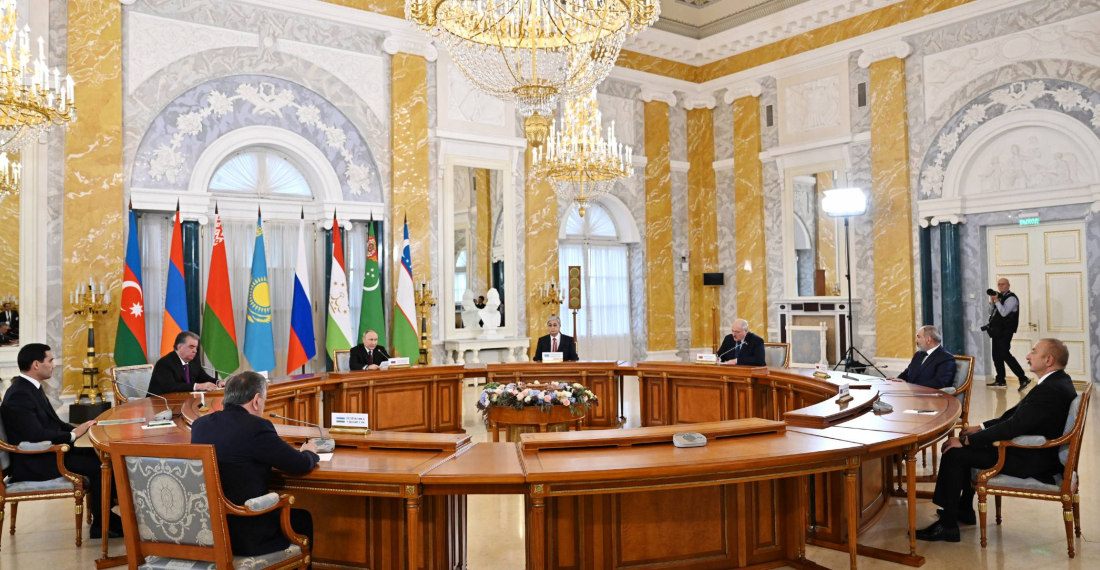
Photo: Azerbaijan president Ilham Aliyev at a recent CIS informal summit in St Petersburg
The views expressed in opinion pieces and commentaries do not necessarily reflect the position of commonspace.eu or its partners



