


Massive Russian attack on Kyiv leavies dozens killed or injured

Russian forces launched a major drone and missile attack on Kyiv overnight, killing 20 people, in what the city's mayor has described as the "most massive attack" on the Ukrainian capital. Vitaly Klitschko said around 90 people were injured. He said an ambulance station was among the places hit in the strikes and declared Friday a day of mourning.

Although previous attacks have killed more people, this latest barrage deployed the largest number of weapons on the capital and hit locations over a very wide area of Kyiv.

Several neighbourhoods were evacuated as strikes rocked buildings throughout the city, hours after Ukrainian President Volodymyr Zelensky warned Russia was preparing an attack.

Moscow said its forces hit what it called military plants in retaliation against attacks on Russian civilian infrastructure.

Kremlin spokesman Dmitry Peskov told reporters on Thursday that Russia would "continue to increase pressure on the Kyiv regime in order to achieve our set goals".

Ukraine accused Moscow of targeting civilian areas and said it would be wrong to equate the actions of the "aggressor and a country defending itself".

Children were among the "significant number" of casualties, Tymur Tkachenko, the head of Kyiv's ​military administration, said.

"The enemy is once again deliberately targeting residential areas and killing civilians," he said early on Thursday.

Kyiv's metro authorities said 52,500 people, including 4,500 children, sheltered in underground stations overnight, which they said was the highest number in "recent years".

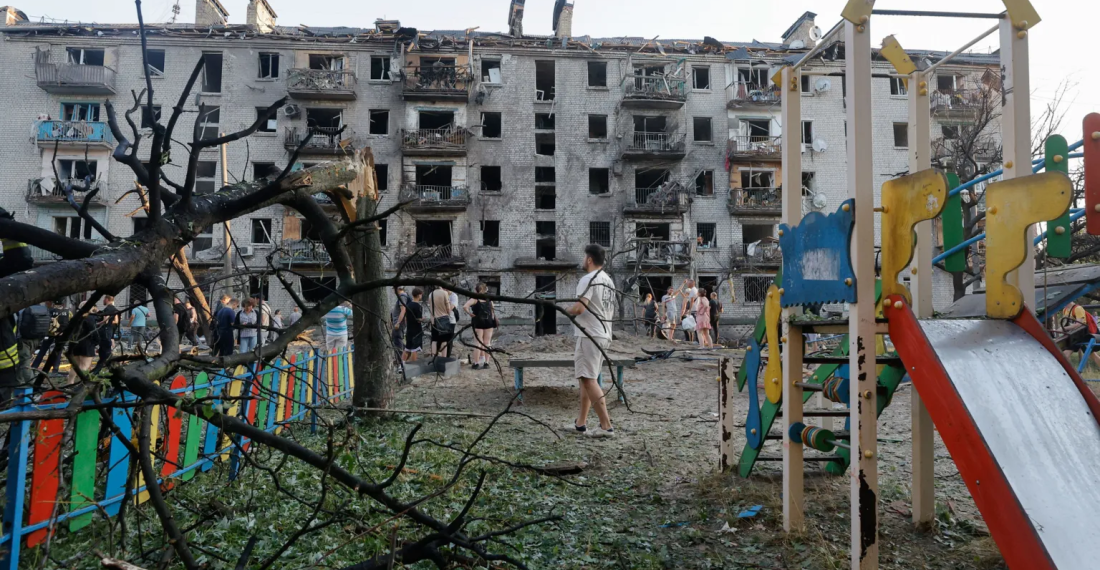
Among the places hit by the strikes was a high-rise block of flats in south-east Kyiv, part of which was blown off.

In a video posted on Telegram, Klitschko said rescuers were trying to find, among others, a 15-year-old girl and her family.

On the city's left bank, in Darnitskyi district in south-east Kyiv, two missiles hit a residential area directly, causing devastation.

One missile left a giant crater next to a kindergarten and the buildings all around have been gutted by fire, their metal balconies twisted.


The attack on Kyiv lasted more than 11 hours and came in several waves starting with a drone strike on Kyiv's historic quarter, setting off a fire in a hotel in the city centre.

At 01:00 (23:00 GMT on Wednesday), dozens of ballistic and cruise missiles were fired. A brief lull preceded another dozen of cruise missiles at 03:00, followed by a swarm of drones which targeted the capital until dawn.

Residents of Kyiv who have lived through four-and-a-half years of war say they have perceived a change in the pattern of Russia's assaults on the capital over the last two months. Attacks may now happen less frequently - albeit still every few days - but last longer, and seem more powerful and widespread.

source: commonspace.eu with BBC London and agencies.

Related articles

Editor's choice
News
Azerbaijan and the European Union find a common language

Azerbaijan and the European Union find a common language

After years of bickering, during which relations reached  "diplomatic lows", Azerbaijan and the European Union appear to have found a common language on how to build relations between them. The president of the European Commission on Wednesday (1 July) visited Baku for meetings with president Ilham Aliyev.. In a key speech, addressing president Aliyev, president Van der Leyen outlined the position of the European Union on various asspects of EU-Azerbaijan relations. "I am here today to deepen a partnership that matters greatly to the European Union. And one that has real momentum, as the President just described. But first, let me turn to the most important development in this region in decades. Peace. Let me congratulate you on initiating an historic peace agreement with Armenia. You showed personal leadership in promoting peace and cooperation across the region. And it is creating new opportunities for stability, trust and shared prosperity. The EU strongly supports this process. And we will continue to do so. Together, we can turn peace on paper into peace in practice. That is why we are working here today together." President Aliyev replied in kind: This is unprecedented dynamism in our relationship, which reflects the mutual will of both sides to intensify our cooperation and to strengthen our partnership. We highly value the relationship with the European Commission, and today, with Madame President and the delegations, we broadly discussed a very impressive agenda. The European Union is Azerbaijan's main trading partner. More than 40% of our trade is with the member states, and for the European Union, Azerbaijan is the main trading partner in the South Caucasus. Almost 70% of trade in the South Caucasus is trade with Azerbaijan." From what Aliyev and Van der Leyen said on 1 July, relations between the two is entering a new, positive, phase. (click picture to read a full report).

Popular

Editor's choice
Interview
Thursday Interview: Murad Muradov

Thursday Interview: Murad Muradov

Today, commonspace.eu starts a new regular weekly series. THURSDAY INTERVIEW, conducted by Lauri Nikulainen, will host  persons who are thinkers, opinion shapers, and implementors in their countries and spheres. We start the series with an interview with Murad Muradov, a leading person in Azerbaijan's think tank community. He is also the first co-chair of the Action Committee for a new Armenian-Azerbaijani Dialogue. Last September he made history by being the first Azerbaijani civil society activist to visit Armenia after the 44 day war, and the start of the peace process. Speaking about this visit Murad Muradov said: "My experience was largely positive. My negative expectations luckily didn’t play out. The discussions were respectful, the panel format bringing together experts from Armenia, Azerbaijan, and Turkey was particularly valuable during the NATO Rose-Roth Seminar in Yerevan, and media coverage, while varied in tone, remained largely constructive. Some media outlets though attempted to represent me as more of a government mouthpiece than an independent expert, which was totally misleading.  Overall, I see these initiatives as important steps in rebuilding trust and normalising professional engagement. The fact that soon a larger Azerbaijani civil society visits to Armenia followed, reinforces the sense that this process is moving in the right direction." (click the image to read the interview in full)


