Editor's choice
This is a members’ functionality. Please
Sign upOpinion
Trending
Opinion: A Corridor as a Guarantee - Why TRIPP Needs an International Consortium
15 August 2026
The road across the South Caucasus could become not only a transport route but also a system of mutual commitments that makes another war prohibitively costly for all involved, writes Mehman Aliyev in this article that was first published by Turan Analytical Service.
In Nakhchivan, separated from the rest of Azerbaijan by Armenian territory, the old railway served for decades as a reminder of the disintegration of a once-unified South Caucasus. The rails remained, but regional links were severed by war, blockade and mutual distrust.
Now it is here that one of the most consequential infrastructure experiments in the post-Soviet space may begin.
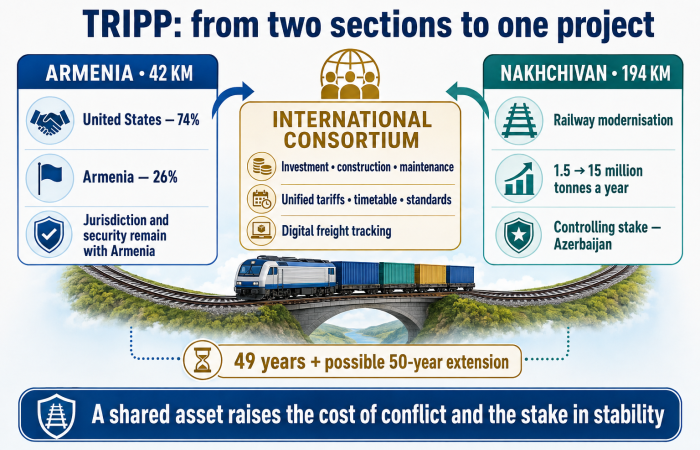
During a visit to Nakhchivan on August 11, President Ilham Aliyev said an international consortium could be created to reconstruct the Nakhchivan railway. The controlling stake, he stressed, should belong to the Azerbaijani state, but foreign companies and organisations could be among the investors. According to the president, the European Union and several countries have already shown interest in the project.
The plan concerns 194 kilometres of railway in Nakhchivan. It is expected to be modernised so that annual freight capacity can rise from the current 1.5 million tonnes to 15 million tonnes. The Armenian section of the future route is considerably shorter, at 42 kilometres. Aliyev said its construction should begin in 2026. The full text of the president’s interview shows that the consortium proposal relates primarily to the Nakhchivan railway, not to placing the Azerbaijani part of TRIPP under foreign control.
That distinction matters. In official documents, TRIPP — the “Trump Route for International Peace and Prosperity” — refers to communications passing through Armenian territory. Aliyev’s proposal, however, effectively broadens the idea of international participation itself: different but interconnected models of infrastructure governance are taking shape on either side of the border.
In Armenia, the leading role is assigned to an Armenian–American company. In Azerbaijan, a consortium may emerge in which the state retains control. Together, these arrangements could transform the road from the subject of a territorial dispute into an international economic asset. The project could evolve from two national sections with different management models into a single international transport organism. If Azerbaijan and Armenia take their places as co-operators and key players, the corridor could become not only a road between East and West but also the first major joint system created by the two states after decades of conflict. (click image to read article in full)