We honour the memory of Greek composer and activist Mikis Theodorakis who died aged 96

Thousands of Greeks on Sept. 8 bid farewell to Mikis Theodorakis, the world-renowned activist and musician whose work brought Greek culture to a global audience in the latter 20th century who died on 2 September aged 96.

Theodorakis, whose musical score for the 1964 movie “Zorba the Greek” helped foster a carefree image of Greece abroad for millions, died on Sept. 2 aged 96.

For Greeks, he epitomized the history of a nation through class struggles and resistance for the past half century.

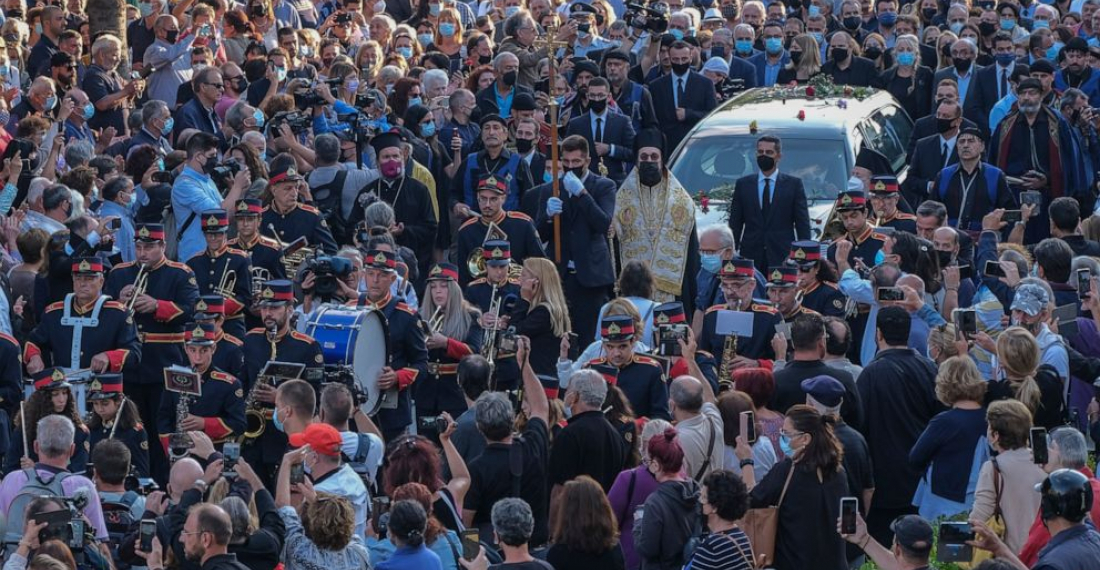
A farewell ceremony on Sept. 8 drew officials and ordinary Greeks, who gathered in a light autumnal drizzle outside a central Athens cathedral.

“He will always be with us, rooted in our collective memory,” Greek President Katerina Sakellaropoulou said in an eulogy at Athens’s Metropolitan Cathedral, where Theodorakis had been lying in state since Monday for members of the public to pay their last respects.

His compositions went from the soundtrack of “Zorba,” starring Anthony Quinn as a loveable rogue dancing barefoot on a Cretan beach, to the thumping intensity of “Romiosini” (Greekness) a series of rousing songs of identity and resistance.

Much of his music was adapted to songs of Greek poets, bringing national prose to the mainstream. His tunes gained widespread popularity, becoming anthems of the political left.

He was born Michalis Theodorakis on the island of Chios on July 29, 1925. Theodorakis wrote more than 200 popular songs, 10 symphonies, two oratorios, three ballets, a folk opera and the Olympic anthem, first performed at the 1992 Barcelona Games.

Theodorakis was incarcerated twice. Accused of guerrilla sympathies in the war between right-wing royalists and left-wing popular forces after World War Two, he was arrested in July 1947. He was released in August 1949. Under the military junta that ruled Greece from 1967 to 1974 he was jailed and tortured again. He was released under international pressure in 1970.

“With his songs, he made people cry, and to fight for a better life,” said Ilias Koutsogiannis, who attended the ceremony.

The funeral and burial was held on the island of Crete on 9 September.

source: commonspace.eu with agencies

photo: The funeral of Greek Composer and Activist Mikis Theodorakis was held in Athens on 8 September 2021 
Related articles

Editor's choice
News
Borrell tells the European Parliament that the situation in Afghanistan was critical, but the EU will remain engaged

Borrell tells the European Parliament that the situation in Afghanistan was critical, but the EU will remain engaged

Borrell underlined that the European Union will make every effort to support the peace process and to remain a committed partner to the Afghan people. "Of course, we will have to take into account the evolving situation, but disengagement is not an option.  We are clear on that: there is no alternative to a negotiated political settlement, through inclusive peace talks.
Editor's choice
News
NATO Chief says war is on Europe's doorstep, and warns against complacency

NATO Chief says war is on Europe's doorstep, and warns against complacency

Russia could attack a Nato country within the next five years, the Secretary General of NATO, Mark Rutte, said in a stark new warning. "Nato's own defences can hold for now," Rutte warned in Berlin, but conflict was "next door" to Europe and he feared "too many are quietly complacent, and too many don't feel the urgency, too many believe that time is on our side. "Russia is already escalating its covert campaign against our societies," Rutte said in a speech in Germany. "We must be prepared for the scale of war our grandparents or great-grandparents endured." Earlier this month, Russia's President Vladimir Putin said his country was not planning to go to war with Europe, but it was ready "right now" if Europe wanted to - or started a war. But similar reassurances were given by Moscow in 2022, just before 200,000 Russian troops crossed the border and invaded Ukraine. Putin has accused European countries of hindering US efforts to bring peace in Ukraine - a reference to the role Ukraine's European allies have recently played in trying to change a US peace plan to end the war, whose initial draft was seen as favouring Russia. But Putin was not sincere, Nato's secretary-general said in the German capital, Berlin. Supporting Ukraine, he added, was a guarantee for European security. "Just imagine if Putin got his way; Ukraine under the boot of Russian occupation, his forces pressing against a longer border with Nato, and the significantly increased risk of an armed attack against us." Russia's economy has been on a war footing for more than three years now - its factories churn out ever more supplies of drones, missiles and artillery shells. According to a recent report by the Kiel Institute for the World Economy, Russia has been producing each month around 150 tanks, 550 infantry fighting vehicles, 120 Lancet drones and more than 50 artillery pieces. The UK, and most of its Western allies, are simply not anywhere near this point. Analysts say it would take years for Western Europe's factories to come close to matching Russia's mass-production of weapons. "Allied defence spending and production must rise rapidly, our armed forces must have what they need to keep us safe," the Nato chief said.

Popular

Editor's choice
News
NATO Chief says war is on Europe's doorstep, and warns against complacency

NATO Chief says war is on Europe's doorstep, and warns against complacency

Russia could attack a Nato country within the next five years, the Secretary General of NATO, Mark Rutte, said in a stark new warning. "Nato's own defences can hold for now," Rutte warned in Berlin, but conflict was "next door" to Europe and he feared "too many are quietly complacent, and too many don't feel the urgency, too many believe that time is on our side. "Russia is already escalating its covert campaign against our societies," Rutte said in a speech in Germany. "We must be prepared for the scale of war our grandparents or great-grandparents endured." Earlier this month, Russia's President Vladimir Putin said his country was not planning to go to war with Europe, but it was ready "right now" if Europe wanted to - or started a war. But similar reassurances were given by Moscow in 2022, just before 200,000 Russian troops crossed the border and invaded Ukraine. Putin has accused European countries of hindering US efforts to bring peace in Ukraine - a reference to the role Ukraine's European allies have recently played in trying to change a US peace plan to end the war, whose initial draft was seen as favouring Russia. But Putin was not sincere, Nato's secretary-general said in the German capital, Berlin. Supporting Ukraine, he added, was a guarantee for European security. "Just imagine if Putin got his way; Ukraine under the boot of Russian occupation, his forces pressing against a longer border with Nato, and the significantly increased risk of an armed attack against us." Russia's economy has been on a war footing for more than three years now - its factories churn out ever more supplies of drones, missiles and artillery shells. According to a recent report by the Kiel Institute for the World Economy, Russia has been producing each month around 150 tanks, 550 infantry fighting vehicles, 120 Lancet drones and more than 50 artillery pieces. The UK, and most of its Western allies, are simply not anywhere near this point. Analysts say it would take years for Western Europe's factories to come close to matching Russia's mass-production of weapons. "Allied defence spending and production must rise rapidly, our armed forces must have what they need to keep us safe," the Nato chief said.