


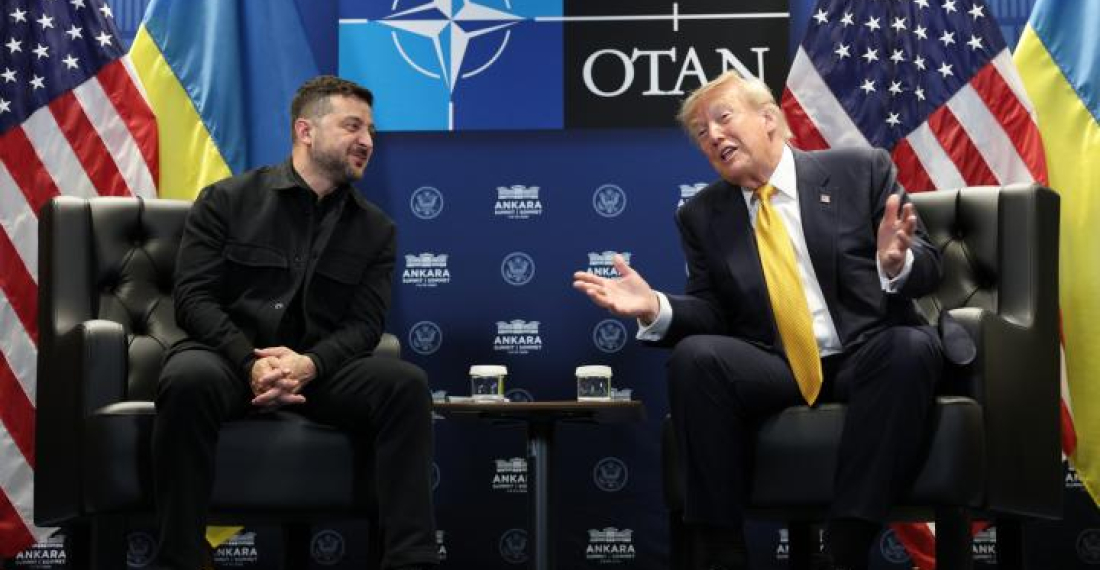
U.S. President Donald Trump announced on Wednesday (July 8), during the NATO summit in Ankara, that the United States would grant Ukraine a license to manufacture Patriot interceptor missiles, a move intended to strengthen Kyiv’s air defence against Russia’s continuing ballistic missile attacks. Speaking alongside Ukrainian President Volodymyr Zelensky, Trump said, “We’ll give them the right to make Patriots. We’ll show them how to do it,” describing the Patriot as “a defensive weapon.” He added that the decision had not yet been communicated to defence manufacturers but expressed confidence that the arrangement would proceed.
The announcement did not include details on the timeline, production location or conditions of the proposed licensing agreement. Trump acknowledged that the United States has a limited supply of Patriot systems, stating, “We have Patriots, but we don’t have that many. We need them for ourselves too.” He suggested that licensed production would help Ukraine reduce its dependence on U.S. deliveries and said Ukrainian industry had demonstrated the capacity to manufacture sophisticated weapons.
The proposal follows repeated Ukrainian requests for additional Patriot interceptors, which are regarded as one of the few systems capable of countering Russian ballistic missiles. Although the licensing announcement could strengthen Ukraine’s long-term air defence capabilities, analysts note that Patriot production is technically complex and would take years to establish. According to the Foreign Policy Research Institute, powering Ukraine’s war efforts through manufacturing Patriot missiles in Ukraine will continue to remain out of reach for the foreseeable future: a PAC-3 MSE interceptor requires approximately 24 months, while its rocket motor takes around 30 months to produce. Military experts have also questioned whether such production could safely be established inside Ukraine while Russian long-range strikes continue.
Following the meeting, Zelensky thanked Trump for placing “strong emphasis” on strengthening Ukraine’s air defence and said Ukrainian officials would work to implement the agreements discussed. During his opening address to NATO leaders on 7 July, President Zelensky urged partners to accelerate deliveries of U.S.-made air defence systems, arguing that Patriot interceptors are essential to protect Ukrainian cities from increasingly frequent missile strikes. His appeal followed another wave of Russian drone and ballistic missile attacks on Kyiv at the beginning of the week, with Ukrainian authorities reporting further overnight strikes on 8 July.
In its summit declaration, NATO pledged €70 billion in military equipment, assistance and training for Ukraine in 2026, while allies committed to maintaining at least equivalent levels of support in 2027. Trump also indicated openness to expanding defence cooperation through the possible purchase of Ukrainian-made drones, although no formal agreement was announced.
Source: commonspace.eu with TIME (Washington DC) and Le Monde (Paris).



