Terrorist attack kills 160 civilians in Burkina Faso

160 civilians have been killed in a suspected jihadist attack in Solhan, a northern village of Burkina Faso near the country’s borders with Mali and Niger. The attack, which took place on the night of 4-5 June at 2am, is one of the deadliest in the country since jihadist violence began in 2015.

Reports state that a group of unidentified armed individuals, whom the government has described as terrorists, drove into the village on motorcycles and opened fire on civilians. According to local sources, the attackers first targeted the post of the VDP ("Volunteers for the Defence of the Homeland") – a civilian defence force created in December 2019, recruited and trained by the army to fight terrorism – before attacking a gold mine, adjacent to the village. The 160 people killed are said to include around 20 children.

On 5 June, Burkinabé President Roch Marc Christian Kaboré denounced the "barbaric attack" and decreed seventy-two hours of national mourning. 

The United Nations Secretary General, Antonio Guterres, has expressed outrage over the attack, stressing "the urgent need for the international community to strengthen its support for one of its members in their fight against extremist violence". The French foreign minister, Jean-Yves Le Drian, announced on Sunday (6 June) that he had spoken on the phone with President Kaboré, noting that he would express “France's solidarity once again” during his visit to the country this week.

The Solhan attack followed another attack in the Yagha Province on Friday (4 June), in which at least 14 people, including 13 civilians and a soldier, were killed. 

The attacks come a week after two others in the same area, in which four people, including two VDP members, were also killed. On 18 May, 15 villagers were killed in an assault on a village in the northeast of the country. Security forces are struggling to stem the spiral of jihadist violence that has killed more than 1,400 since 2015 and displaced more than a million people, fleeing areas of violence.

Yesterday (7 June), in response to the attacks, the governor of Burkina Faso’s northern Sahel region, Colonel-Major Salfo Kaboré, ordered the closure of mining sites and restrictions on the movement of two- and three-wheeled vehicles in certain localities.  
 

source: commonspace.eu with Le Monde (Paris) and Franceinfo Afrique (Paris) and agencies
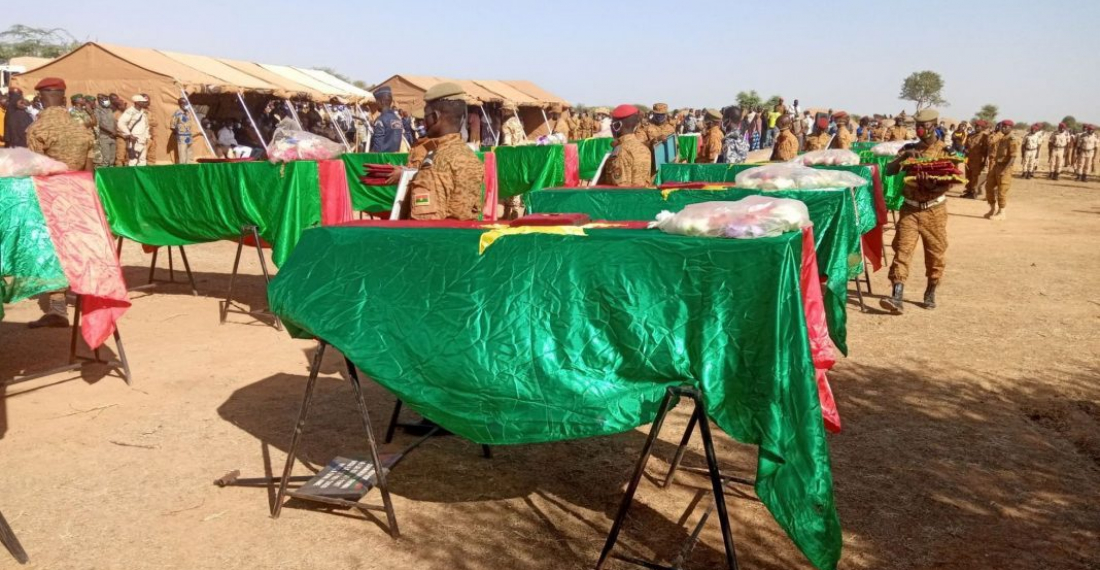
photo: Coffins of the victims of the Solhan attack lay draped in the Burkina Faso flag; Agence d’Information du Burkina

Related articles

Editor's choice
News
Borrell tells the European Parliament that the situation in Afghanistan was critical, but the EU will remain engaged

Borrell tells the European Parliament that the situation in Afghanistan was critical, but the EU will remain engaged

Borrell underlined that the European Union will make every effort to support the peace process and to remain a committed partner to the Afghan people. "Of course, we will have to take into account the evolving situation, but disengagement is not an option.  We are clear on that: there is no alternative to a negotiated political settlement, through inclusive peace talks.
Editor's choice
News
Germany accuses Russia of cyberattacks and disinformation campaign

Germany accuses Russia of cyberattacks and disinformation campaign

The German government holds Russia responsible for a cyberattack on German air traffic control, and for targeted disinformation campaigns before the last federal election. According to the German Foreign Office in Berlin, the incidents could be clearly attributed to the Russian military intelligence service, the GRU. In response, the Russian ambassador to Berlin was summoned to the Foreign Ministry. "We have been observing a massive increase in threatening hybrid activities by Russia for some time now," a spokesperson for the Foreign Ministry stated. These range from disinformation campaigns and espionage to cyberattacks and sabotage attempts. The aim is to divide society, sow distrust, and undermine confidence in democratic institutions. The spokesperson added that with these actions, Russia is "very concretely threatening our security, not only through its war of aggression against Ukraine, but also here in Germany."  The Foreign Ministry spokesperson explained that the cyberattack on air traffic control in August 2024 was clearly attributed to the hacker collective "APT28," known as "Fancy Bear," and to the responsibility of the Russian military intelligence service, the GRU. Furthermore, it could now be "conclusively stated" that Russia had attempted "to influence and destabilize both the last Federal election and the ongoing internal affairs of the Federal Republic of Germany." There was "absolutely irrefutable evidence" for this". The so-called "Storm 1516" campaign, which has been running since 2024, is allegedly backed by "reliable information" that the Moscow-based think tank "Center for Geopolitical Expertise" is behind it. The Center is also said to be supported by Russian military intelligence. Its primary aim is to influence democratic elections in the West. (Click the image to read more).

Popular

Editor's choice
News
Germany accuses Russia of cyberattacks and disinformation campaign

Germany accuses Russia of cyberattacks and disinformation campaign

The German government holds Russia responsible for a cyberattack on German air traffic control, and for targeted disinformation campaigns before the last federal election. According to the German Foreign Office in Berlin, the incidents could be clearly attributed to the Russian military intelligence service, the GRU. In response, the Russian ambassador to Berlin was summoned to the Foreign Ministry. "We have been observing a massive increase in threatening hybrid activities by Russia for some time now," a spokesperson for the Foreign Ministry stated. These range from disinformation campaigns and espionage to cyberattacks and sabotage attempts. The aim is to divide society, sow distrust, and undermine confidence in democratic institutions. The spokesperson added that with these actions, Russia is "very concretely threatening our security, not only through its war of aggression against Ukraine, but also here in Germany."  The Foreign Ministry spokesperson explained that the cyberattack on air traffic control in August 2024 was clearly attributed to the hacker collective "APT28," known as "Fancy Bear," and to the responsibility of the Russian military intelligence service, the GRU. Furthermore, it could now be "conclusively stated" that Russia had attempted "to influence and destabilize both the last Federal election and the ongoing internal affairs of the Federal Republic of Germany." There was "absolutely irrefutable evidence" for this". The so-called "Storm 1516" campaign, which has been running since 2024, is allegedly backed by "reliable information" that the Moscow-based think tank "Center for Geopolitical Expertise" is behind it. The Center is also said to be supported by Russian military intelligence. Its primary aim is to influence democratic elections in the West. (Click the image to read more).