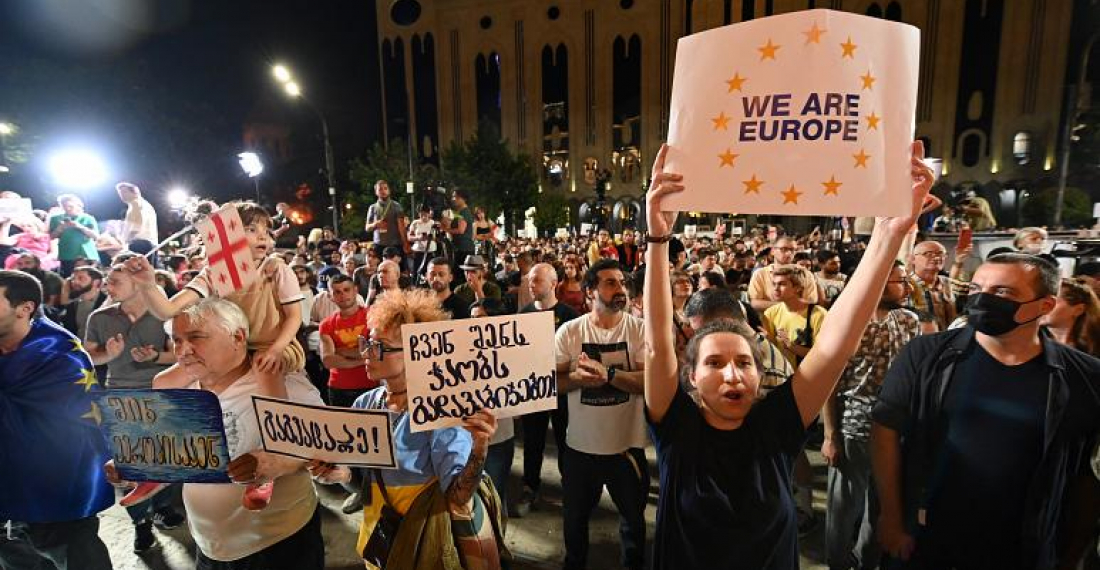
Tens of thousands of Georgians attended a pro European rally in Tbilisi on Monday (20 June) amid continuing controversy about the country's European asspirations.
On Friday, the European Commission recommended to EU leaders to give Georgia a membership perspective, but stopped short of granting the country the same candidate status as it recommended for Ukraine and Moldova. The three countries, sometimes referred to as the "Trio" countries recently submitted an application for full membership of the European Union. The EU on its part has dealt with the applications with unusual speed, motivated primarily by a wish to send a positive signal to Ukraine as it continues to resist a Russian military invasion.
In its opinion published on Friday, the European Commission agreed to recommend to the European Heads of Government who will meet this week, that in the case of Ukraine and Moldova that they should be granted candidate status on the understanding that steps are taken in a number of areas.
On Georgia, the Commission took a different approach. It said that it "assesses that Georgia has a foundation in place to reach the stability of institutions guaranteeing democracy, the rule of law, human rights and respect for and protection of minorities, even if recent developments have undermined the country's progress; it has achieved a good degree of macroeconomic stability and has a sound record of economic policy and a favourable business environment, but further reforms are needed to improve the functioning of its market economy; and overall, Georgia has established a solid basis for further alignment with the EU acquis.
On this basis, the Commission recommends that Georgia be given the perspective to become a member of the European Union. It should be granted candidate status once a number of priorities have been addressed."
In practice this means that a decision on Georgia has been differed.
"It is up to Georgia to accelerate (the reforms) and move towards this open door," commented Commission President Ursula von der Leyen.
"Georgia must now come together politically to design a clear path towards structural reform and the EU," Commission President Ursula von der Leyen said on twitter. "So we recommend to grant Georgia the European perspective, but to come back and assess how it meets a number of conditions before granting it candidate status."
The decision has created huge controversy in Georgia where government and opposition have been at loggerheads for months. Whilst the Georgian Dream government has described the recommendation of the European Commission to give Georgia a membership perspective as a victory, opposition leaders have described the failure to keep in step with the other trio countries as a disaster. Supporters out on the streets on Monday evening seemed to think so too.
Leaders of EU member states will meet in the framework of the European Council on Friday to endorse or otherwise the recommendation of the Commission.