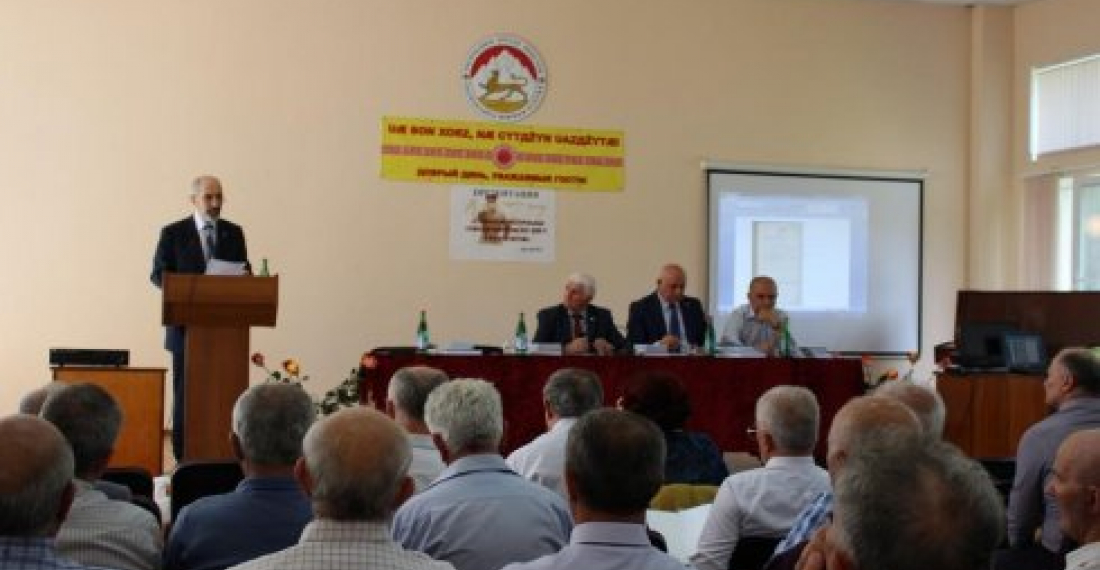
A leading South Ossetian intellectual has strongly advocated unification with Russia as the only long term guarantee for the security of the South Ossetian people. Kosta Dzugaev, who holds the title of "Honored Scientist of the Republic of South Ossetia" and is Associate Professor of the Department of Philosophy of South Ossetian State University,was speaking at the presentation of his 3-volume scientific monograph "The concept of a window of opportunity" which was held in Tskhinval.
South Ossetia is a self-declared republic which seceded from Georgia but which is still recognised as part of Georgia by most of the international community. Russia and a handful of other countries have recognised its independence in 2008 and since.
Attending the presentation at the South Ossetian Research Institute in Tskhinvali where members of the de facto government, including de facto foreign minister Dimitri Medoev, representatives of the Russian embassy in Tskhinvali, academics and intellectuals.
In a report carried by the South Ossetian RES news agency it was reported that during the presentation, Kosta Dzugaev spoke about the content of his scientific works, and also read out a report on the topic: "Stalin's execution lists and the repressions of 1937-1938. in South Ossetia ".
Dzugaev noted that the topic of his report is devoted to one of the most difficult pages in the history of South Ossetia.
"This topic complements the third monographic study, and, in my opinion, gives some significant new change to this problem. I carried out here a comparative analysis of these so-called "Stalinist execution lists" and the list of repressed residents of South Ossetia in 1937-1938 available today. The list was first published by me in the third monograph on the attempt at reunification in 1936, which was then drowned in blood. The very problem of the repressions of 1937-1938. in the USSR, as is well known, it is a field of collisions of diametrically opposed views and assessments of the events that took place at that time; at the same time, as a rule, attention is focused on the personality of the then leader of the country, Joseph Stalin ... ", the report said.
Dzugaev emphasized that falsifications of history are being carried out on an ever-increasing scale, "an ever-increasing resource is being used."
"... In this context, one should consider the problem of falsification of the Stalinist period in the history of the USSR, and in the entire world history of the 20th century. Taking these circumstances into account, it is necessary to analyze the specific task of conducting a comparative analysis of the "Stalinist execution lists" and the repressions of 1937-1938 in South Ossetia, "he said.
Kosta Dzugaev noted that the repressions of 1937-1938 for the South Ossetians became a tragedy precisely because South Ossetia was a part of the Georgian state.
"The harsh lesson of history must be learned by us, otherwise a repetition of the genocidal policy of the existing Georgian state towards South Ossetians is inevitable. The only guarantee of security from this is joining Russia. At the same time, I emphasize that before leaving for the holidays, the State Duma of Russia adopted a law - the first of more than one hundred laws to be adopted in pursuance of amendments to the Constitution of the Russian Federation - according to which not only the alienation of the territory, but even the very raising of such a question is prohibited and will be prosecuted ... In other words, joining Russia removes once and for all the threat from the Georgian state, "the author of the monograph emphasized.
Dzugaev, addressing the audience, asked the question: "Does anyone have any doubts that the new execution lists have long been ready and are being replenished in the Georgian special services? - We all understand that under the Saakashvili regime, one such list was published in the Georgian media. So, so that such a tragedy does not happen again, we need to resolve the issue of the reunification of Ossetia within Russia ".
The event in Tskhinvali happened in the same week that Georgia marked the anniversary of its 2008 war with Russia. Georgian leaders pledged that they will remain committed to the restoration of the territorial integrity of Georgia by peaceful means. Georgia considers South Ossetia as a territory occupied by Russia and has called for Russian military forces to leave South Ossetia.
source: commonspace.eu with with RES news agency (Tskhinvali) and agenda.ge (Tbilisi)
photo: Kosta Dzugaev, calling for the unification of South Ossetia to Russia at a presentation of his scientific work in Tskhionvali on 14 August 2020 (Picture courtesy of RES news agency, Tskhinvali)