Putin welcomed in Mongolia despite ICC arrest warrant

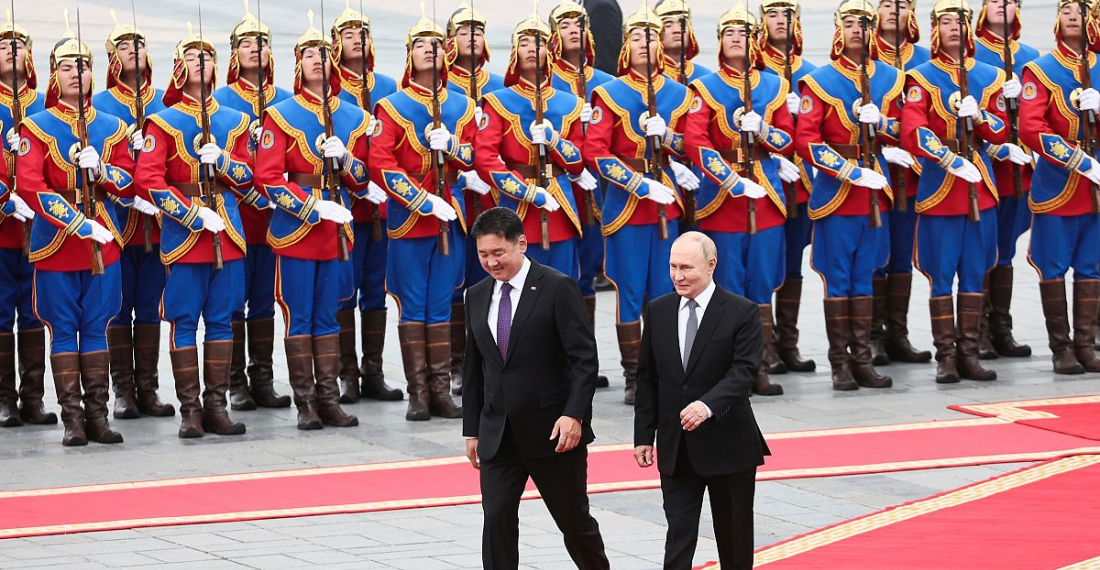
Russian President Vladimir Putin received a red carpet welcome on Tuesday (3 September) during a state visit to Mongolia. The country's decision not to arrest him despite a warrant from the International Criminal Court (ICC) drew criticism from Ukraine, which saw it as a setback for justice. Arriving in the capital, Ulaanbaatar, Putin was greeted by Mongolian President Ukhnaagiin Khurelsukh. A line of ceremonial guards on horseback wearing pointed helmets lined up in his honour.
 
The ICC arrest warrant, issued last year, obliges its 124 member states, including Mongolia, to arrest Putin and hand him over for trial in The Hague if he enters their territory. Ukraine criticised Mongolia's failure to act on the warrant, with foreign ministry spokesman Heorhiy Tykhyi calling it "a heavy blow to the International Criminal Court and the criminal justice system". He said that by allowing "an accused criminal to escape justice", Mongolia was sharing responsibility for war crimes. Tykhyi added on the Telegram messaging app that Ukraine would work with its allies to ensure that Mongolia faced consequences for this decision.

President Khurelsukh expressed hope that Putin's visit would boost trade and economic cooperation between the two countries. Mongolia lies on the proposed route of a major gas pipeline that Russia wants to build. The project, known as Power of Siberia 2, is part of Russia's strategy to compensate for the loss of most of its gas sales to Europe following the start of the war in Ukraine. It will follow an existing pipeline of the same name, which already supplies Russian gas to China and is expected to reach its full capacity of 38 billion cubic metres a year by 2025.
Source: commonspace.eu with Reuters and other agencies
 

Related articles

Editor's choice
News
Borrell tells the European Parliament that the situation in Afghanistan was critical, but the EU will remain engaged

Borrell tells the European Parliament that the situation in Afghanistan was critical, but the EU will remain engaged

Borrell underlined that the European Union will make every effort to support the peace process and to remain a committed partner to the Afghan people. "Of course, we will have to take into account the evolving situation, but disengagement is not an option.  We are clear on that: there is no alternative to a negotiated political settlement, through inclusive peace talks.
Editor's choice
News
Thai-Cambodia border clashes enter fourth day

Thai-Cambodia border clashes enter fourth day

Renewed fighting between Thailand and Cambodia has entered its fourth day, with both sides accusing one another of violating international law, as they await a promised phone call from United States President Donald Trump. Cambodia’s Ministry of Defence accused Thailand’s military of carrying out numerous attacks within the country in the early hours of Thursday morning, including deploying tanks and artillery to strike targets in the country’s Pursat, Banteay Meanchey, and Oddar Meanchey provinces. In one such attack, Cambodia accused Thai soldiers of violating international humanitarian law by firing on civilians in Prey Chan village in Banteay Meanchey province. In another, it accused Thai forces of shelling “into Khnar Temple area”, and said Thai forces had also “fired artillery and support fire into the O’Smach area”. “Cambodia urges that Thailand immediately stop all hostile activities and withdraw its forces from Cambodia’s territorial integrity, and avoid acts of aggression that threaten peace and stability in the region,” the Defence Ministry said. Clashes took place on Wednesday at more than a dozen locations along the contested colonial-era demarcated 817-kilometre (508-mile) Thai-Cambodian border, with some of the most intense fighting being reported since a five-day battle in July, which saw dozens killed on both sides. Cambodia’s Ministry of the Interior said homes, schools, roads, Buddhist pagodas and ancient temples had been damaged by “Thailand’s intensified shelling and F-16 air strikes targeting villages and civilian population centres up to 30km [18.6 miles] inside Cambodian territory”. (click the image to read the full story).

Popular

Editor's choice
News
Thai-Cambodia border clashes enter fourth day

Thai-Cambodia border clashes enter fourth day

Renewed fighting between Thailand and Cambodia has entered its fourth day, with both sides accusing one another of violating international law, as they await a promised phone call from United States President Donald Trump. Cambodia’s Ministry of Defence accused Thailand’s military of carrying out numerous attacks within the country in the early hours of Thursday morning, including deploying tanks and artillery to strike targets in the country’s Pursat, Banteay Meanchey, and Oddar Meanchey provinces. In one such attack, Cambodia accused Thai soldiers of violating international humanitarian law by firing on civilians in Prey Chan village in Banteay Meanchey province. In another, it accused Thai forces of shelling “into Khnar Temple area”, and said Thai forces had also “fired artillery and support fire into the O’Smach area”. “Cambodia urges that Thailand immediately stop all hostile activities and withdraw its forces from Cambodia’s territorial integrity, and avoid acts of aggression that threaten peace and stability in the region,” the Defence Ministry said. Clashes took place on Wednesday at more than a dozen locations along the contested colonial-era demarcated 817-kilometre (508-mile) Thai-Cambodian border, with some of the most intense fighting being reported since a five-day battle in July, which saw dozens killed on both sides. Cambodia’s Ministry of the Interior said homes, schools, roads, Buddhist pagodas and ancient temples had been damaged by “Thailand’s intensified shelling and F-16 air strikes targeting villages and civilian population centres up to 30km [18.6 miles] inside Cambodian territory”. (click the image to read the full story).