


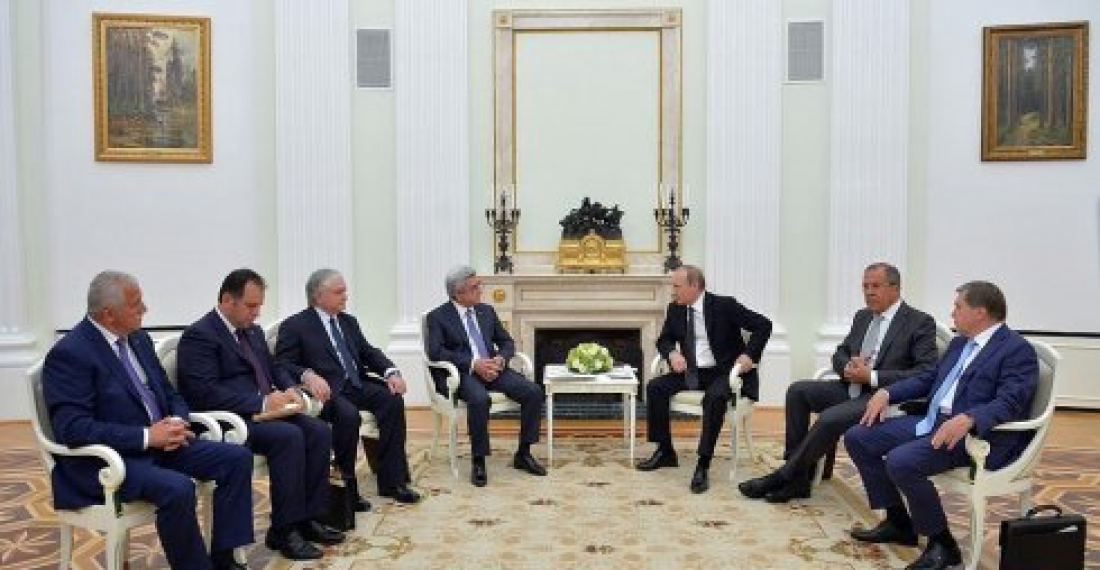
Putin meets with the Armenian President in Moscow (Updated)

(This news item has been updated)

Russian president Vladimir Putin has met with his Armenian counterpart, Serzh Sargsyan in Moscow. The meeting was attended by the foreign ministers of the two countries, Edward Nalbandian and Sergei Lavrov. The meeting followed Putin's meeting with Azerbaijani President Ilham Aliev in Baku Monday and that with Turkish president Recip Tayip Erdogan in St Petersburg yesterday.

The conflict settlement in Nagorno-Karabakh was expected to be on the agenda of the Putin-Sargsyan meeting, as well as a number of bilateral issues between the two countries.

Speaking prior to the meeting president Putin said Armenia was Russia's strategic partner in the Caucasus. Putin said that after its first year as a member of the Eurasia Economic Union Armenia's GDP had grown by 10 %. Responding to President Putin president Sargsyan said that Armenia's trade turnover with Russia has increased by 12 % over the past six months and Armenian exports to Russia are up by 90 % as a result of the EEU membership. He thanked president Putin for his efforts to resolve the Nagorno-Karabakh conflict. Putin on his part said that he had discussed the issue with president Aliev in Baku on Monday and promised to let president Sarsgyan know the results of that meeting.

source: commonspace.eu

photo: The meeting between President Putin of Russia and president Sargsyan of Armenia in Moscow on 10 August 2016 (picture courtesy of the Press Service of the President of Russia).


Related articles

Editor's choice
News
Armenia-Azerbaijan Strategic Expert Platform: Members emphasise the importance of the present moment for the South Caucasus and call for the momentum to be used for the long-term peace and prosperity of the region

Armenia-Azerbaijan Strategic Expert Platform: Members emphasise the importance of the present moment for the South Caucasus and call for the momentum to be used for the long-term peace and prosperity of the region

On 27 February 2026, the members of the Armenia-Azerbaijan Strategic Expert Platform met in Antwerp, Belgium, to assess developments in the South Caucasus following the initialling of a peace agreement between Armenia and Azerbaijan on 8 August 2025 at the White House. The members described the present moment as one of major importance for the region and its neighbours, urging leaders and societies alike to use the current momentum to secure long-term peace and prosperity. Established in 2024 with the support of LINKS Europe, the Platform provides a space for direct dialogue and joint analysis between Armenian and Azerbaijani experts. The members also reaffirmed the importance of continued international engagement and expressed strong support for LINKS Europe’s ongoing peacebuilding work in the region. (Click on the image above for the full statement.)

Popular

Editor's choice
Interview
Thursday Interview: Murad Muradov

Thursday Interview: Murad Muradov

Today, commonspace.eu starts a new regular weekly series. THURSDAY INTERVIEW, conducted by Lauri Nikulainen, will host  persons who are thinkers, opinion shapers, and implementors in their countries and spheres. We start the series with an interview with Murad Muradov, a leading person in Azerbaijan's think tank community. He is also the first co-chair of the Action Committee for a new Armenian-Azerbaijani Dialogue. Last September he made history by being the first Azerbaijani civil society activist to visit Armenia after the 44 day war, and the start of the peace process. Speaking about this visit Murad Muradov said: "My experience was largely positive. My negative expectations luckily didn’t play out. The discussions were respectful, the panel format bringing together experts from Armenia, Azerbaijan, and Turkey was particularly valuable during the NATO Rose-Roth Seminar in Yerevan, and media coverage, while varied in tone, remained largely constructive. Some media outlets though attempted to represent me as more of a government mouthpiece than an independent expert, which was totally misleading.  Overall, I see these initiatives as important steps in rebuilding trust and normalising professional engagement. The fact that soon a larger Azerbaijani civil society visits to Armenia followed, reinforces the sense that this process is moving in the right direction." (click the image to read the interview in full)

