


Editor's choice
News
Armenia-Azerbaijan Strategic Expert Platform: Members emphasise the importance of the present moment for the South Caucasus and call for the momentum to be used for the long-term peace and prosperity of the region

Armenia-Azerbaijan Strategic Expert Platform: Members emphasise the importance of the present moment for the South Caucasus and call for the momentum to be used for the long-term peace and prosperity of the region

On 27 February 2026, the members of the Armenia-Azerbaijan Strategic Expert Platform met in Antwerp, Belgium, to assess developments in the South Caucasus following the initialling of a peace agreement between Armenia and Azerbaijan on 8 August 2025 at the White House. The members described the present moment as one of major importance for the region and its neighbours, urging leaders and societies alike to use the current momentum to secure long-term peace and prosperity. Established in 2024 with the support of LINKS Europe, the Platform provides a space for direct dialogue and joint analysis between Armenian and Azerbaijani experts. The members also reaffirmed the importance of continued international engagement and expressed strong support for LINKS Europe’s ongoing peacebuilding work in the region. (Click on the image above for the full statement.)
Editor's choice
Interview
Thursday Interview: Dr. Anar Valiyev

Thursday Interview: Dr. Anar Valiyev

Dr. Anar Valiyev is an Associate Professor of Urban and Public Affairs at ADA University in Baku, Azerbaijan, with more than 18 years of experience in higher education. His research focuses on public policy, urban development, governance, and post-Soviet regional affairs. He holds a PhD in Urban and Public Affairs from the University of Louisville and has published widely on urbanisation, policy reform, and regional connectivity in the South Caucasus and beyond. This week, commonspace.eu spoke with Dr. Valiyev in Brussels ahead of a roundtable jointly organised by LINKS Europe Foundation and the European Policy Centre. He is taking part in a panel discussion focusing on the Armenia–Azerbaijan peace process, its implications for both countries and the wider region, the involvement of the European Union and the United States, and the challenges that lie ahead. In this interview, he reflects on how his research has evolved over nearly two decades in academia, examines the transformative potential of regional connectivity and trade, discusses the strategic role of energy in Azerbaijan’s foreign policy, and highlights the importance of people-to-people ties through education as a form of long-term soft power. (Read the full interview by clicking on the image above)

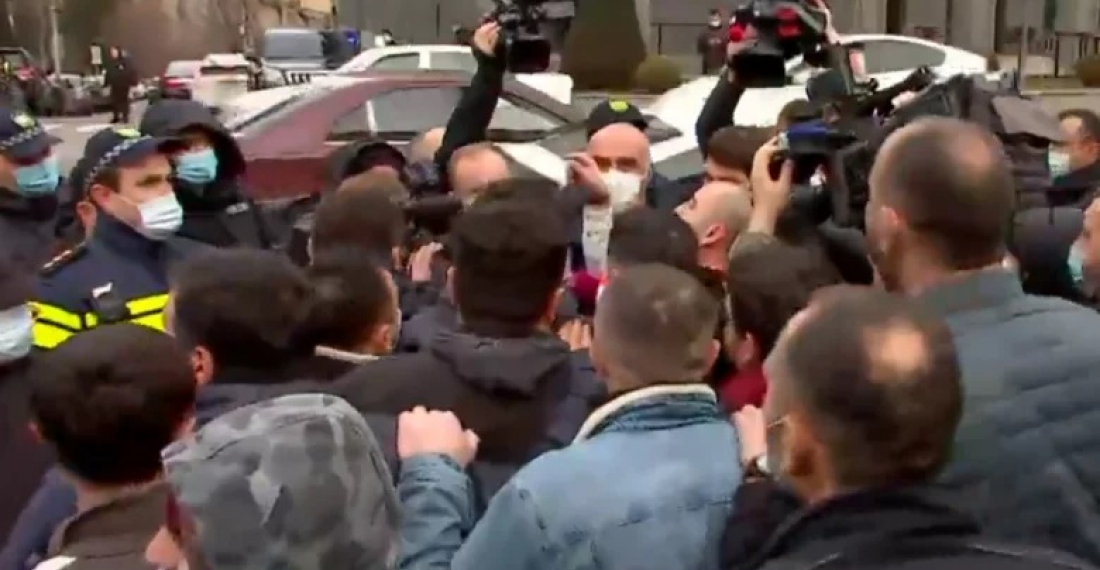
Police clash with protestors in Tbilisi

Police clashed with protestors in Tbilisi as Georgia faces political turmoil following the resignation on Thursday (18 February) of prime minister Giorgi Gakharia.

The website civil.ge says police detained 20 pro-UNM activists after physical confrontation between law enforcement officers and activists over installing protest tents outside the Parliament building on Rustaveli Avenue, Tbilisi’s main thoroughfare.

The Georgian Interior Ministry confirmed to Civil.ge that the activists were detained under Article 173 of the Code of Administrative Offenses, involving disobedience of police orders. According to reports police seized a tent in the lead up to the skirmishes.

Gakharia resigned on February 18 over disagreement with the ruling Georgian Dream party on Melia’s detention.

 The new prime minister will be Irakli Gharibashvili who has been nominated for the post by the ruling Georgian Dream party. He was defence minister in the outgoing government and served as prime minister before. He announced on Friday he will not reshuffle the government keeping all the ministers who served under Gaharia in place. However, first deputy prime minister and Minister of Regional Development and Infrastructure, Maia Tskitishvili has resigned, saying she wanted to spend more time with her family. 

source: commonspace.eu with civil.ge and agencies

Related articles

Editor's choice
News
Armenia-Azerbaijan Strategic Expert Platform: Members emphasise the importance of the present moment for the South Caucasus and call for the momentum to be used for the long-term peace and prosperity of the region

Armenia-Azerbaijan Strategic Expert Platform: Members emphasise the importance of the present moment for the South Caucasus and call for the momentum to be used for the long-term peace and prosperity of the region

On 27 February 2026, the members of the Armenia-Azerbaijan Strategic Expert Platform met in Antwerp, Belgium, to assess developments in the South Caucasus following the initialling of a peace agreement between Armenia and Azerbaijan on 8 August 2025 at the White House. The members described the present moment as one of major importance for the region and its neighbours, urging leaders and societies alike to use the current momentum to secure long-term peace and prosperity. Established in 2024 with the support of LINKS Europe, the Platform provides a space for direct dialogue and joint analysis between Armenian and Azerbaijani experts. The members also reaffirmed the importance of continued international engagement and expressed strong support for LINKS Europe’s ongoing peacebuilding work in the region. (Click on the image above for the full statement.)

Popular

Editor's choice
Interview
Thursday Interview: Murad Muradov

Thursday Interview: Murad Muradov

Today, commonspace.eu starts a new regular weekly series. THURSDAY INTERVIEW, conducted by Lauri Nikulainen, will host  persons who are thinkers, opinion shapers, and implementors in their countries and spheres. We start the series with an interview with Murad Muradov, a leading person in Azerbaijan's think tank community. He is also the first co-chair of the Action Committee for a new Armenian-Azerbaijani Dialogue. Last September he made history by being the first Azerbaijani civil society activist to visit Armenia after the 44 day war, and the start of the peace process. Speaking about this visit Murad Muradov said: "My experience was largely positive. My negative expectations luckily didn’t play out. The discussions were respectful, the panel format bringing together experts from Armenia, Azerbaijan, and Turkey was particularly valuable during the NATO Rose-Roth Seminar in Yerevan, and media coverage, while varied in tone, remained largely constructive. Some media outlets though attempted to represent me as more of a government mouthpiece than an independent expert, which was totally misleading.  Overall, I see these initiatives as important steps in rebuilding trust and normalising professional engagement. The fact that soon a larger Azerbaijani civil society visits to Armenia followed, reinforces the sense that this process is moving in the right direction." (click the image to read the interview in full)


