


Pashinyan: "We will not refuse to dialogue, and we will carefully listen to the counterarguments of our colleagues"

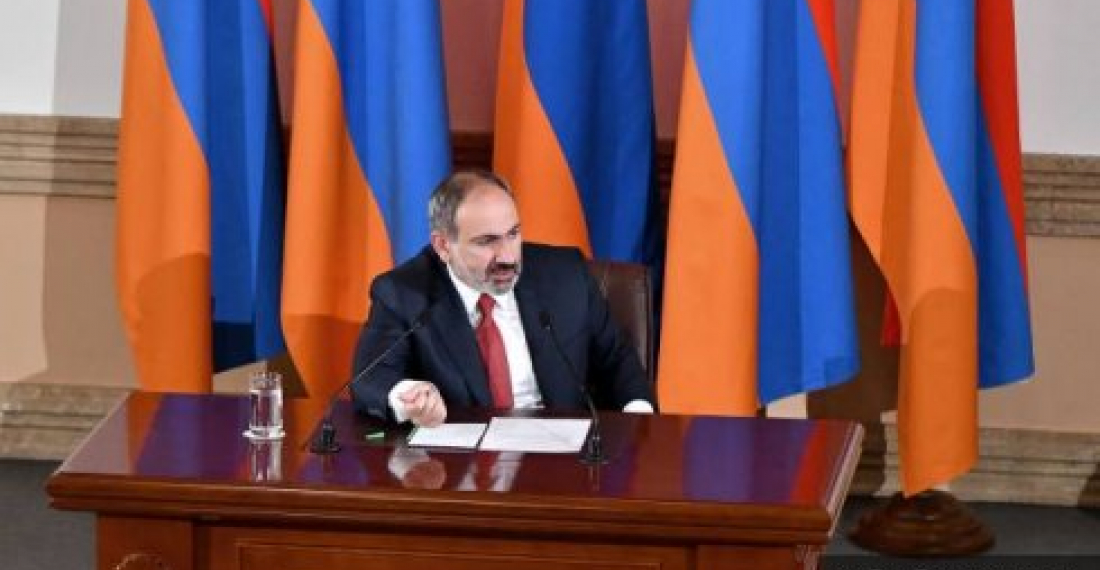
Armenian prime minister Nikol Pashinyan held a press conference in Yerevan on Tuesday, during which he reviewed progress in the work of his government and addressed a number of topical issues, including future negotiations to resolve the Karabakh conflict.

Armenpress  news agency reports from Yerevan, that asked how long Armenia is ready to wait if Azerbaijan doesn't agree with his call to include Nagorno-Karabakh in the negotiation process Pashinyan replied:

"There is no need to wait at all. It's just necessary to work consistently in the diplomatic process because, frankly speaking, what is stated publicly, is not something new both for the OSCE Minsk Group Co-Chairs and Azerbaijan. What we have said at this period, I have proposed that agenda during certain talks: that is the same agenda which was formed in May 2018, we continue serving that agenda, and I want to highlight an important nuance: as I have already announced in Stepanakert, this is neither a whim nor a precondition from our side. This proposal is not for changing the format, but for restoring the negotiation format. We will continue the discussion on this topic with our partners and will try to continue this discussion in the field of facts because negotiation is a negotiation in a sense that we listen to each other. Armenia has demonstrated that ability, to listen to the other, try to understand, and we expect the same from them".

The Armenian prime minister reminded the media that in the last year he had made a number of statements calling for the inclusion of Nagorno-Karabakh in the negotiations, adding that "this series of statements is not a challenge, but an invitation to dialogue, a part of the dialogue process. This dialogue didn't start just now, it started in Dushanbe, continued in St. Petersburg, Davos, I don't know where the next dialogue will take place, and we do not imagine a situation where one of the sides says it refuses to dialogue. That will not be a logical approach, we will not refuse to dialogue, we will put our facts on the table during that dialogue and we will carefully listen to the counter-arguments of our colleagues. I think the constructive and effective solution or continuation must be within this logical framework", Pashinyan said.

During the press conference Pashinyan also addressed his critics. He dismissed suggestions that there was instability in Armenia or that new elections were likely. Hinting that these critics were related to the previous government Pashinyan had a stark message for them. "These people must understand their ship has sailed long ago, they wouldn't catch up with it even on a Ferrari, their chapter is closed. They have one way, stand before the people, repent and ask for forgiveness". Pashinyan added that millions of dollars are being spent on a smear campaign against his government, but the government is not taking any actions against this. Pashinyan did not specify who the propagandists are, armenpress reported.

source: commonspace.eu with Armenpress news agency, Yerevan

photo: Armenian prime minister Nikol Pashinyan addressing a press conference in Yerevan on 19 March 2019 (picture courtesy of Armenpress news agency, Yerevan)




Related articles

Editor's choice
News
Key European countries back Denmark in the face of Trump's continuing insistence on taking over Greenland

Key European countries back Denmark in the face of Trump's continuing insistence on taking over Greenland

 Six major European countries have declared their support to Denmark following renewed insistence by the US that it must have control over Greenland. "Greenland belongs to its people, and only Denmark and Greenland can decide on matters concerning their relations," said the leaders of the UK, France, Germany, Italy, Poland, and Spain, in a joint statement, issued on Tuesday (6 January), together with Denmark. On Sunday, Donald Trump said the US "needed" Greenland - a semi-autonomous region of fellow Nato member Denmark - for security reasons. He has refused to rule out the use of force to take control of the territory, and Danish Prime Minister Mette Frederiksen warned on Monday that an attack by the US would spell the end of Nato. The issue of Greenland's future resurfaced in the wake of the US military intervention in Venezuela, during which elite troops went in to seize the country's President Nicolás Maduro and take him to face drugs and weapons charges in New York. Following the raid, Trump said the US would "run" Venezuela for an unspecified period of time. He also said the US was returning to an 1823 policy of US supremacy in its sphere of influence in the Western hemisphere - and he warned a number of countries the US could turn its attention to them. The US military raid in Venezuela has reignited fears that the US may consider using force to secure control of Greenland. A day after the raid, Katie Miller - the wife of one of Trump's senior aides - posted on social media a map of Greenland in the colours of the American flag, alongside the word "SOON". On Monday, her husband Stephen Miller said it was "the formal position of the US government that Greenland should be part of the US". In an interview with CNN, he also said the US "is the power of Nato. For the US to secure the Arctic region, to protect and defend Nato and Nato interests, obviously Greenland should be part of the US." Asked repeatedly whether the US would rule out using force to annex it, Miller responded: "Nobody's going to fight the US over the future of Greenland." Stressing they were as keen as the US in Arctic security, the seven European signatories of Tuesday's joint statement said this must be achieved by Nato allies, including the US "collectively" - whilst "upholding the principles of the UN Charter, including sovereignty, territorial integrity and the inviolability of borders". Greenland's Prime Minister Jens-Frederik Nielsen welcomed the statement and called for "respectful dialogue". "The dialogue must take place with respect for the fact that Greenland's status is rooted in international law and the principle of territorial integrity," Nielsen said. Trump has claimed that making Greenland part of the US would serve American security interests due to its strategic location and its abundance of minerals critical to high-tech sectors. Greenland, which has a population of 57,000 people, has had extensive self-government since 1979, though defence and foreign policy remain in Danish hands. While most Greenlanders favour eventual independence from Denmark, opinion polls show overwhelming opposition to becoming part of the US.

Popular

